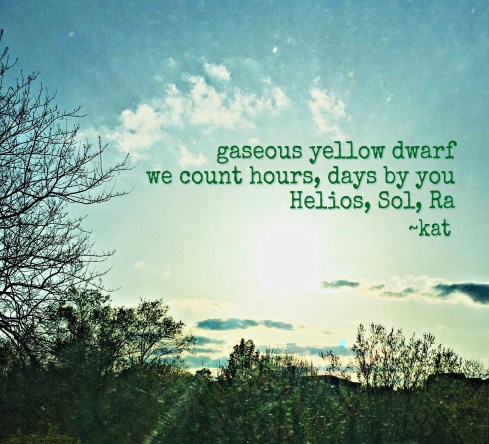
gaseous yellow dwarf
we count the hours, days by you
Helios, Sol, Ra
~kat
For Haiku Horizons Challenge, prompt word, ‘sun’.
gaseous yellow dwarf
we count the hours, days by you
Helios, Sol, Ra
~kat
For Haiku Horizons Challenge, prompt word, ‘sun’.
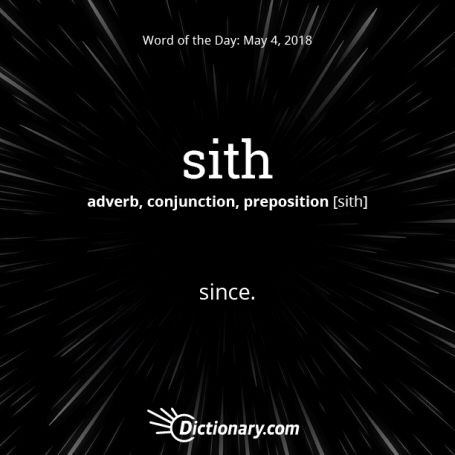
May the Fourth be with You! Friday’s Word of the Day at Dictionary.com is sith, and if you’re a nerd it means something entirely different to you that its archaic (dictionary’s word, not mine) definition. It’s an adverb that means “since”. Dictionary says sith (obsolete), originated before 950; Middle English; Old English siththa, dialectal variant of siththan, orig., sīth thām after that, subsequently to that, equivalent to sīth subsequently (akin to Gothic seithus, Old Norse sīth- late, German seit since) + thām, dative of demonstrative pronoun, i.e., “to that”; compare Old Norse sīthan sith.
But the word in today’s vocabulary has gained popularity as a reference to dark forces from the Star Wars sagas. Wikipedia gives a good background for the modern word sith, implying that the word originated in 1976, which lends additional credence to the “obsolete” nature of the original word that is said to have fallen from usage in the 16th Century.
For those of you who are not Star Wars enthusiasts, here is a snippet from Wikipedia: The Sith originated in a species of Force-sensitive warriors who discovered the efficacy of passion as a tool to draw on the Force approximately 6,000 years prior to the events of the first Star Wars film. Fully embracing this approach, they became defined and corrupted by it.
The Sith are major antagonists in the space opera franchise Star Wars. They are depicted as an ancient monastic and kraterocratic organization of supernaturally gifted warriors driven by an agenda of galactic domination and revenge against their predecessors, the Jedi.

Darth Sidious
There are several theories regarding how George Lucas came to call this evil side of the force, the Sith. Some believe it is a combination of names Darth and Sidious, for the Emperor Palpatine/Darth Sidious. Scheming, powerful, and evil to the core, Darth Sidious restored the Sith and destroyed the Jedi Order. Others believe it was chosen for its snakelike sound, Siithththth. But it is clear that no reference was ever made to the original word sith.
On that note, back to our word of the day and its former use. Here are a few examples:
They said it was a great matter, sith I had risked mine own life.” Emily Sarah Holt, Clare Avery
“Sith Alwyn vails of himself, it is thine, by might and by right.” Edward Bulwer-Lytton, The Last Of The Barons, Complete
“Why, I reckon it cannot be over nine days sith thine were writ.” Emily Sarah Holt, Joyce Morrell’s Harvest
“Here’s twentye groates of white moneye, Sith thou will have it of mee.” Various Authors, A Book of Ballads, Volume 3
So there you have it. Sith, an obsolete, resurrected word that is now the stuff of legends. “A long time ago in a galaxy far, far away….” A sith once meant since, and is now the name for dark forces that resulted from a passion for power run amuck!
I’m afraid today’s Haiku is a jumble. But here it is!
sith it is the fourth
a day we honor the force
not for Sith…Jedi
~kat
 photo by David Clode via Unsplash
harmless to humans
so they say, these lemon sharks
only attacked ten
~kat
A Haiku for Three Line Tales.

they cannot be moved
those touched by passion’s resolve
when life is at stake
~kat
For Haiku Horizons, Prompt Word: Move.
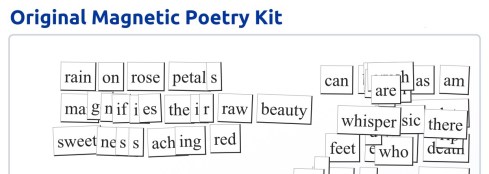 rain on rose petals
magnifies their raw beauty
sweetness aching red
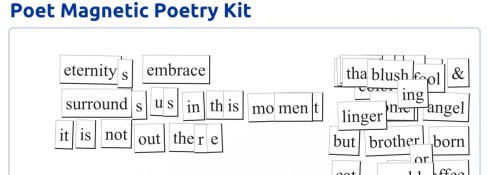 eternity’s embrace
surrounds us in this moment
it is not out there
 innocently charmed
by love’s sweetness keeps our heart
open to life’s hope
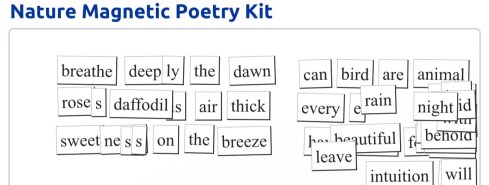 breathe deeply the dawn
roses, daffodils, air thick
sweetness on the breeze
~kat
Haikus today, for an extra challenge, using Magnetic Poetry Online.