

wild climbing vine
deep root tendriled covering
nature’s song in green
~kat
Magnetic Poetry Nature Kit with a photo montage of a Virginia Creeper vine that is overtaking my front porch!
wild climbing vine
deep root tendriled covering
nature’s song in green
~kat
Magnetic Poetry Nature Kit with a photo montage of a Virginia Creeper vine that is overtaking my front porch!

“Happy Sunday!”
“Happy, you say?!”
“Well, in a transcendental, metaphysical, quasi-spiritual, dreamy, optimistic sort of way, yes, happy. And it is a fact that it is Sunday…unless you reside in the Far East…then it is almost Monday…but I divagate.”
“You what?”
“Divagate….as in digress? Remember? The new word we learned this week.”
“You’re such a diva!”
“Am not! You are! But back to your original question, ‘happy, you say?!’ … yes, I take it you’re not.”
“Well, how can anyone be happy when everything in the world is spiraling out of control?”
“Take a Dramamine?”
“Come on! Global warming, a heath care bill that is going to kill people, an insane, mean old man running the country, Russia (need I say more?), collapsing infrastructure, the assault on our public schools, voting rights, gerrymandering, voter suppression, nationalism, travel bans, ageism, misogyny, racism, homophobia, religious profiling, insane tweets, the wall…”
“Feel better yet?”
“No, I’m just getting started. And just you wait. Tomorrow something else will happen to prove we’re all up shit’s creek without a paddle. So forgive me miss giddy twinkle shoes if I can’t be happy right now! I’m mortified! It’s terrifying!”
“Oh, but you can. Be happy that is. It’s all a choice. It only takes a second.”
“Harrumph! Delusional you mean!”
“No. Happy. Right here, right now, this moment. Let me show you. First, close your eyes…now think about something that makes you happy.”
“You mean used to…”
“Give it a chance. And you opened your eyes…start over. Close your eyes…think happy something…anything. Got it?”
“Yeah. Okay now what?”
“Now take a deep breath in. Imagine yourself completely enveloped by your happy thing…don’t breathe out just yet…imagine…okay now…slowly…let it go. Feel better?”
“I do actually. I get it. I remember. Thanks self for pulling me off the ledge one more time.”
“Don’t mention it. We’re in this together you know. Happy Sunday?”
“Yeah, I’ll give you that. It’s happy enough, given the circumstances.”
“You’re exhausting!”
😳😊😟😉😜😀😢😣😐😘😌☺️😒😅😮
And…welcome to my world! My mind battles itself regularly. Yeah, the world is a bit, chaotic these days, but it’s important to unplug when it gets to be too much.
We’re gonna survive this, like we have survived every trying time in our history. I’m not going to tell you, “don’t worry, be happy”. That is a bit delusional, and it is important to stay engaged as a member of “we the people”. But…there is nothing wrong with divagating into your happy place every now and again.
Look! There goes a butterfly! A beautiful graceful butterfly…and there! Look! A flower! Oh, and I just noticed someone being kind…Wow! It’s not as hard as you think.
So…Happy Sunday y’all! I hope you can find your happy, if even for just a moment, this week. Just remember to breathe. ❤️
Shi Sai Sunday’s Week in ReVerse – 2 July 2017
If people only knew
never say it…only
smoldering remains
weeps perfume when crushed
from obsidian to glass
Some souls find heaven in hell’s corridors.
look! a butterfly!
divagating tweeted blips,
because that is what those with the truest hearts do
softly
magic is in the air
make love bloom
dreamers ask,
“why not?”~kat
A shi sai or ReVerse poem is a summary poem with a single line lifted from each entry of a collection of work over a particular timeframe and re-penned in chronological order as a new poem. Unlike a collaborative poem, the shi sai features the words of one writer,providing a glimpse into their thoughts over time. I use it as a review of the previous week.

deliriously mad
dreamers ask,
“why not?”
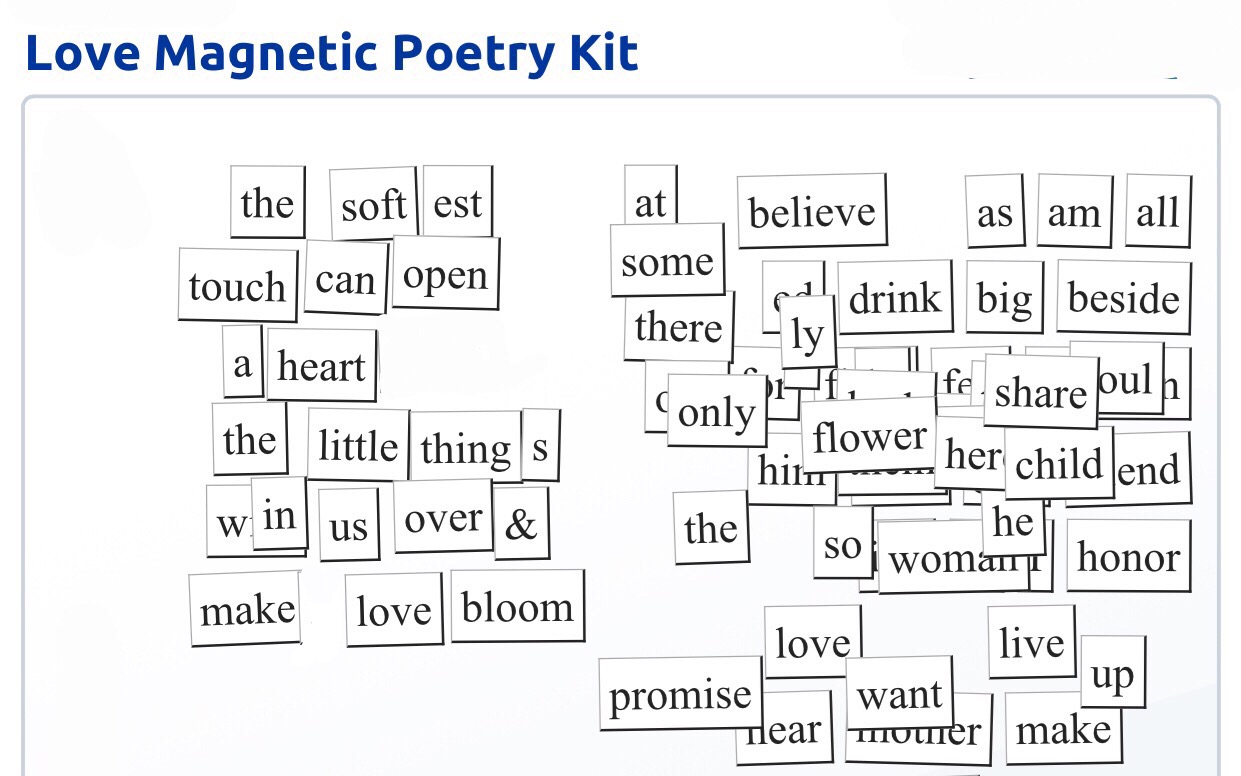
the softest
touch can open
a heart
the little things
win us over and
make love bloom

on a good day
magic is in the air
no one dies or
lies and peace is
not a thing
to long for like
red velvet cake
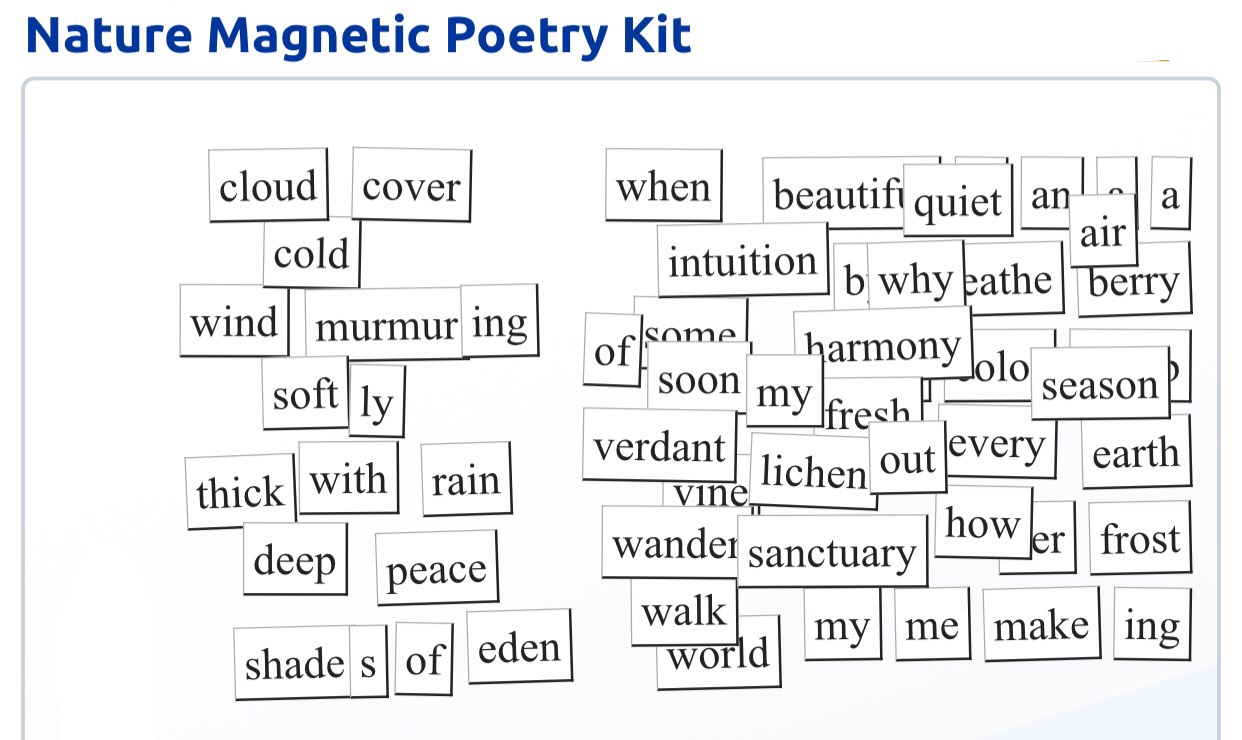
cloud cover
cold
wind murmuring
softly
thick with rain
deep peace
shades of eden
~kat
Created with Magnetic Poetry Online, Original, Poet, Nature and Love Kits.

It’s Friday and time to learn a new word and use it in a Haiku. Though I must admit that the 5/7/5 verses that I come up with are not “true” haiku. By definition, a Haiku is “a Japanese poem of seventeen syllables, in three lines of five, seven, and five, traditionally evoking images of the natural world.”
There have been a few words of the day that had something to do with nature. Although I do strive to maintain the form and the “in the moment” impression and “ah-ha” revelation aspect in each Haiku I write. And I might add that I am not Japanese. At least that’s what my DNA tells me….
This piece, though, and my other Friday forays might better be defined as a “Haibun”. Defined as “haikai writings, a prosimetric literary form originating in Japan, combining prose and haiku. The range of haibun is broad and frequently includes autobiography, diary, essay, prose poem, short story and travel journal.” (from Wikipedia)
Ah, but, I divagate, pronounced dahy-vuh-geyt not ‘dee-vuh-geyt’ as you might be tempted to say it, today’s word of the day at Dictionary.com. Although the word “diva” is hard to miss in the first part of this word, its etymology will clarify everything for you. First used late 16th century: from Latin divagat- ‘wandered around,’ from the verb divagari, from di- ‘widely’ + vagari ‘wander.’ (from google under ‘divagate etymology’)
So you see, divagate is not ‘diva+gate’ (sounds like a beauty pageant fiasco, doesn’t it?! 😉), but rather it is ‘di-vagate’ which accounts for its unique pronunciation.
And finally, what does all this mean? I’m glad you asked! According to dictionary.com Divagate means “to wander; stray, or to digress in speech.”
Does the fact that someone is prone to divagate make them a diva? Perhaps. If only to illustrate that said divagator likes to hear themselves talk while demanding that everyone around them listen with rapt attention to their gibberish!
But alas, there I go divagating again. I have been accused of this before, not because I am a diva mind you. Blame it on a short attention span and my tendency to become easily distracted. 😜
And if you have read this far, the very least I can do is reward you with a Haiku or two, the part two of this haibun, which I learned is also Japanese…which I am not…😊
Have a great weekend…and for my US friends, enjoy your Independence…4th of July Celebration Day…emphasis on “independence” while it lasts!!! 😳
one hundred forty
divagating tweeted blips,
known also, as spin
follow if you can
divagators who drivel
look! a butterfly!
~kat

mirrors woo the vain
from obsidian to glass
illusions inversed
~kat
For Haiku Horizons Challenge inspired by the prompt word Mirror.




 like mercury colliding...