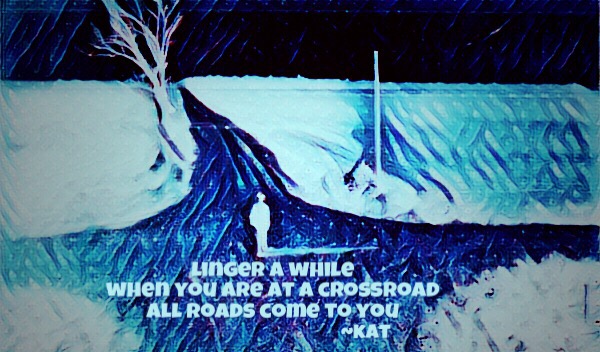
linger a while
when you are at a crossroad
all roads come to you
~kat
For Haiku Horizon’s Prompt Word: Road.
linger a while
when you are at a crossroad
all roads come to you
~kat
For Haiku Horizon’s Prompt Word: Road.
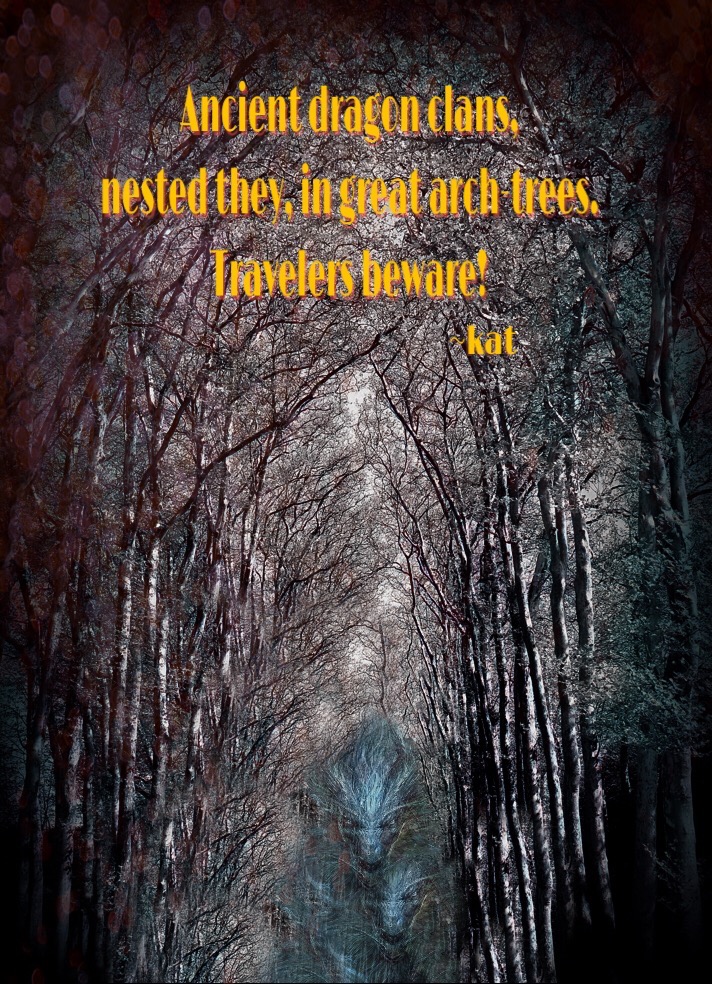
Arch-Trees
Ancient dragon clans,
nested they, in great arch-trees.
Travelers beware!
~kat
For TJ’s Household Haiku, photo/word prompt. the words are Arch & Tree. In researching the words I discovered that mythical legends tell tales of dragons nested in the arch-trees, their dense limbs brushing the underside of heaven. So to illustrate, I added our friends to TJ’s awesome photograph for my haiku.
Drem Yol Lok (“peace fire sky” in Dragon speak. It means, “Greetings” and an acknowledgement of territory and temporary withholding of agression). You might want to familiarize yourself with that phrase should you find yourself in the presence of a dragon in the arch-trees! 🙂
Here’s TJ’s original photo for the prompt:



petulant karma,
unforgiving, easily vexed
la femme bête noire
~kat
For Ronovan Writes Haiku Challenge, prompt words: excite (vex) & karma.
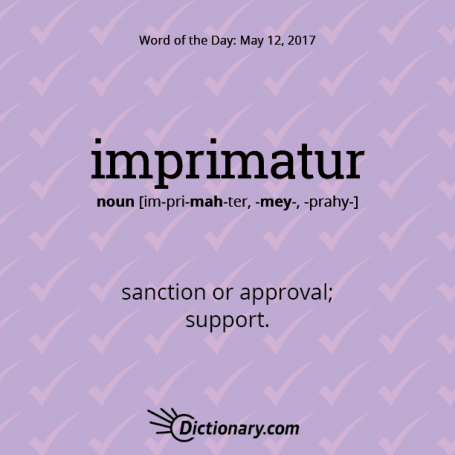
Missed yesterday…I need a less crazy day job so I have evenings to write. By the time I get home it’s time for bed and then to start again. At any rate, the word of the day for Friday from dictionary.com was imprimatur.
Dictionary.com defines imprimatur as an official license to print or publish a book, pamphlet, etc., especially a license issued by a censor of the Roman Catholic Church; or simply a sanction or approval; support. The word originated in 1640, Modern Latin, literally “let it be printed,” the formula of a book licenser, third person singular present subjunctive passive of Latin imprimere “to print” (see impress). Originally of state license to print books, later only of Roman Catholic Church.
A peruse of Wikipedia revealed that the word actually dates back to the dawn of printing. In England the Licensing of the Press Act of 1662 required an official license for printing books. The 1662 act required books, according to their subject, to receive the authorization, known as the imprimatur, of the Lord Chancellor, the Earl Marshall, a principal Secretary of State, the Archbishop of Canterbury, or the Bishop of London. Essentially, t was government ordered and sanctioned censorship. Those who broke this law could be sued for libel. The law finally expired in 1695.
Shortly after its expiration the first significant event in the evolution and history of the copyright, the Statute of Anne in 1710 (Anne being Queen Anne), removed the right to print and publish a written work from publishers, printers and the state, returning it to the authors as a way to encourage learning and the sharing of ideas.
Here is an excerpt from the statute: Whereas Printers, Booksellers, and other Persons, have of late frequently taken the Liberty of Printing, Reprinting, and Publishing, or causing to be Printed, Reprinted, and Published Books, and other Writings, without the Consent of the Authors or Proprietors of such Books and Writings, to their very great Detriment, and too often to the Ruin of them and their Families: For Preventing therefore such Practices for the future, and for the Encouragement of Learned Men to Compose and Write useful Books; May it please Your Majesty, that it may be Enacted ..
Thank you Queen Anne! Despite its flaws the statute was a significant game-changer. Eventually copyright law has evolved to include protections for sheet music, audio – voice and music, media broadcasts, film and television, internet content and intellectual property.
But back to our word of the day. I for one am glad that I don’t need to obtain an imprimatur for the words I write here on this blog or for any words I might decide to publish in print. Freedom of expression enriches us all.
freedom to express
needing no imprimatur
enriches the mind
~kat

fleeting as a blink
life’s miraculous splendor
hiding in plain sight
~kat
For Ronovan Writes Haiku Challenge, prompt words, “Fast” (Fleeting) & “Plain”