Tag Archives: nature

black moon rising – magnetized

black moon rising

season of the in-between
frosted blossoms withering
trees of verdant green
now softly browning
squirrels root for seed
to winter on
come dark moon, the nights
grow longer
gently rock this world
rest our souls
in deepest peace…

kat ~ 30 October 2016
(Magnetic Poetry Online Nature Kit)


She Will Always Win

1474813632345

She lets you believe
you are in control
she lets you believe
deep down in your soul
your wishes she’ll embrace
you are in control
beguiled by her grace
blinded to her verve
your wishes she’ll embrace
selfish to preserve
she cannot be crossed
blinded to her verve
that when you have lost
you won’t even care
she cannot be crossed
no one can ensnare
a force such as she
you won’t even care
stunned by her beauty
she lets you believe
a force such as she
she lets you believe.

kat ~ 26 September 2016
(a Terzanelle)


Eden

eden

Eden

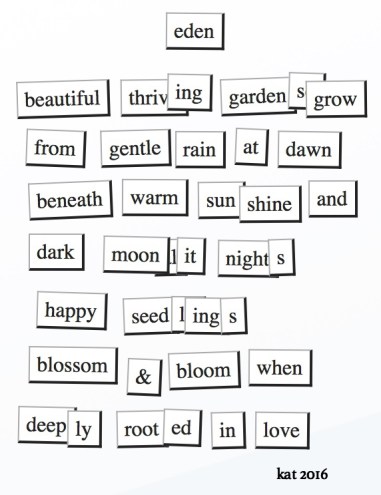
beautiful thriving gardens grow
from gentle rain at dawn
beneath warm sunshine and
dark moonlit nights
happy seedlings
blossom and bloom when
deeply rooted in love

kat – 6 August 2016

For Elusive Trope’s Magnetic Poetry Saturday Challenge. Today I used the Nature Kit.


Robin Red Dawning

Every morning before the sun comes up, I see this fellow on my neighbor’s roof. This is a little digital painting of a photo I took of him. He is quite comical and has grown accustomed to me. Sometimes he tilts his curious head as he glances at me. I think that I would miss him were he not there. I wonder if he would miss me. I wrote a little Senryu poem about him. I consider him one of those momentary graces that wait for me to discover them each day. I’m so glad that I’m paying attention. 🙂

robinonroof

Robin Red Dawning

Robin on the roof
every morning before dawn
watching me watching.

kat ~ 3 May 2016
(a Senryu Poem)


April Poetry Month – A Poem a Day #13

Happy Poetry Month this 13th day of April! Today’s poetry form, the Sijo originates from Korea and like its cousins, the haiku and tantra, is comprised of three lines. Each line should have 14-16 syllables, pausing in the middle, the first half containing 6 to 9 syllables with the balance in the second. A Sijo may be narrative or thematic. It develops in three parts: introduction of a situation or problem; development or “turn” in line two; and resolution in the third, often employing a twist or surprise in the first half of the line. Sijo is strongly based in nature and may take on religious or metaphysical themes as well. Unlike haiku, sijo relies heavily on the use of metaphors, symbols, puns, allusions and other word play. Some modern print restrictions may show a sijo in six lines.

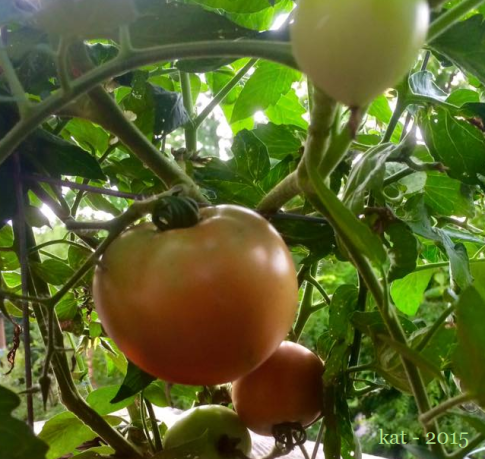
I take my inspiration today from an amazing “volunteer” tomato plant. I found it last summer, thriving in the middle of my compost heap. I am not a gardener. I barely knew what to do with it once I found it. But despite my inadequacy, Nature saw fit to provide me with a dozen or so plump tomatoes.

Nature has a way of surprising us with her wild chaotic unruliness. She has been sustaining life for eons, long before the first human thought to contain her in tidy rows with hoe in hand. It’s comforting to those of us who tend to go with the flow to know that Nature has our back…and a few tomatoes to spare.
tomatoes

This is an actual photo of my wild tomatoes from Summer 2015!

Nature’s Garden

Gardeners, who fancy their thumbs green, primp and prune and toil
Sowing seeds, midst fussy plots of weeds, their empty plates to fill.
My garden thrives in a compost heap, vines bursting tomatoes!

kat ~ 13 April 2016