it’s backwards you know
referencing days past as old
as if days could age
~kat
For Ronovan Writes Haiku Challenge prompt words: old & days.
it’s backwards you know
referencing days past as old
as if days could age
~kat
For Ronovan Writes Haiku Challenge prompt words: old & days.
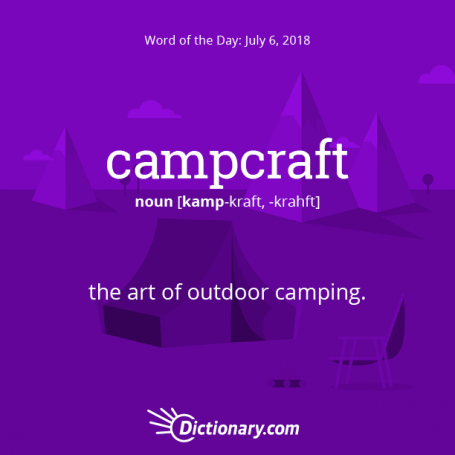
Today’s Word of the Day at Dictionary.com is Campcraft, defined as the “art of outdoor camping”. Okay, I have to stop here for a minute…art? Really!? Can you tell that my brow is furrowed right now? Camping as “art”? I think that’s a stretch. Maybe I should look at other dictionary definitions of the word, campcraft.
But before I do that, let’s look up the word “art”. Wow! What a can of worms that is. Suffice to say that there is an entire field of philosophical study, and a good amount of disagreement regarding art and whether it is even possible to define art; whether anyone should even try. There are pages and pages of methodology and reasoning, but nowhere, NOWHERE do I see any reference to campcrafting. Not a one. It may have something to do with the fact that campcraft is a relatively new word. According to dictionary.com: “Campcraft is a straightforward compound noun. Camp ultimately derives from Latin campus “field, plain,” especially the Campus Martius “the field of Mars” (so called from the altar dedicated to Mars), which was originally pastureland between the Tiber River and the northwest boundary of Rome. The Campus Martius was used for recreation and exercise, various civilian meetings, and army musters and military exercises. Craft is a common Germanic word: cræft in Old English, Kraft in German, kraft in Danish, Norwegian, and Swedish. All of the Germanic languages except English have maintained the original meaning “strength, power”; only English has developed the sense “skill, skilled occupation.” Campcraft entered English in the 20th century.”
But I digress. This is the most neutral, reasonable definition I found for the word “Art”: “the expression or application of human creative skill and imagination, typically in a visual form such as painting or sculpture, producing works to be appreciated primarily for their beauty or emotional power.” See camping in there? uhh hmmm…nope…just as I suggested.
And about those other dictionaries…The Oxford Dictionary says that campcraft is “knowledge and skill required for an outdoor life lacking modern conveniences”. Thank you Oxford Dictionary! Yes! I can relate to this definition. Merriam-Webster says campcraft is “skill and practice in the activities relating to camping”. Wiktionary says campcraft is “Any of the outdoor skills associated with camping expeditions, such as map-reading.” Ah, map reading, and that word again, skill. I get that. It takes a certain amount of skill to survive on limited resources and no creature comforts in the wild, as it were.
I suppose I am a bit biased in my aversion to the idea of camping as art. My latest guilty pleasure has been binge-watching a new reality show on the Discovery Channel called “Naked and Afraid”. Its premise is basically this. Teams (a man and a woman, strangers before the challenge) are dropped off in the wilderness. Each person is allowed to bring a tool of their choice and they are given a square canvas over the shoulder bag…and, ahem, the catch…no clothes allowed. Not a stitch. The object of the game, if you can call it that, is to survive the elements and each other for 40 days, while wandering around with wild animals in some of the world’s most dangerous places. (and we’re not talking about Manhattan here…or Chicago…or our southern border…sorry…not sorry). It’s survival at its rawest. And I can tell you, it’s not pretty. It is extreme campcraft, but is it art? For that I must refer back to the definition of art… “the expression or application of human creative skill (…that word again) and imagination (it certainly takes imagination and skill for these people to figure out how to make it without dying or being eaten by predators), typically in visual form such as painting or sculpture (well…nope, that doesn’t fit), producing works to be appreciated primarily for their beauty or emotional power”. And with that last part, I may just be talking myself out of my first assumption. Survival is not necessarily beautiful to look it. It is pretty messy, in fact, and scary. But now that I think about it, watching these naked people struggling to survive (believe me, it’s hard to not watch, once you’re hooked…and don’t worry, the producers blur out the sensitive anatomic areas, not that it matters, you really get to know the people. That’s what hooks you in.)…watching them take on the challenge is definitely emotionally gripping and inspirational. When I think of art, however one defines what is or isn’t art, there is a common denominator. It causes us to feel something.
So…okay Dictionary.com, I’ll give you the use of the word, art, in your definition. I admit my first thoughts were of bunsen burners, bug spray, flashlights, tents and sleeping bags, lions, tigers and bears…spiders and snakes. In that context, art is a stretch. Even “Glamping” can’t hold a candle to the Mona Lisa. But there is beauty in the skill and creativity of survival. I still like Oxford, Wiktionary, and Merriam-Webster’s definitions, but I get it now. Campcraft can be a beautiful thing. Maybe even art. It’s all in how you perceive it.
campcraft is a skill
in the art of survival
the goal…not dying
~kat

blue-sky canapy
oppressive humidity
raindrops suspended
~kat
For Haiku Horizons Challenge, prompt word: Blue.
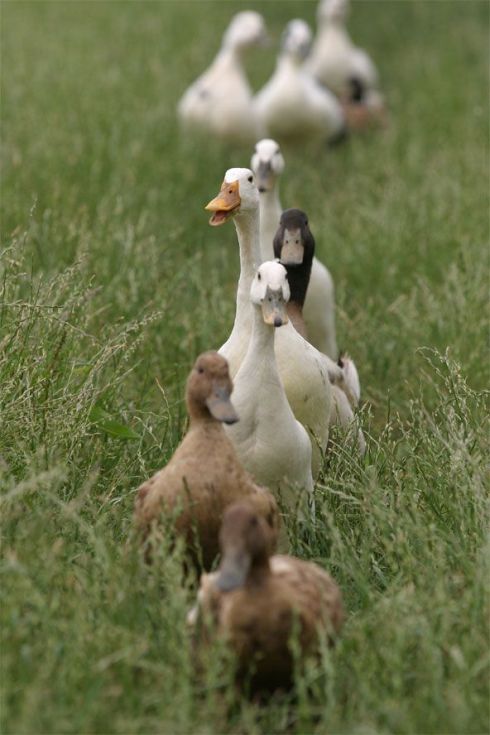
Photo from Pinterest – Ducks and Geese in a Row
gathering gaggle
of honking geese, waddling
odd ducks in a row
~kat
For Ronovan Writes Haiku Challenge, word prompts: Chance (odd) & Unite (gathering).

Today’s word of the day at Dictionary.com is flexitarian. It’s a relatively new word, a portmanteau (remember that word of the day?) created by combining the words “flexible” and “vegetarian”. It was first recorded in 1990 and is defined as a person whose diet is mostly vegetarian but sometimes includes meat, fish, or poultry, or it is also a term relating to flexitarians or their diet: a flexitarian cookbook.
I get it. I’ve been a pescetarian for several years now, which means I eat a vegetarian diet and occasionally I east fish. But if I’m being completely transparent, I suppose what I really am is a pesce-ovo-lacto-tarian since I also eat eggs and dairy. But I am definitely not a flexitarian. I do not eat meat from mammals or poultry.
But I get it. We are all striving to be more health conscious when it comes to our diets. Going vegetarian, or vegan can be a daunting exercise for carnivores. Some people would never consider such a radical approach, especially those who opt for keto (high fat, popularized by Jack Spratt’s wife), low carb, or paleo fare. And then, of course there are is the gluten-free crowd, and the locavores who limit their diet to food that is produced locally. As radical as veganism or vegetarianism may seem, there are the raw diet aficionados, fruitarians (fruit only) and breatharians who believe that food is not necessary for human subsistence. I had never heard of this latter group, but I suspect that they are a dying breed…(Forgive my humor if you are a breatharian. I mean no disrespect. Obviously, if you are, and are still living and breathing, then my humorless assumption is incorrect.) There are a few other -tarians worth a mention, pollo-tarians (poulty eaters), the faith-based Kosher, Buddhist, and Hindu/Jain diets, and last but not least, diets that relate to specific populations: the Inuit, Mediterranean, and from our friends “down under” the kangatarians. Yep, you guessed it…they eat kangaroo meat to the exclusion of all other meats. Just one more…there is also a diet called the Shangri-La Diet, which involves consuming 100-400 calories of flavorless “food” such as extra virgin olive oil between meals as a way to lose weight. The Shangri-La Diet, when one examines the details, seems like an oxymoron to me. I guess this is a good place to stop. Though you should know, this is not an exhaustive list. You can find that list at Wikipedia.
All this to say that I think it is safe to say, we like our labels and categories. It makes us feel like we’re special, that we belong, which brings me to our word of the day…flexitarian. Is that really a thing, or is it rather a “non-thing”? Before the age of dietary enlightenment, weren’t we all flexitarians? Like I said, I get it. We like our labels and categories. Flexitarians can have their meat and eat it too.
Does it really matter how we identify our eating habits? Restaurants are catching on, as are food labels, making it easier for us to identify the special foods we choose to consume be it for religious, health, spiritual, or activist reasons. It really shouldn’t matter what we choose to eat. But as an Executive Administrative Assistant, I can tell you catering a nice employee appreciation luncheon can be a nightmare. From the moment the email invitation drops, I can count on being flooded with requests for the precise menu that is being served, and if it does not meet the “needs” of my invitees, requests for substitutions ultimately follow. The days of employees excited about a box of Krispy Creme donuts in the break room are long over. Believe me, it’s not worth the trouble to offer people free food. When the company asks for cost savings…I have a few ideas.
Before I launch into a rant…let me get to my haiku for the day using our word of the day… because I’m flexible that way I shall not tarry any longer. Have a great weekend and remember to be kind. Eat and let eat…and have the damn cake if you want it. Life is short. 🙂
in the beginning
we were flexitarians
just didn’t know it
~kat