Stravage – Friday’s Word of the Day Haiku

stravage

Happy Friday. Today’s Dictionary.com Word of the Day is Stravage.

Originally entering the English language in the late 18th century this Scottish/Irish word is derived from an aphetic contraction, which means that it is a word formed by combining two words as well as by aphesis (the loss of an unstressed vowel at the beginning of a word (e.g., of a from around to form round ).

From Medieval Latin we have ‘extravigari’ which means to wander out of bounds, digress or ramble. ‘Vagare’ is an Italian intransitive verb that means: to wander around, roam around, to roam. I particularly like this Italian phrase: “vagare con la fantasia” which means to give free rein to one’s imagination, let one’s imagination run away with one.

And to round out the etymology of this most interesting word, the Italian verb ‘vagare’ or ‘vargari’ is derived from the adjective ‘vagus’ which means strolling or unsettled and is thought to be a precursor of the English word ‘vagrant’. Back to our word, stravage. To get to its current form, the “ex” from the original Latin ‘extravigari’ was dropped by the Scots who converted the word to ‘stravaig’. It was later embraced by the English, dropping the ‘i’and adding an ‘e’.

I was able to find a delightful, award-winning Glasgow restaurant called Stravaigin in my stravaging across the internet. True to its name, their website’s “About” page links us back to this 18th century word: “‘Stravaig’ meaning ‘to wander’ encompasses our ‘Think Global, Eat Local’ ethos perfectly. So wander off the beaten path into either the street level cafe bar or the downstairs restaurant where you’ll find menus showcasing Scottish produce that isn’t tethered to its roots. Awarded the Michelin Bib Gourmand every year since 2012.” Stravaigin is quite modern however, offering local fare with an exotic flare. Click on the link of their name above to check them out. If ever you’re in Glasgow…;)

The Scots, I have learned, are very proud of their native language and heritage. There is an entire website devoted to all thing Scots…but I suppose I am digressing…or stravaging you might say. Since I am descended from Scottish ancestors, this will be on my to-do list for future study. 🙂

I am quite fond of stravaging. I admit that I do it often! Those who know me are able to recognize my stravaging ways immediately. I am told my eyes glaze over and I may start humming a tune to myself, which drives people batty. But in my mind, I am having a jolly good time taking it all in. The scenery that is. I am not so worried about the destinations in life that I do not pay good mind to the journey. The journey after all is where it’s at. (whatever “it” may be) I have a tin plaque in my room that says, “I never worry when I get lost, I just change where I want to go.” A friend got it for me. Stravage is a good word of the day for me. Fits me to a “t”. Have a great Friday!

to those who stravage
some may think you’re a lost fool
 but you are seeking 

to be an artist
it helps to be an odd bird
with stravaging wit

delicate ivy
stravages up walls, clinging
destruction’s embrace

~kat – 10 March 2017


privilege

Entitled, you say? How could
that be true? After all,
it’s not like I go
around demanding
things or that
I must be
first in
line or worse, that I believe
I am better than anyone
else…I don’t think
that, in fact
I never gave
it much
thought.
Never
have.
…
…
Oh.

~kat ~ 10 March 2017


…It’s How You Play the Game

photo by Jake Oates via Unsplash.


Plenty of parents hated Joe and thought nothing of letting him know right to his face, in no uncertain terms, that he was the worst coach in the league. 

The Little Monsters hadn’t won a game all season; even worse they hadn’t even scored a run, not one.

But I saw a different side to Joe, and came to appreciate him all the more because my kid came home from every game, not sad that they had lost, but happy and proud that he had played his best and because he’d had fun.

kat – 9 March 2017

For Sonya’s Three Line Tale Challenge based on this prompt photo by Jake Oates via Unsplash.


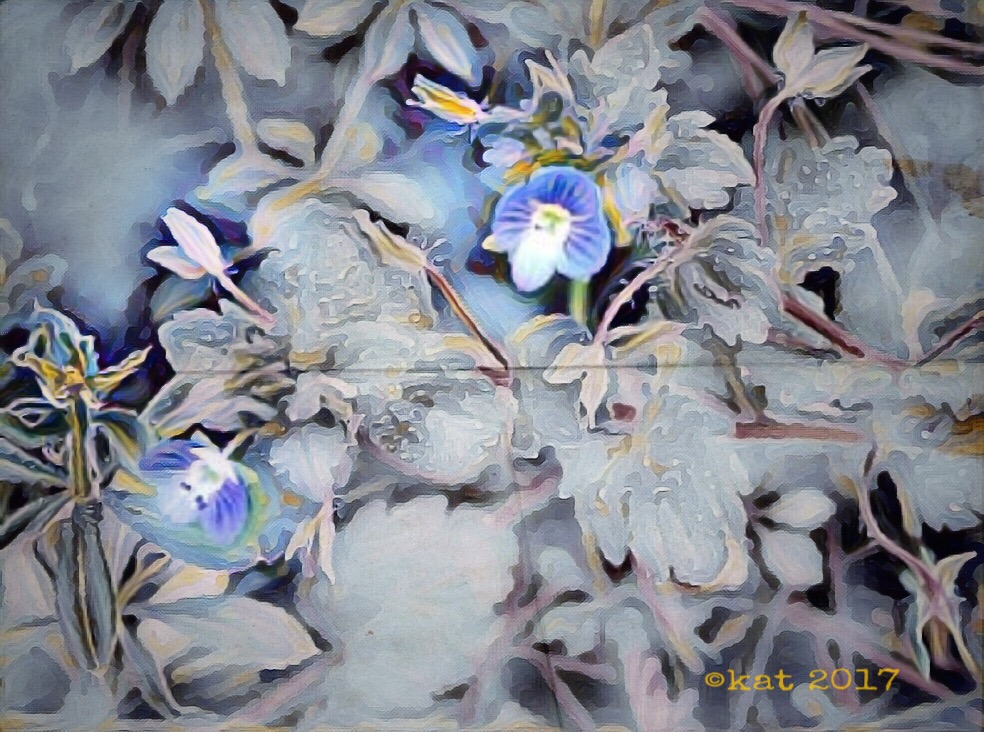
It’s Just a Weed


it’s just a weed
you know it’s true
it’s just a weed

with blooms of blue
the first to rise
you know it’s true

feast for our eyes
a sign of spring
the first to rise

though winter clings
with one more frost
a sign of spring

seems all but lost
it will not die
with one more frost

it will survive
it’s just a weed
it will not die
it’s just a weed

~kat – 9 March 2017
(A Terzanelle Poem)


Aak Attack

No automatic alt text available.

PHOTO PROMPT © Shaktiki Sharma

“Tell me what happened,” said the detective.

“Well, she came in…sat at the bar. This guy, he’s a regular, took a shining to her, but he’d had a few and I guess he got carried away. He grabbed her, you know, where he shouldn’t of. She told him to stop. When he didn’t she sprayed this awful smelling stuff on him. He dropped dead, on the spot.”

When Scientists at the Etymology Experimental Lab across town heard the story they celebrated.The suspect was likely the person who had stolen a vial of “Aak Attack”, an anti-rapist agent. It worked!

~kat – 8 March 2017
(100 Words)

For Rochelle Wiseoff-Fields Friday Fictioneers 100 Word Story Challenge.

A bit of background on the grasshopper you see above from Wikipedia:

Poekilocerus pictus is a large brightly colored grasshopper from India. Nymphs of the species are notorious for squirting a jet of liquid up to several inches away when grasped. It is also known as Aak grasshopper or locally in few tribal areas called titighodo

Adult Form

The half-grown immature form is greenish-yellow with fine black markings and small crimson spots. The mature grasshopper has canary yellow and turquoise stripes on its body, green tegmina with yellow spots, and pale red hind wings.

The grasshopper feeds on the poisonous plant Calotropis gigantea (Giant Milkweed).

Upon slight pinching of the head or abdomen, the half-grown immature form ejects liquid in a sharp and sudden jet, with a range of two inches or more, from a dorsal opening between the first and second abdominal segments. The discharge is directed towards the pinched area and may be repeated several times. The liquid is pale and milky, slightly viscous and bad-tasting, containing cardiac glycosides* that the insect obtains from the plant it feeds upon. In the adult, the discharge occurs under the tegmina and collects as viscous bubbly heap along the sides of the body.

*From ancient times, humans have used cardiac-glycoside-containing plants and their crude extracts as arrow coatings, homicidal or suicidal aids, rat poisons, heart tonics, diuretics and emetics. Today these steroids are processed to treat heart conditions.