
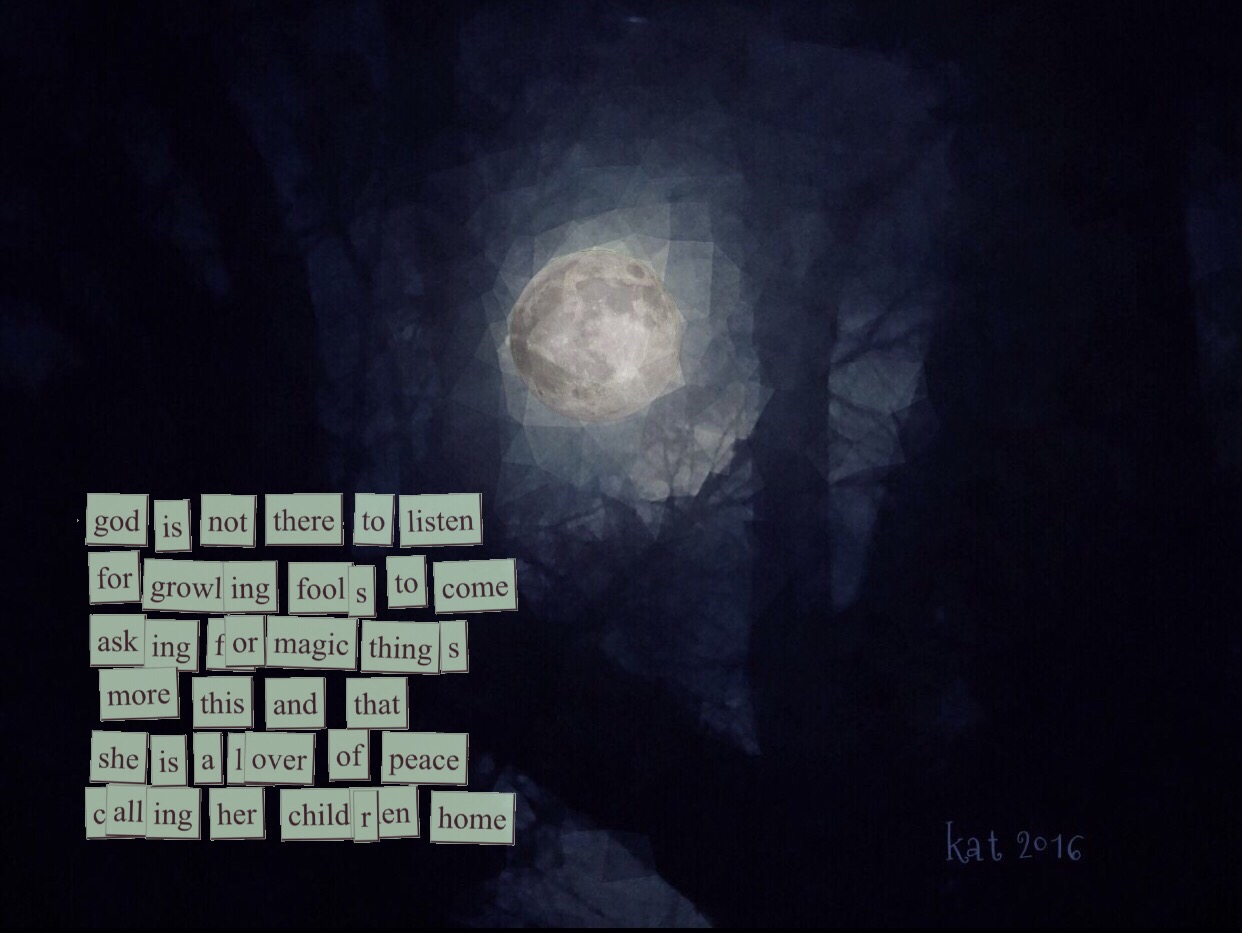
God is not there to listen
for growling fools to come
asking for magic things…
more this and that.
She is a lover of peace
calling her children home.
kat – 13 February 2017
(Magnetic Poetry – Poet Kit)
God is not there to listen
for growling fools to come
asking for magic things…
more this and that.
She is a lover of peace
calling her children home.
kat – 13 February 2017
(Magnetic Poetry – Poet Kit)

Well, it’s Sunday again and I’m happy to say as I write this, and if you’re reading this, we’re all still here. I have to admit, it’s been touch and go for a few weeks. Still, the sun and moon have kept to their schedule. We even saw a comet pass by with little fanfare or disruption to our day to day. In fact you might be tempted to think that it was a normal week, or at least as normal as anyone can expect…except…
There were a few collateral casualties this week, depending on your point of view, on a whole host of battle fronts…education, speech, equality, ethics, justice, retail profit and loss, immigration, environment, freedom, separation of powers, diplomacy, and healthcare. And as a final exclamation point to wrap up the week, North Korea launched a ballistic missile into the Sea of Japan (no it wasn’t the aforementioned comet…that happened too) while Japan’s Prime Minister golfed with the president at his Florida resort residence.
But many people probably missed all of this because…well because the sun and moon kept to their schedules this week. And that’s okay. Following current events is a daunting task after all and not for the faint of heart. Fortunately there are those of us who persist, nevertheless.
So, no worries. I hear the sun is scheduled to rise again tomorrow morning. Those of us who concern ourselves with the details, with the minutiae of the day, who are not afraid of the dark, who persist…and who resist will keep the light on for you. Have a great week!
Shi Sai Sunday’s Week in ReVerse – 12 February 2017
So, this is an “alt-clerihew”
but that was not his mortal sin
their family grows
separated, what a pity
but here’s the thing
your days were numbered
denying reality
Liberty’s a bearded fellow
return home to the freedom of the sea
Love is everything
just as I believed…
Drum roll paleeaaze
those who curse the rain
beguiling, mesmerizing, looming
unless they’re a duck
spinning alternative facts
ferocious and wild
easily flustered, weak and unruly
keep us in suspense too long
not that I notice such things.kat
A shi sai or ReVerse poem is a summary poem with a single line lifted from each entry of a collection of work over a particular timeframe and re-penned in chronological order as a new poem. Unlike a collaborative poem, the shi sai features the words of one writer, providing a glimpse into their thoughts over specified period of time. I use it as a review of the previous week. 😊

Oh, let not your hearts be troubled my dears
when storm clouds loom, there is nothing to fear.
Remember that they are temporary,
brief forces of nature just rattling trees.
The sky will soon become bright blue and clear.
For tempests are blowhards, or so I hear,
bag-o-wind braggarts who blast in our ears,
minor annoyances, blustering bullies,
easily flustered, weak and unruly
Oh, let not your hearts be troubled
Here’s a suggestion when chaos comes near:
Fire up the hearth, or chill out, grab a beer,
slip on your galoshes, go on a spree.
Stomp every puddle with child-like glee.
Radiate love when a whirlwind appears.
Oh, let not your hearts be troubled
~kat – 11 February 2017
(A Rondeau)
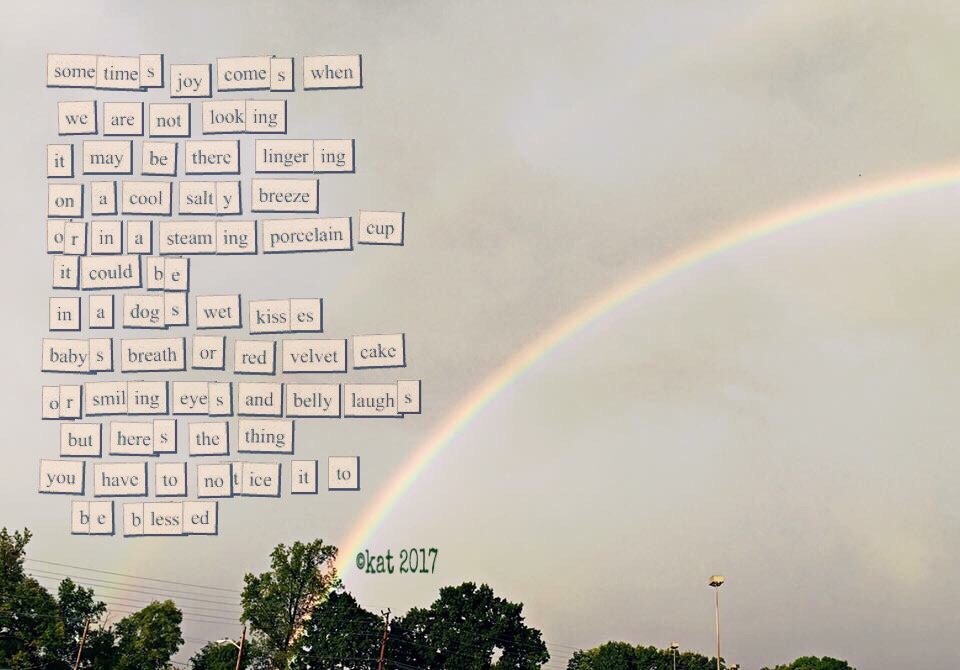
sometimes joy comes when
we are not looking
it may be there, lingering
on a cool salty breeze
or in a steaming porcelain cup…
it could be
in a dog’s wet kisses,
baby’s breath or red velvet cake
or smiling eyes and belly laughs…
but here’s the thing
you have to notice it to
be blessed.
kat ~ 6 February 2017
Magnetic Poetry – Poet Kit
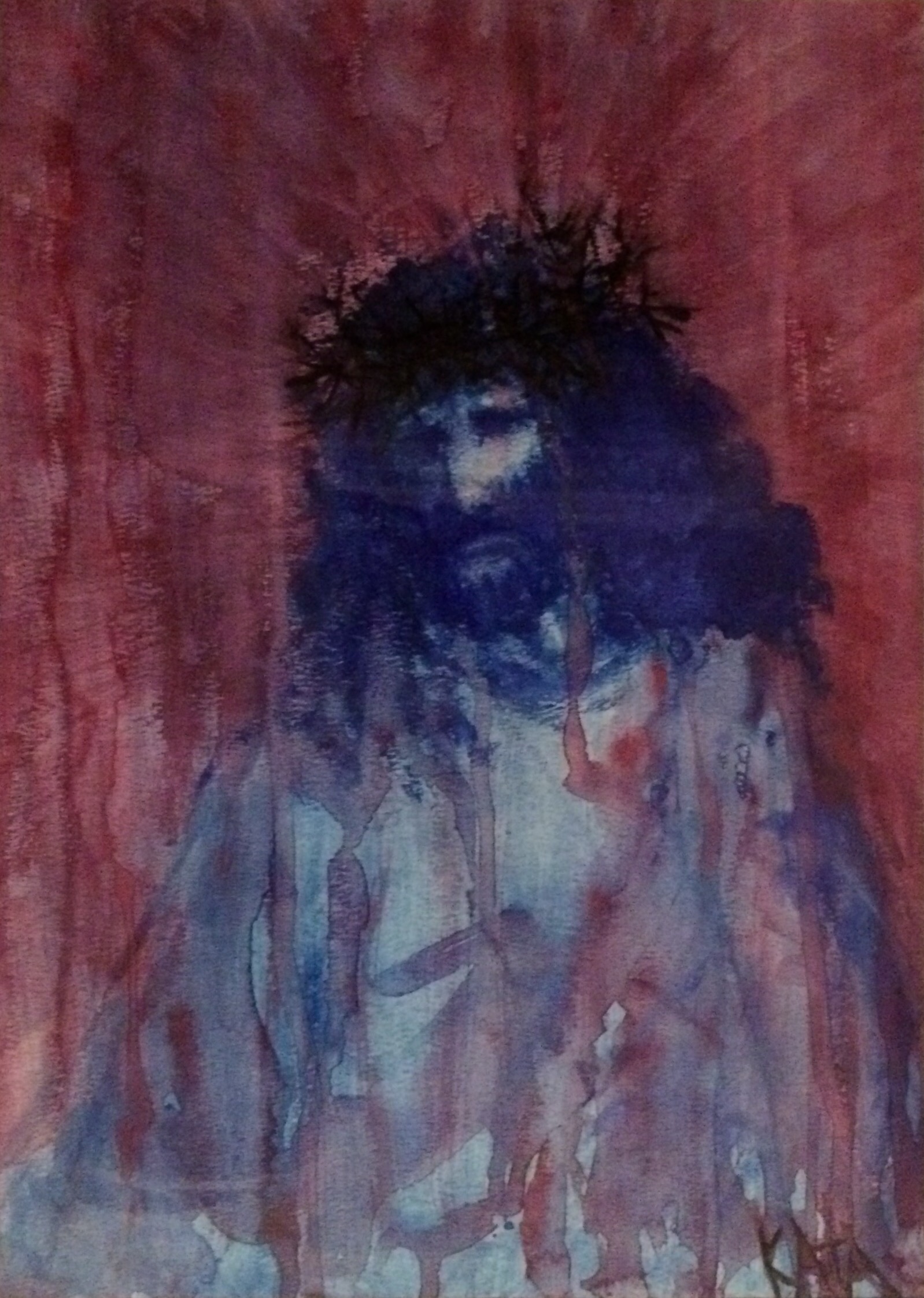
“They Know Not” – Watercolor Painting by Kat Myrman
Fear makes us do crazy things.
What frightens you most?
Are you free?~ kat – 4 February 2017
I am full of questions now. Here is another quinzaine to ponder …
“Pro Life” is a misnomer.
Is life eternal?
What is death?~ kat – 4 February 2017
Wow! This poetry form is like a brain worm! It might even be the key to solving the world’s woes!!! More questions…
Happiness is everything.
What makes you happy?
Glass half full?~ kat – 4 February 2017
Okay…one more. Then I need to turn off my inquiring mind. I have things to do today!
We can never know the truth.
Is truth absolute?
Do you think?~ kat – 4 February 2017
The Quinzaine
This poetry form is one I’ve never tried before. Warning…it can be addictive once you give your deepest questions a voice. Don’t let its brevity fool you. This seemingly simple 15 syllable French poetry form is one powerful little dynamo. Here is a bit from Shadow Poetry explaining what makes a quinzaine a quinzaine, in case you want to give it a try:
“The English word quinzaine come from the French word qunize, meaning fifteen. A quinzaine is an unrhymed verse of fifteen syllables. These syllables are distributed among three lines so that there are seven syllables in the first line, five in the second line and three in the third line (7/5/3). The first line makes a statement. The next two lines ask a question relating to that statement.”





 like mercury colliding...