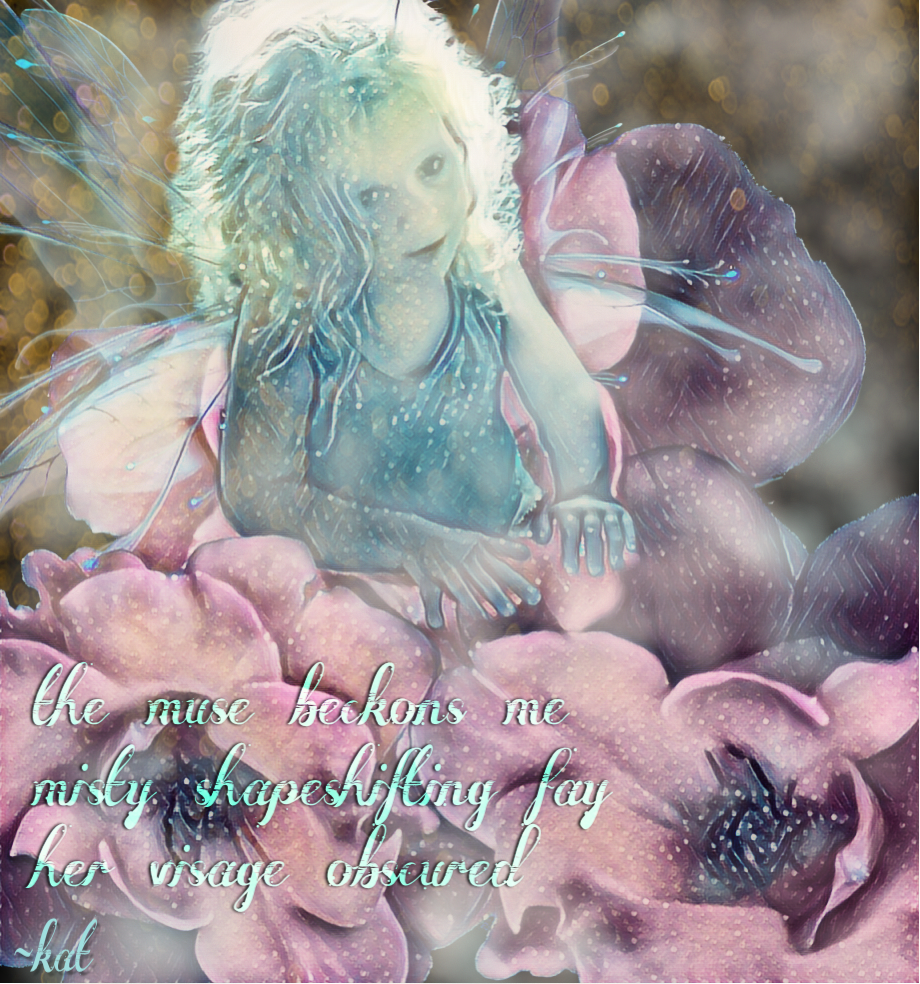
the muse beckons me
misty shapeshifting fay
her visage obscured
~kat
A Senryu for Colleen Chesebro’s Tuesday Poetry Challenge based on the prompt words Mist and Shape.


the muse beckons me
misty shapeshifting fay
her visage obscured
~kat
A Senryu for Colleen Chesebro’s Tuesday Poetry Challenge based on the prompt words Mist and Shape.


there is a haunting cloud of poison
in the air this morning…a red hot sky
our salty tears making dirty trails
on our faces…smiles darkened
in the wake of hate’s fire
~kat
Remembering Las Vegas…and keeping close to heart, those still suffering in Puerto Rico, islands in the Caribbean and Texas and Florida.

my garden heaves her
last bit of sweetness
as the cool beauty of
death whispers to her
urging her to sleep…
to dream of spring

I am not dazzled by
broken gods and
fool-hearty men who
must be surrounded by
all-embracing prisoners
of fear to feel whole

keep trusting in
the goodness of
others even if it is
hard to see….I
believe it’s always
there, waiting to care

every path is thick
with followers but
wanderers leave fresh
tracks through the wild
~kat

Today’s Word of the Day on dictionary.com is lonely-hearts. It is defined as: of or for people seeking counseling or companionship to bring love or romance into their lives: a lonely-hearts column in the newspaper or in more modern terms, online dating sites. Dictionary.com also explains the origin of lonely-hearts as:
The noun lonely heart in the sense “a lonely or friendless person” and the adjective lonely-hearts, referring especially to a column or feature in a newspaper feature entered English nearly simultaneously. The terms are probably most closely associated with the novel Miss Lonelyhearts by Nathanael West (1903-40). The noun lonely heart entered English in 1932; the adjective lonely-hearts entered English in 1933.
I was intrigued by the reference to Nathanael West’s novel Miss Lonelyhearts. “Miss” Lonelyhearts was actually an anonymous male journalist who wrote an advice column for a New York newspaper during the Depression. Not only was Lonelyheart considered something of a joke by the newspaper staffers, but he allegedly fell into a deep depression, burdened by the desperate letters from his readers. This led Lonelyheart on a downward spiral of heavy drinking and bar brawls and a few affairs, the last of which would lead to his ironic demise. Despite all this he tried desperately to escape the pain of the letters, traveling to the countryside with his fiance and by turning to religion. It was only after he had a religious epiphany that he met his end at the hands of the husband of his latest mistress. This black comedy, as it was described, weaves elements of Marxist ideology, religion, the sad state of a valueless world and the cynicism of a “machine” that mass produces empty solutions to systemic problems of society.
It’s easy to see, from this best-selling book of the 1930’s, how “lonely-hearts” became an adjective. And despite the lessons of the book, it is interesting to note that we still seek advice from sterile advice columns. We read daily horoscopes hoping for direction or affirmation of what we already know or hope for. We seek entertainment to escape the reality of our lives. And we seek love by scanning fabricated personal profiles on online dating sites. But it all falls flat, because we do these things anonymously, without having to bare our heart and soul. It is no wonder we are forever searching for answers, because the answers we seek, answers that truly make a difference, need to be personal, not mass-tabloid, bottom of the birdcage-lining rags. Poor Lonelyheart. I get the sense from reading a summary of the book, that he finally finds his answers through a spiritual awakening. But he meets his end, all the same, at the hands of an enraged man who fails to see his change of heart for what it is. I think that is the greatest tragedy of all.
How often do we hear it said that someone can feel lonely even in a room full of people. Modern technology, instant gratification, social media, texting, tweeting, all keep us disconnected and detached from each other.
But there are moments. Eye contact and smiles from strangers that stop you in your tracks and ignite a spark in your heart. That moment’s connection can change you. I live for those moments. We all do. And the best thing about recognizing this is that we can be this moment for another person. Being, not receiving, can change us too. Make eye contact…smile. It will change your life.
Well! I certainly didn’t see all that coming. It’s amazing what can come of ruminating over a simple word of the day. Lonely-heart. Here’s a Haiku to wrap things up.
lonely-hearts flutter
to pipe-dreams on inked pages
like moths to a flame
~kat