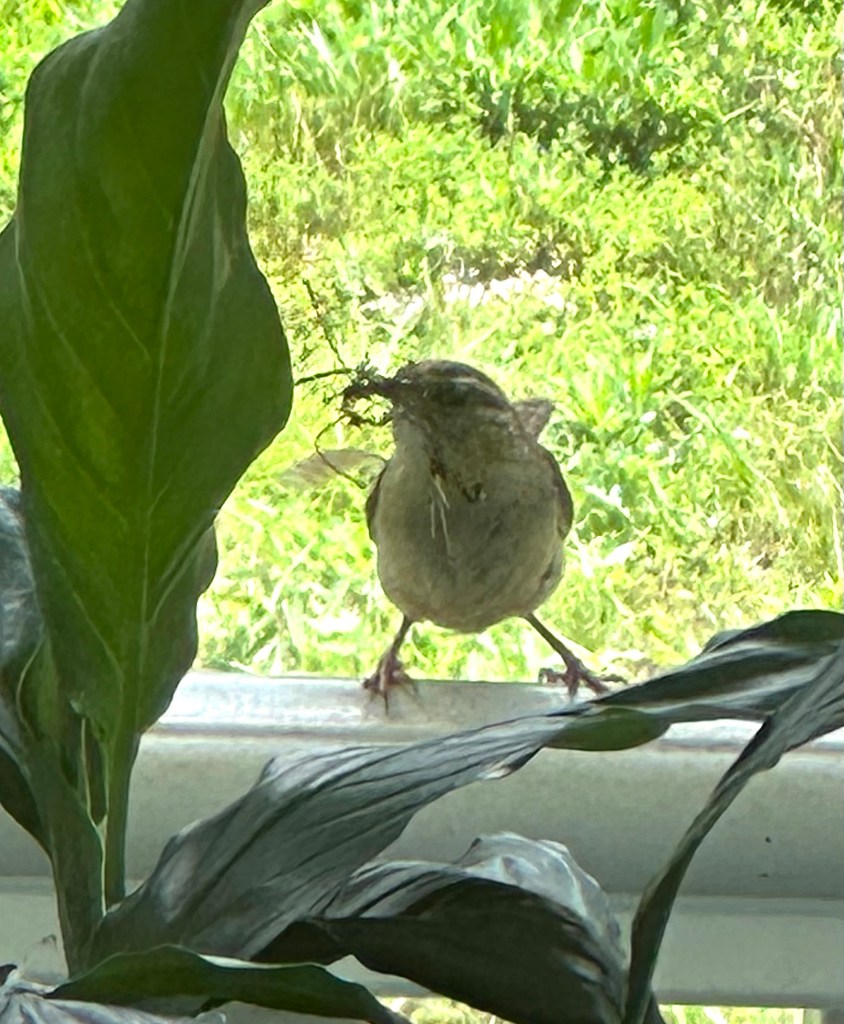
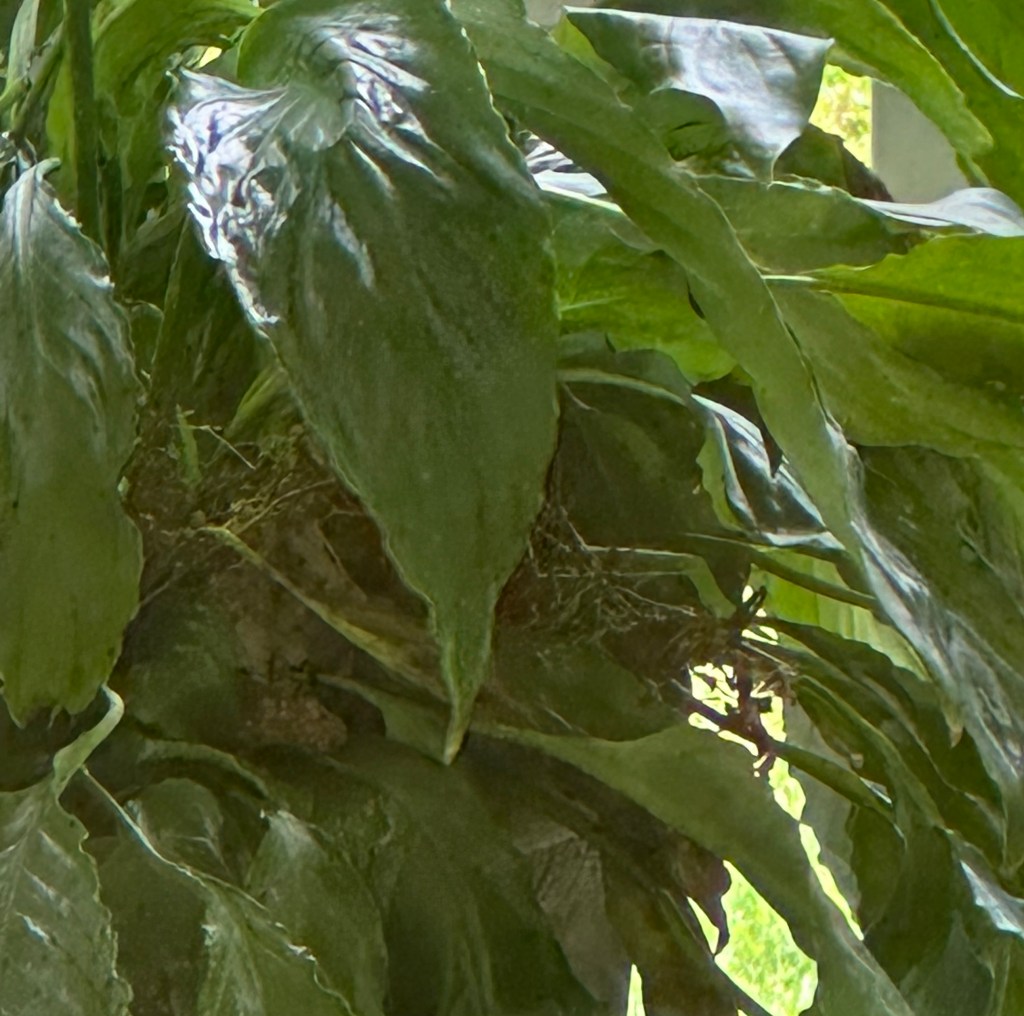
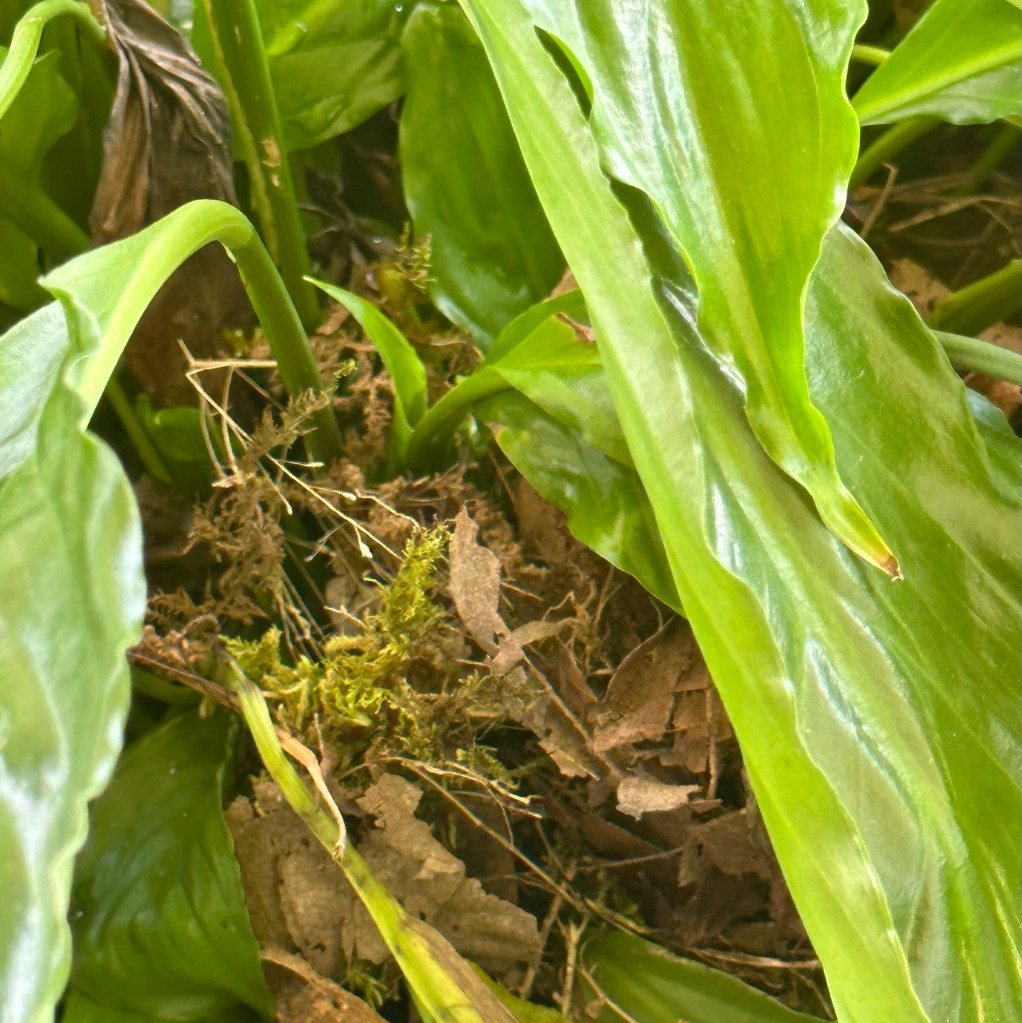
persistent little wren thrice thwarted from nesting in nooks on my porch making peace in the lily pot
~kat
Naani Poem
So…this week I’m exploring the Naani. See a description of this form below:
The Naani poem has its roots in India. It’s a modern day type of poem. It has four lines only. The entire poem can have 20-25 syllables. there is no restriction concerning the theme of the poem.
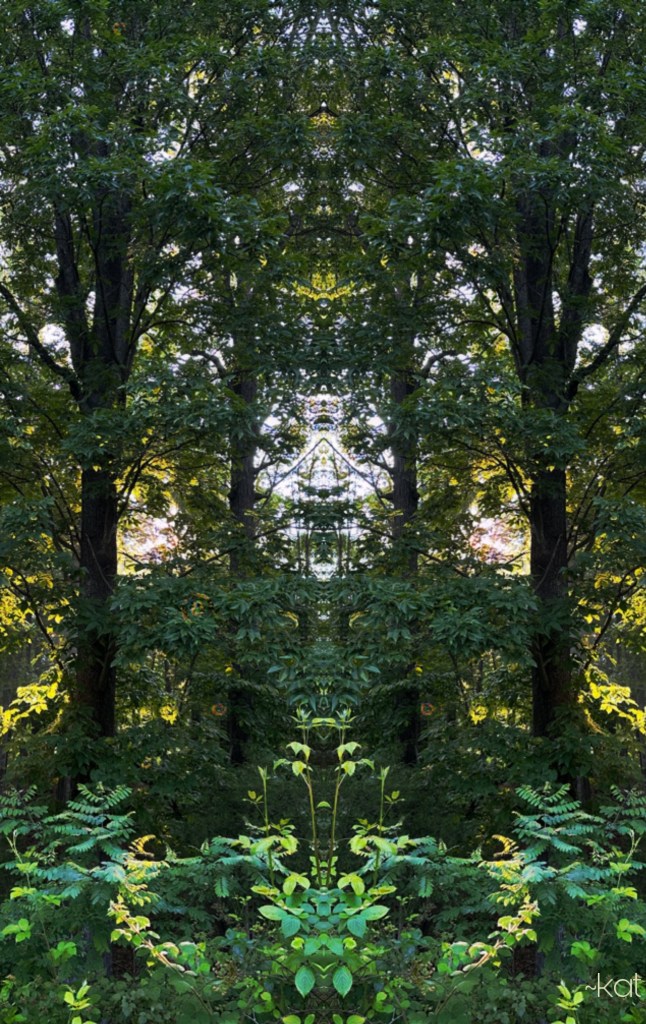
So, this has been a creative endeavor. While playing around with a recent photo of the forest in my back yard I stumbled upon the face of the goddess herself, smiling at me through the trees…or maybe I just have an overactive imagination. At any rate it made for an interesting poem and an even more interesting graphic to accompany it. I’m posting the original and then the enhanced mirrored version. Do you see her? Or maybe it’s just me! 🥰
Dawn on Bramlett Mountain ~ kat 2023Dawn on Bramlett Mountain ~ through the looking glass ~ kat 2023
Gaia

Grecian immortal
goddess, primordial
great-breasted nurturer,
gift-giver, earth mother,
green-adorned sustainer
giving birth to the sky…
generations, extolled

~kat
Pleiades
This titled form was invented in 1999 by Craig Tigerman, Sol Magazine’s Lead Editor. Only one word is allowed in the title followed by a single seven-line stanza. The first word in each line begins with the same letter as the title. Hortensia Anderson, a popular haiku and tanka poet, added her own requirement of restricting the line length to six syllables.
Background of the Pleiades: The Pleiades is a star cluster in the constellation Taurus. It is a cluster of stars identified by the ancients, mentioned by Homer in about 750 B.C and Hesiod in about 700 B.C. Six of the stars are readily visible to the naked eye; depending on visibility conditions between nine and twelve stars can be seen. Modern astronomers note that the cluster contains over 500 stars. The ancients named these stars the seven sisters: Alcyone, Asterope, Celaeno, Electra, Maia, Merope, and Tygeta; nearby are the clearly visible parents, Atlas and Pleione.
The poetic form The Pleiades is aptly named: the seven lines can be said to represent the seven sisters, and the six syllables represent the nearly invisible nature of one sister.
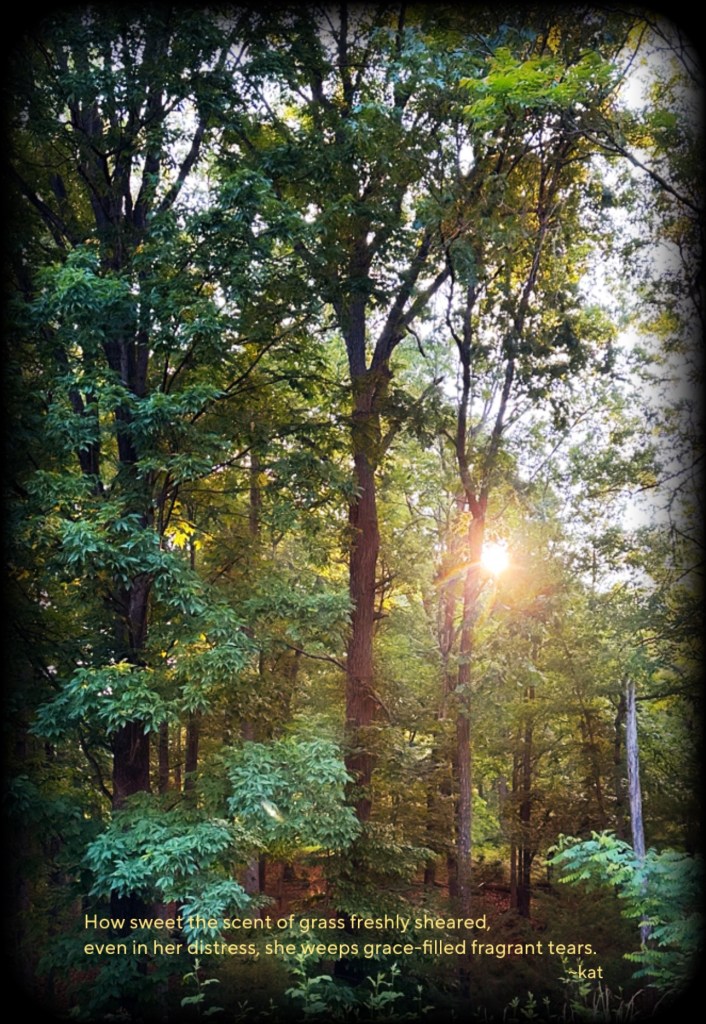
How sweet the scent of grass, freshly sheared,
even in her distress, she weeps grace-filled fragrant tears.

~kat
I have so enjoyed the Landay this week. It’s an evocative, bold form that truly gives the writer permission to say what needs to be said. Perhaps even a way to say out loud what others wish they had the nerve to say! It’s been a good week. I am glad to now have the Landay in my notebook. I’m sure I will revisit it again. But for now, it’s time to explore another form. Tomorrow we will explore the Tricube! Stay tuned!
Landay – The Landay is the poetic form of Afghan women. The poem is 22 syllables long and contains 2 lines. 9 syllables in the first and 11 in the second. Rhyme is not specifically called for but a great many do rhyme at the end of each line. Subjects can include, but are not limited to, war, separation, homeland, grief, or love.
Pronunciation/Etymology. In Pashto, “landay (LAND-ee)” means “short, poisonous snake,” likely an allusion to its minimal length and use of sarcasm. Landays (or landai) often criticize traditions and gender roles.
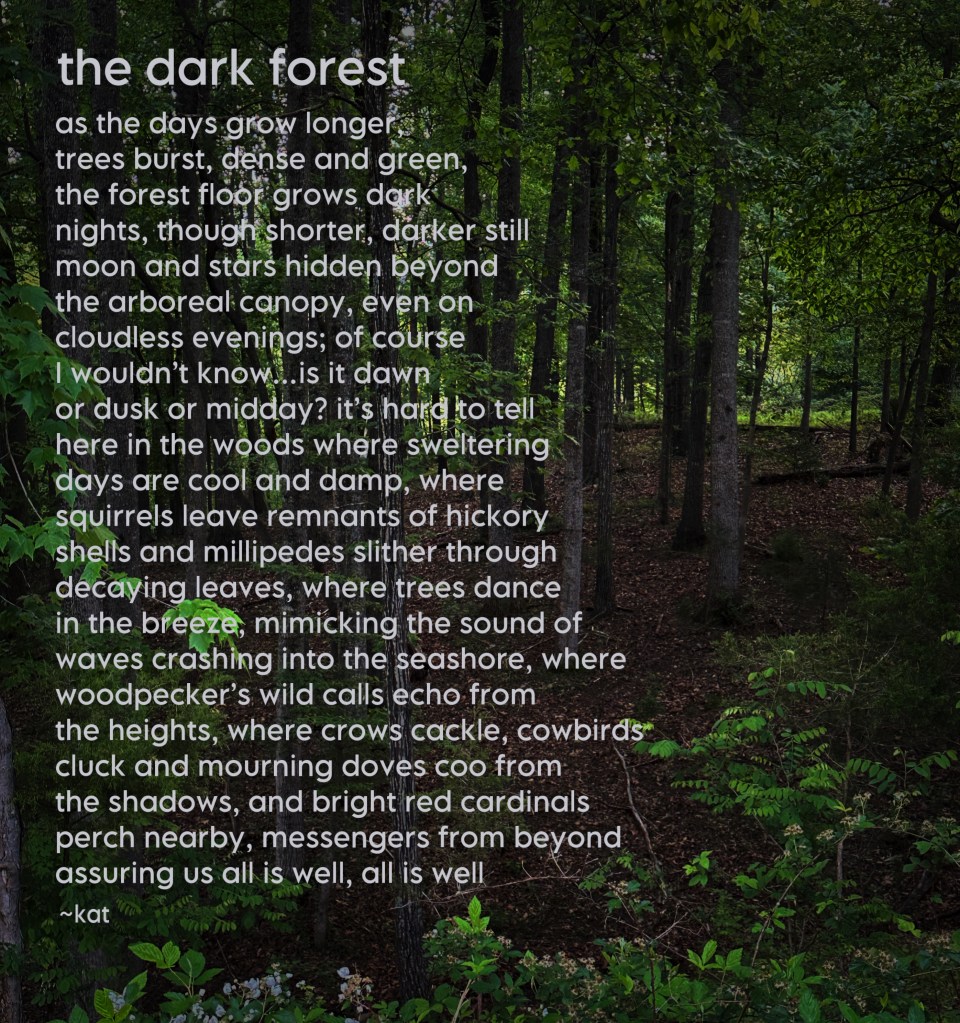
as the days grow longer, trees burst, dense and green, the forest floor grows dark nights, though shorter, darker still moon and stars hidden beyond the arboreal canopy, even on cloudless evenings; of course I wouldn’t know…is it dawn or dusk or midday? it’s hard to tell here in the woods where sweltering days are cool and damp, where squirrels leave remnants of hickory shells and millipedes slither through decaying leaves, where trees dance in the breeze, mimicking the sound of waves crashing into the seashore, where woodpecker’s wild calls echo from the heights, where crows cackle, cowbirds cluck and mourning doves coo from the shadows, and bright red cardinals perch nearby, messengers from beyond assuring us all is well, all is well
~kat
Taking a break today from the brevity of micro poetry. Isn’t this time of year breathtaking?! My senses are waking up from slumber…just had to pause to take it all in! 🌷
bloom flower moon I hardly noticed day fading into night bright
~kat
I have enjoyed spending a week with the Elfchen. Come Monday looking forward to a new, new poetry form to practice…the Than-bauk! With three four syllable lines in total, easy-peasy right?! Ah, but there is a bit of a twist! Stay tuned! 😊

The Elfchen, known as an “elevenie” in English, the German elfchen (which loosely translates to “little eleven” or “wee eleven”) contains 11 words separated into five lines: one word, then two, then three, then four, then one again. The first line of an elfchen is traditionally some single-word concept, thought, or thing, which the rest of the poem describes—what it does, how it looks, how it makes you feel, whatever strikes your fancy. The last line is often a synonym or some other overarching reflection of your first word.
So it is easier for you to find all the parts/chapters of my ongoing fiction series, I created a new page that lists all the links. You can check it out HERE!
Unauthorized use and/or duplication of this material without express and written permission from this site’s author and/or owner is strictly prohibited. Excerpts and links may be used, provided that full and clear credit is given to Kat Myrman and Like Mercury Colliding with appropriate and specific direction to the original content.









 like mercury colliding...