
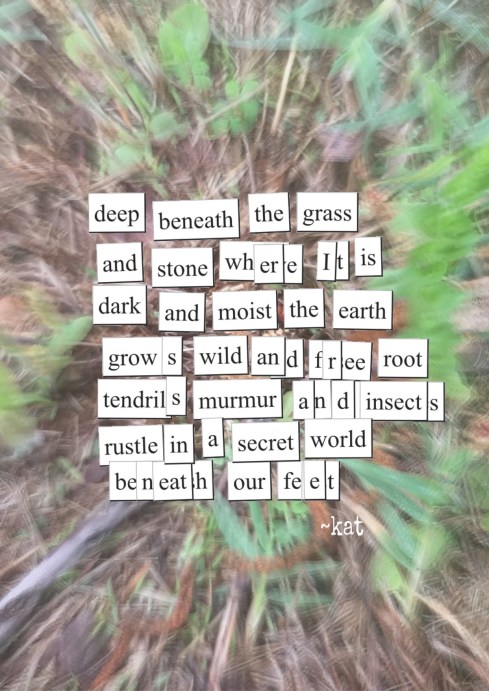
deep beneath the grass
and stone where it is
dark and moist, the earth
grows wild and free…root
tendrils murmur and insects
rustle in a secret world
beneath our feet
~kat
deep beneath the grass
and stone where it is
dark and moist, the earth
grows wild and free…root
tendrils murmur and insects
rustle in a secret world
beneath our feet
~kat

the hatchlings were just three days
old when the storm came, a tempest
that downed trees, swelled creeks,
cresting river banks and dams, poor
phoebe babies, it was too much, too
soon, the eave above their nest too
narrow to protect them, their parents
helpless to intervene…to dust they have
returned, before their first flight, the flutter,
the cool lift of air beneath their wings…
nature is magnificent, but it can seem
cruel, life goes on, scavengers are fed,
the nest abandoned, no time to mourn…
it was only a few days passing before
the bonded phoebe pair surveyed a safer
nesting place, slopping mud-dipped moss,
twigs and grass on a back porch lamp,
days of primping, packing, pruning to
try again, heeding the call of instinct, the
cycle of life, of death, of life, to welcome
a new brood of hatchlings into the harsh,
beautiful, magnificent world where nature
provides and takes away with drops of
rain…at least for today, the sun is shining
~kat
A glimpse into life in the Blue Ridge foothills. I’m spending a lot more time here sheltering in with nature surrounding me. Most days I love it, the sunrises and sunsets, the wildlife, birdsong and spectacular greening, this, my first spring here. And then there are times when the bough breaks…it reminds me of my own fragility. A time to be born and a time to die. What happens in between, the moments are there to inspire me if I’m paying attention. Peace ♾

Sunflowers
come spring, we’ll toss
sunflower seeds over the
wild grassy edge of our
beautiful sanctuary, daffodils
and roses too, along
the forest path…for in
a world so troubled,
there must always be
blossoms, sweet, blooming to
soften the darkest of nights,
if only for a season
~kat
Working my way back into the groove. Monday’s are for Magnetic Poetry and dalliances with the Muse. True story…we did pick up several packages of flower seeds over the weekend, to be sowed in a few weeks, come spring.

hush, be
still my heart,
dawns first light, bright,
through tree leaves, on the breeze
dancing
~kat
A cinqku must always have 5 lines and a perfect seventeen-syllable count. The lines typically follow a 2,3,4,6,2 format. There is no title requirement on the second line. As for syntax and diction styles, it follows the free Tanka style originally. There are no metric requirements for a cinqku poem. Additionally, the final line must contain a cinquain or kireji turn for emphasis.

…just another summer day
simmering humidity, hot, thin air,
clouds hang in the breezeless sky,
low, gray, hoarding raindrops
~kat
Kimo poems are an Israeli version of haikqApparently, there was a need for more syllables in Hebrew. That said, most of the rules are still familiar:
• 3 lines.
• No rhymes.
• 10 syllables in the first line, 7 in the second, and 6 in the third.
Also, the kimo is focused on a single frozen image (kind of like a snapshot). So it’s uncommon to have any movement happening in kimo poems.





 like mercury colliding...