
humble selflessness
distinguishes true heroes
from boastful cowards
~kat
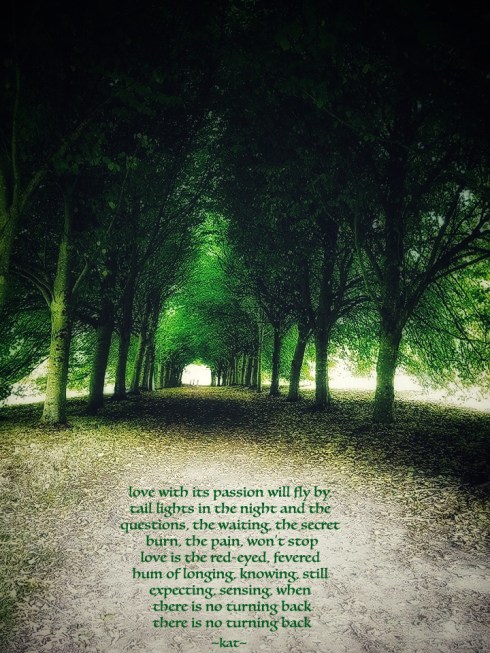
love with its passion will fly by,
tail lights in the night and the
questions, the waiting, the secret
burn, the pain, won’t stop
love is the red-eyed, fevered
hum of longing, knowing, still
expecting, sensing, when
there is no turning back
there is no turning back
~kat
For Manic Monday’s Three-Way Prompt Challenge: Word: Journey/Photo/Song: Big Log by Robert Plant.
Big Log
My love is in league with the freeway
Its passion will ride, as the cities fly by
And the tail-lights dissolve, in the coming of night
And the questions in thousands take flight
My love is the miles and the waiting
The eyes that just stare, and the glance at the clock
And the secret that burns, and the pain that won’t stop
And its fuel is the years
Leading me on – leading me down the road
Driving beyond
Driving me down the road
My love is exceeding the limit
Red-eyed and fevered with the hum of the miles
Distance and longing, my thoughts do collide
Should I rest for a while at the side
Your love is cradled in knowing
Eyes in the mirror, still expecting they’ll come
Sensing too well when the journey is done
There is no turning back
No
There is no turning back
On the run
My love is in league with the freeway
Oh the freeway, and
The coming of night-time
My love
My love is in league with the freeway
Two stanzas today. Yesterday was spent on the road.
nation against nation, a story oft’ repeated
humanity’s a mean, contentious breed driven
by more than basic need, avarice and greed
power is a vile, demanding mistress, irresistible
to those who dare dip from her shallow well
well-spring of life, informing cells that make me, me
eyes of blue, hair, curly blond, pale skin easily burned
my ancestors, from northern climes they came, Vikings,
Ottar, Eystein, Egil, Aun, their names, barbarians
from icy shores, the Nordic Swedes and Danes
~kat
For Jane Dougherty’s August Stanza Challenge.
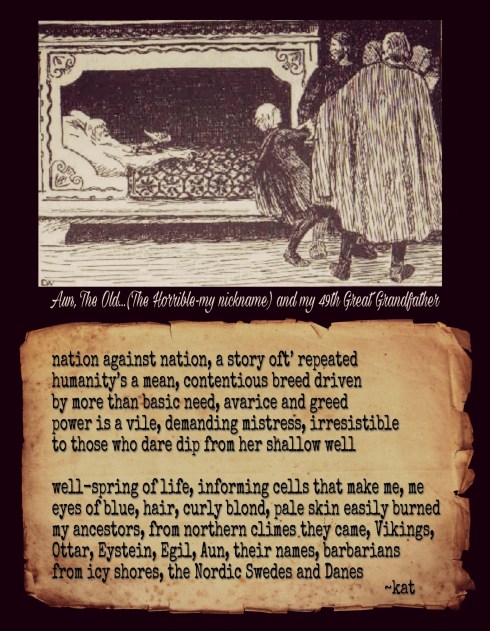
From Wikipedia, a story about Aun, of the Yngling Dynasty, King of Uppsala…and allegedly, if the tree leaves on Ancestry.com are correct, my 49th Great Grandfather. Aun was a horrible man, a terrible father who was sick with power….
Ruling from his seat in Uppsala, Aun was reputedly a wise king who made sacrifices to the gods. However, he was not of a warlike disposition and preferred to live in peace. He was attacked and defeated by the Danish prince Halfdan. Aun fled to the Geats in Västergötland, where he stayed for 25 years until Halfdan died in his bed in Uppsala.
Upon Halfdan’s death Aun returned to Uppsala. Aun was now 60 years old, and in an attempt to live longer he sacrificed his son to Odin, who had promised that this would mean he would live for another 60 years. After 25 years, Aun was attacked by Halfdan‘s cousin Ale the Strong. Aun lost several battles and had to flee a second time to Västergötland. Ale the Strong ruled in Uppsala for 25 years until he was killed by Starkad the old.
After Ale the Strong’s death, Aun once again returned to Uppsala and once again sacrificed a son to Odin; this time Odin told the king that he would remain living as long as he sacrificed a son every ten years and that he had to name one of the Swedish provinces after the number of sons he sacrificed.
When Aun had sacrificed a son for the seventh time, he was so old that he could not walk but had to be carried on a chair. When he had sacrificed a son for the eighth time, he could no longer get out of his bed. When he had sacrificed his ninth son, he was so old that he had to feed, like a little child, by suckling on a horn.
After ten years he wanted to sacrifice his tenth and last son and name the province of Uppsala The Ten Lands. However, the Swedes refused to allow him to make this sacrifice and so he died. He was buried in a mound at Uppsala and succeeded by his last son Egil. From that day, dying in bed of old age was called Aun’s sickness.
Today’s challenge is the perfect setting for a cleave poem. you know the rules: read the FIRST COLUMN FIRST, then the second, then ALL THE / way across.
an empty nester’s CHARADE
I AM FIERCE / i am terrified
AN INDEPENDENT WOMAN / of dying alone
I DON’T NEED ANYONE / that you will forget
I AM A SURVIVOR / i existed
LIFE’S CHALLENGES / most importantly
I’VE OVERCOME EACH ONE / i am afraid
I’M A WINNER / you don’t believe
I’M MAKING A MARK / you were the best part
LEAVING A LEGACY / the biggest thing i ever did
FOR FUTURE GENERATIONS / i have loved you fiercely
REMEMBER ME / more than life itself
~kat
ice and fire don’t mix anymore than church and state
as learned by my great grandpa, Captain Anthony
in Hingham, Mass, the church held heavy sway
his commission challenged, led to excommunication
‘twas a dark divided time in this young nation
~kat
For Jane Dougherty’s August Stanza Challenge.
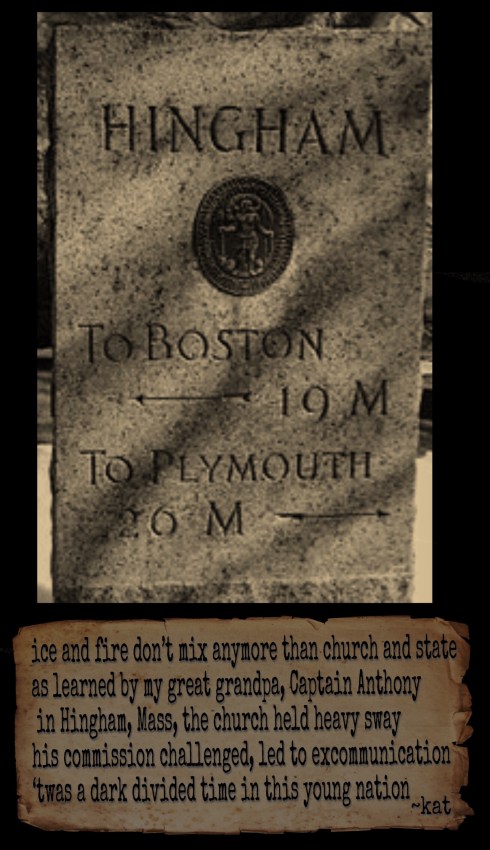
Below is a bit of history that included a snippet of my 12 Great Grandfather Captain Anthony Eames. He and his wife Marjory (Pierce) were among the first to settle in Hingham , Massachusetts. They had 9 children. Anthony was a sea captain, a Freeman at Hingham and Marshfield MA, a church warden at Fordington, MA, deputy to general court at Marshfield MA and Captain in the militia. Though the commission of Captain was much disputed by opposing groups in Hingham…
From Wikipedia:
The town of Hingham was dubbed “Bare Cove” by the first colonizing English in 1633, but two years later was incorporated as a town under the name “Hingham”. The land on which Hingham was settled was deeded to the English by the Wampanoag sachem Wompatuck in 1655.[8] The town was within Suffolk County from its founding in 1643 until 1803; and Plymouth County from 1803 to the present. The eastern part of the town split off to become Cohasset in 1770. The town was named for Hingham, a village in the English county of Norfolk, East Anglia, whence most of the first colonists came, including Abraham Lincoln‘s ancestor Samuel Lincoln (1622–90), his first American ancestor,[9] who came to Massachusetts in 1637. A statue of President Lincoln adorns the area adjacent to downtown Hingham Square.
Hingham was born of religious dissent. Many of the original founders were forced to flee their native village in Norfolk with both their vicars, Rev. Peter Hobart and Rev. Robert Peck, when they fell foul of the strict doctrines of Anglican England. Peck was known for what the eminent Norfolk historian Rev. Francis Blomefield called his “violent schismatical spirit”. Peck lowered the chancel railing of the church, in accord with Puritan sentiment that the Anglican church of the day was too removed from its parishioners. He also antagonized ecclesiastical authorities with other forbidden practices.
The bitter trainband controversy dragged on for several years, culminating in stiff fines. Eventually a weary Eames, who was in his mid-fifties when the controversy began and who had served Hingham as first militia captain, a selectman, and Deputy in the General Court, threw in the towel and moved to nearby Marshfield where he again served as Deputy and emerged as a leading citizen, despite his brush with the Hingham powers-that-be.





 like mercury colliding...