Category Archives: Life Lessons

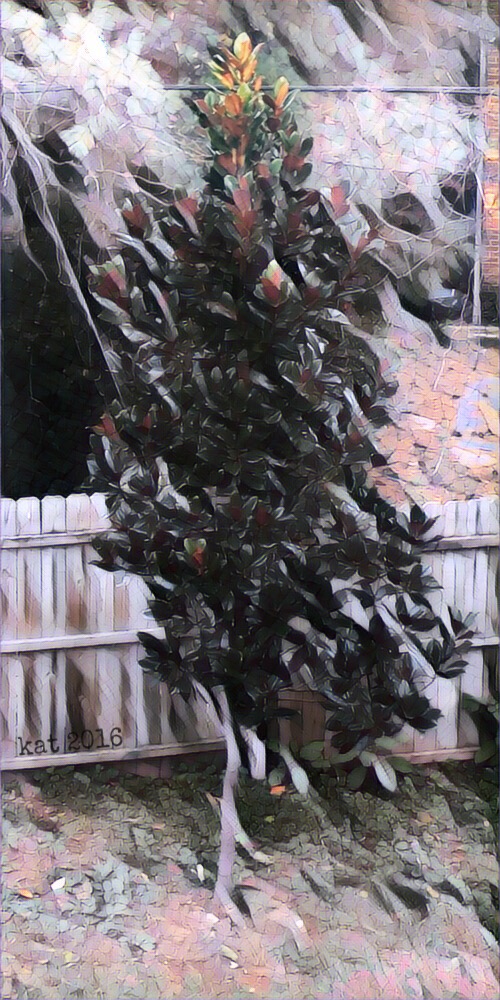
black moon rising – magnetized

black moon rising

season of the in-between
frosted blossoms withering
trees of verdant green
now softly browning
squirrels root for seed
to winter on
come dark moon, the nights
grow longer
gently rock this world
rest our souls
in deepest peace…

kat ~ 30 October 2016
(Magnetic Poetry Online Nature Kit)


Shi Sai Sunday’s Week in ReVerse – 30 October 2016

Happy Sunday. Again this week’s Shi Sai is the perfect snapshot of the week that was. More ugly came out of the shadows rearing its snarling oppressive self in the world politic, but an amazing thing happened. People once ensorcelled by the droning spin started to wake up, started to speak up and declare, “it’s not okay,” “words matter” and “decent people don’t talk like this, or act like this.”

Oh there are still some mesmerized by the extravagant display of privileged unfettered power. Some who believe that words don’t matter, who’ve forgotten what it means to be a united people where everyone matters.

But somehow, even though the latest raging rants cut a little deeper, the truth found a way, like healing balm, to expose the ugly for what it is. And that gives me hope.

Have a wonderful week, breathe deeply and press toward the light! ❤️

Shi Sai Sunday’s Week in ReVerse – 30 October 2016

how she presses toward the light
Finishing a poem.
always breathe
the sand shifts,
might look you straight in the eye,
it’s impossible
it can break a heart,
so he scanned each face in the crowd…
(She) closed her eyes, breathing deeply, losing herself in the musky aroma of damp earth that filled the air
‘midst the thorns she thrives ascending
like moths to a flame
they were ensorcelled
we choose our poison
dark coffee in a porcelain cup,
but only from dusk to dawn.
~kat

The Shi Sai, (formerly known as a ReVerse) is a new form I came up with during Poetry Month in April 2016. I’ve actually been writing shu sai for years but was inspired to give it a proper name. It is a poem created by taking one line of verse from several poems of an author’s own collection. The shi sai is done as a review of a series or collection of poems and therefore, each line should flow in chronological order of the dates the poems were written (from oldest to new). The lines chosen should be the author’s favorite from each poem. This form works best if the author resists the temptation to read the full new poem before all the verses have been added. (It helps one to resist the impulse to change a line to make it “fit”.


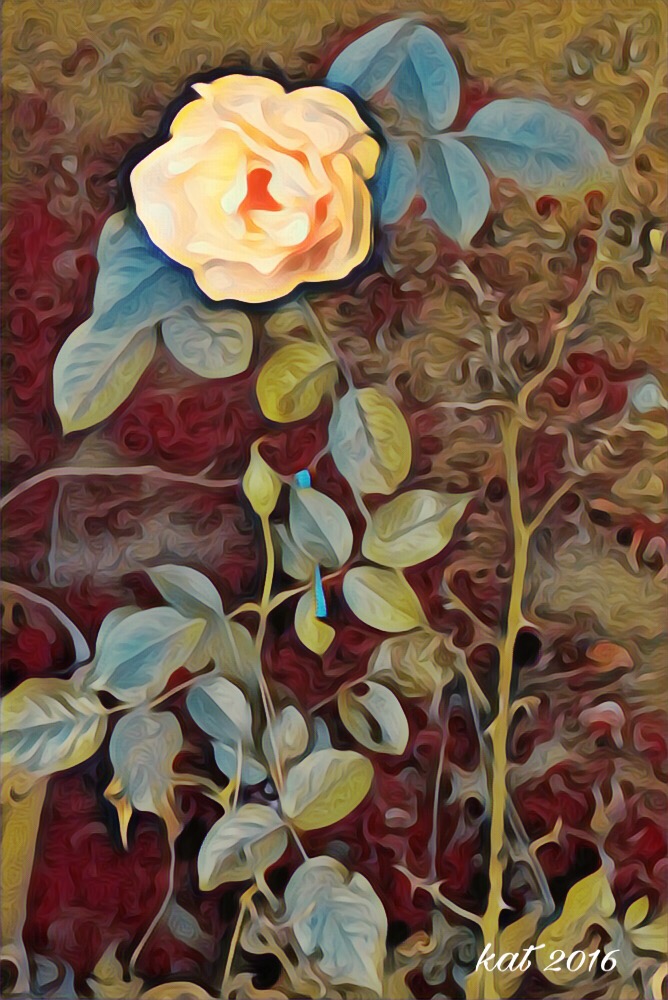
Yellow Rose of Autumn


she always blooms in autumn time
golden bursts of fading summer
she always blooms in autumn time

shorter days and frost become her
fragile petals clinging softly
golden bursts of fading summer

sparking memories held fondly
days of innocence and sweetness
fragile petals clinging softly

cycling seasons meant to teach us
letting go is not the ending
days of innocence and sweetness

‘midst the thorns she thrives ascending
though the winter looms in waiting
letting go is not the ending

rooted deep, her heart pulsating
though the winter looms in waiting
she always blooms in autumn time

kat ~ 17 October 2016
(A Terzanelle – Each line’s meter should be the same/Rhyme Pattern: ABA bCB cDC dED eFE fFAA)


Toward the Light  


how she presses toward the light
though her feet are rooted deep
how she presses toward the light
past the edge while others sleep
walls cannot contain her here
though her feet are rooted deep
tossed by tempests, numb with fear
resisting every urge to hide
walls cannot contain her here
now she sees the other side
breaks free from the shuttered throng
resisting every urge to hide
proving the naysayers wrong
darkness thwarted in the end
breaks free from the shuttered throng
even roots must stretch and bend
how she presses toward the light
darkness thwarted in the end
how she presses toward the light

kat ~ 23 October 2016
(A Terzanelle)


Twittering Tales #1 ~ 17 October 2016


I love flash fiction, six word stories, three line tales and 100 word stories. These minimalist formats have helped me learn the art of telling stories without a lot of unneeded fluff. As they say, “Just the facts ma’am.” 😊

These days Twitter is all the rage, literally. We pop off loud (all caps), mean, obnoxious, inflammatory rants. Fortunately, the Twitter “powers that be” had the wisdom to limit us to 140 characters. Thank you Twitter goddesses!

As one who loves a good challenge, I thought, what if we tried to tell a story in only 140 characters, prompted by a photo or painting? Wouldn’t that be fun?

So, here is my challenge: Each Tuesday I will provide a prompt, and your mission, if you choose to play along, is to tell a story based on that prompt in 140 characters or less.

If you accept the challenge, be sure to let me know in the comments with a link to your tale. A final note: if you need help tracking the number of characters in your story, there is a nifty online tool that will count for you atcharactercountonline.com.

I will do a round up each Tuesday, along with providing us  a new prompt.

To get this challenge started here is today’s prompt:
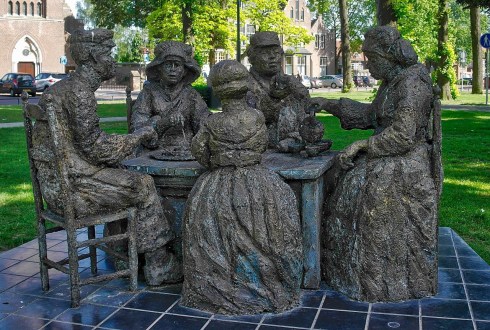

And here’s my twitter tale:

It was a grim sight. The first victims of the plague had turned to stone, ghosts who held too tightly to the past, now doomed to repeat it.

kat ~ 17 October 2016
(139 Characters)

The rest of the story…a bit of background on today’s prompt:

I found this intriguing photo, taken by Marczoutendijk, at wikimedia commons. The bronze sculpture, by Peter Nagelkerkein, was unveiled in Nuenen Park in the Netherlands, despite the vehement protests of residents who considered it ugly. Interestingly, the painting that inspired the sculpture, called “The Potato Eaters” by Vincent Van Gogh, also met with resistance  when it was unveiled. Seen as rough, dark and ugly, many believed it veered too far from the brighter impressionistic genre of the day.  Van Gogh would later write to his sister, saying that he considered this piece, his first official painting, to be his best work.

Obviously, my story has nothing to do with peasants or potatoes. But that is the beauty of art. It’s that “eye of the beholder” thing. So, what do you see? 🤓