When I think of a hobbyhorse I imagine a stick with a horse’s head or a rocking horse, ridden by children, which is, in fact the second definition for today’s word of the day on dictionary.com. The first definition, a pet idea or project is not something I ever associated with the word hobbyhorse.
A look at the word’s origin tells a different story. According to etymology online the word hobby actually means a “small, active horse,” from hobi short for hobyn (mid-14c.; late 13c. in Anglo-Latin), and was probably originally a proper name for a horse that is now extinct. Hobby as a shortening of hobbyhorse also was used in the “morris horse” sense (1760), or as Dictionary.com states “in the 16th century hobbyhorse meant several things, e.g., a figure of a horse made of wicker worn in morris dances, pantomimes, and burlesques; a child’s toy consisting of horse’s head on the end of a stick or a rocking horse; a horse on a merry-go-round or a carousel in the 1680’s. By the 17th century hobbyhorse developed the meaning “pet project, favorite pastime.” Hobbyhorse entered English in the 16th century.”
Is it just me or does the term hobbyhorse sound a bit redundant? Basically one is saying horse (hobby) horse. But I digress.
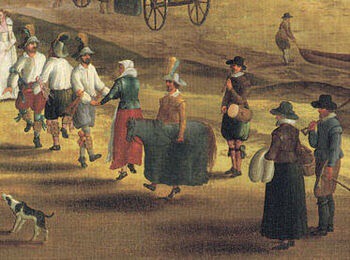
Painting of a hobby horse with Morris dancers beside the River Thames at Richmond, London, c.1620
Hobbyhorses were associated with May Day celebrations, Mummers plays and the aforementioned Morris dance in England in the 17th and 18th centuries. Wikipedia explains that there were several types of hobbyhorses:
*Tourney horses- meant to look like a person riding a small horse that is wearing a long cloth coat or caparison (as seen in medieval illustrations of jousting knights at a tourney or tournament)
* Sieve horses – a simpler version of the tourney horse. Known only in Lincolnshire, made from a farm sieve frame, with head and tail attached, suspended from the performer’s shoulders. The performer wears a horse blanket (the kind that includes a headpiece with holes for the eyes and ears) that covers them and the sieve.
* Mast horses – are meant to represent the horse (or other animal) itself. They had a head made of wood, or sometimes an actual horse’s skull was used; it usually has hinged jaws that can be made to snap. The head is attached to a stick about 1 m (3 ft) long. The person acting the creature is covered by a cloth attached to the back of its head; he (or, rarely, she) bends over forwards or crouches, holding the head in front of their own and resting the other end of the stick on the ground. A tail may be attached to the back of the cloth.
And this is only a sampling of the types of hobbyhorses used in Great Britain. In fact many countries and cultures have used a form of hobbyhorse in ceremonial dance, festivals, customs and theatre for centuries. You can read all about them at Wikipedia HERE.
So how did the word hobbyhorse become associated with an obsession? According to Wikipedia the term “hobby horse” came from the expression “to ride one’s hobby-horse”, meaning “to follow a favourite pastime”, and in turn, the modern sense of the term hobby. Makes perfect sense to me! 😉
Of course there is also the literary reference to the word penned by none other than the Bard himself, “Cal’st thou my love Hobbi-horse?” (Translation: A loose woman or strumpet) – William Shakespeare, Loves Labour’s Lost, in 1588. And there is the ‘velocipede’ (sounds like a very fast many-legged slug…the stuff of nightmares!)…also called a ‘pedestrian hobbyhorse’ or ‘dandy horse’. it was a two wheeled ‘bicycle’ that the rider propelled by pushing the ground with each foot alternately. This modern marvel, a forerunner to the modern pedaled version was all the rage in the early 19th century. It was featured in The Gentleman’s Magazine, February 1819.

So there you have it; a glimpse into today’s word of the day. And here’s a little Haiku to bring it all home…
this blogs a hobby
could say, it’s my hobbyhorse
my tack is a pen
~kat