4-
mourning dove coos
at dusk sooth me
my cue to breathe

5-
how green the earth
with new birth verve
what mirth, spring bliss

~kat
Than-bauk
This Burmese poetic form is pithy and often clever, comprising just three four-syllable lines. The last syllable of the first line rhymes with the third syllable of the second line, as well as the second syllable of the third line.
1-
you make me wait
always late, i’m
irate…you’re rude

2-
don’t say, “love you”
only true love
will do…show me

3-
it’s exhausting
me, watching you
sleeping…awake

~kat
Introducing the Than-bauk! I started to give this challenging little poetry form a go yesterday. I must warn you…it’s addictive! Before I knew it I had an entire stream of Than-bauk poems. Here are three to get this week started.
Than-bauk – This Burmese poetic form is pithy and often clever, comprising just three four-syllable lines. The last syllable of the first line rhymes with the third syllable of the second line, as well as the second syllable of the third line.
bloom flower moon I hardly noticed day fading into night bright
~kat
I have enjoyed spending a week with the Elfchen. Come Monday looking forward to a new, new poetry form to practice…the Than-bauk! With three four syllable lines in total, easy-peasy right?! Ah, but there is a bit of a twist! Stay tuned! 😊

The Elfchen, known as an “elevenie” in English, the German elfchen (which loosely translates to “little eleven” or “wee eleven”) contains 11 words separated into five lines: one word, then two, then three, then four, then one again. The first line of an elfchen is traditionally some single-word concept, thought, or thing, which the rest of the poem describes—what it does, how it looks, how it makes you feel, whatever strikes your fancy. The last line is often a synonym or some other overarching reflection of your first word.
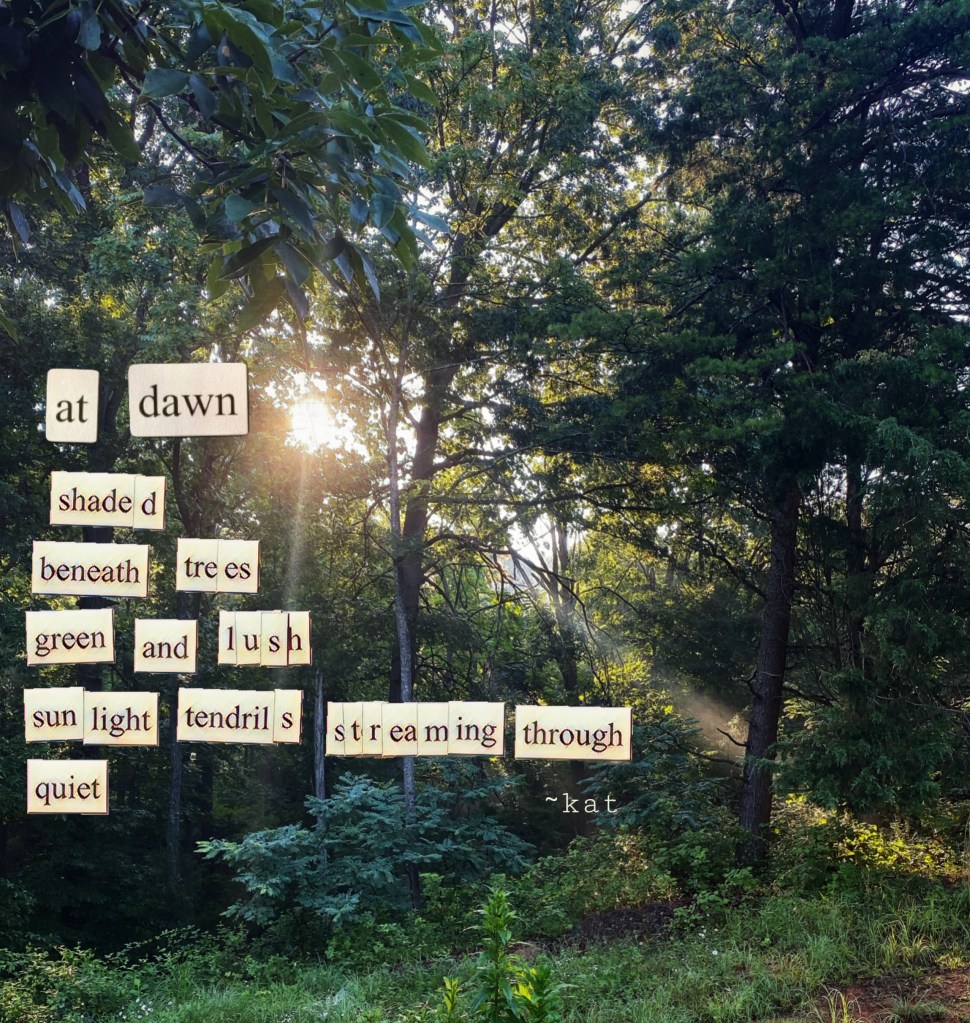
shaded beneath trees green and lush sunlight tendrils streaming through quiet
~kat
It’s a Saturday, so I decided to combine poetry forms: an Elfchen using Magnetic Poetry tiles from the Nature Collection because…hey, why not! 😊
An Elfchen is known as an “elevenie” in English, the German elfchen (which loosely translates to “little eleven” or “Elfchenwee eleven”) contains 11 words separated into five lines: one word, then two, then three, then four, then one again. The first line of an elfchen is traditionally some single-word concept, thought, or thing, which the rest of the poem describes—what it does, how it looks, how it makes you feel, whatever strikes your fancy. The last line is often a synonym or some other overarching reflection of your first word.
pleasantry, idle chitchat is rarely benign when whispered ostentatiously…it’s gossip
~kat
The Elfchen, known as an “elevenie” in English, the German elfchen (which loosely translates to “little eleven” or “wee eleven”) contains 11 words separated into five lines: one word, then two, then three, then four, then one again. The first line of an elfchen is traditionally some single-word concept, thought, or thing, which the rest of the poem describes—what it does, how it looks, how it makes you feel, whatever strikes your fancy. The last line is often a synonym or some other overarching reflection of your first word.
So it is easier for you to find all the parts/chapters of my ongoing fiction series, I created a new page that lists all the links. You can check it out HERE!
Unauthorized use and/or duplication of this material without express and written permission from this site’s author and/or owner is strictly prohibited. Excerpts and links may be used, provided that full and clear credit is given to Kat Myrman and Like Mercury Colliding with appropriate and specific direction to the original content.







 like mercury colliding...