Category Archives: Haiku

Phenology – Friday’s Word of the Day Haibun


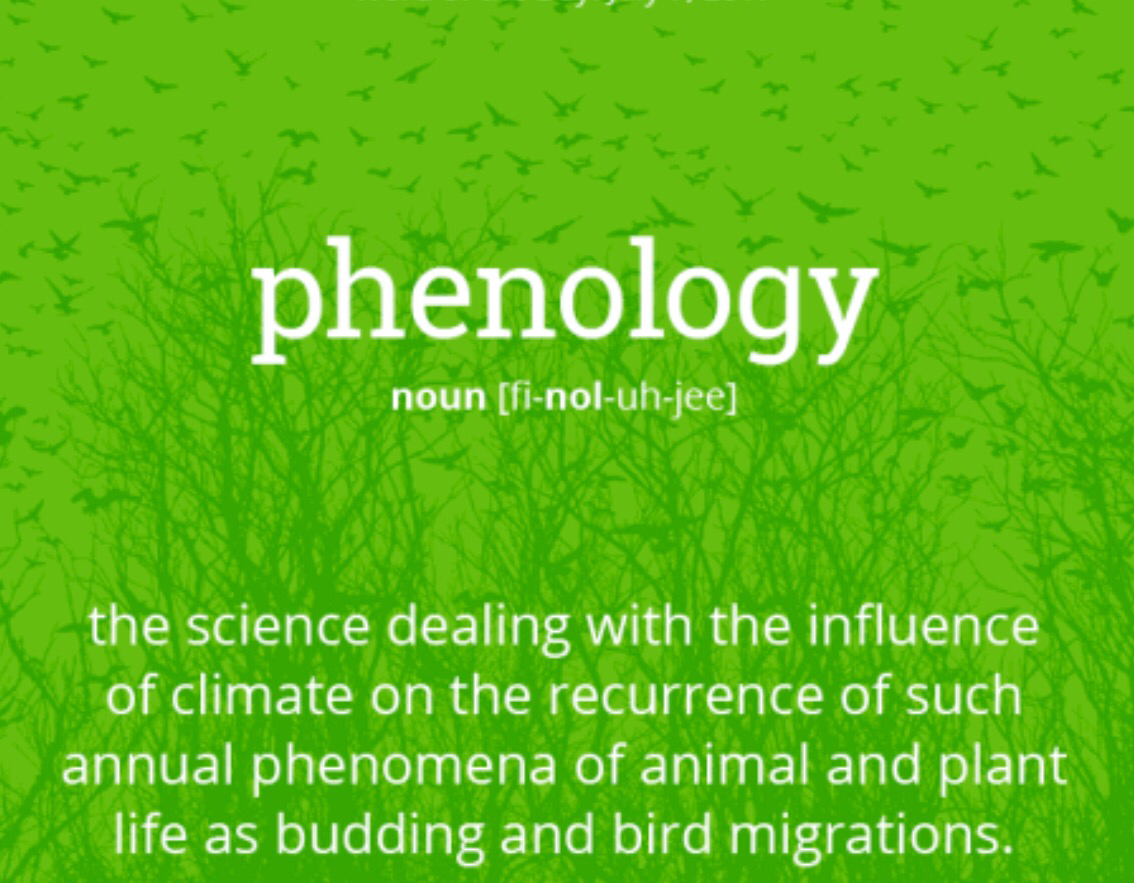
Happy Friday. Today’s dictionary.com Word is Phenology. According to dictionary.com, “Phenology entered English in the 1880s as acontracted variant of phenomenology, with restrictionto climatic phenomena.” It is defined as “the science dealing with the influence of climate onthe recurrence of such annual phenomena of animaland plant life as budding and bird migrations.”

After a further bit of research I learned that the study of phenology goes back thousands of years and is in fact one of the oldest sciences dealing with the natural world. According to the website, Windows to the Universe, “The Chinese are credited with the first written phenological records dating back to around 974 B.C. For the past 1200 years, observations of the timing of peak cherry blossoms in Japan have been recorded.”

I also learned that there are a number of proverbs and sayings that refer to phenology. Here are a few that I found:

“If oak’s before ash, you’re in for a splash. If ash before oak, you’re in for a soak”.

And another version along this line…

“If the oak is out before the ash, ‘Twill be a summer of wet and splash; If the ash is out before the oak,’Twill be a summer of fire and smoke.”

“In like a lion, out like a lamb”

“Christmas in clover, Easter in snow”…

“Spring is sooner recognized by plants than by men.”

Windows to the Universe explains: “Phenological observations have been used for centuries to maximize crop production, prepare for seasonal allergies, and anticipate optimal wildflower viewing conditions. Today, this well established science is used to track the effect of global warming and climate change on organisms and to make predictions about the future health of the environment.”

Did you know that scientists have tracked and discovered that the beginning of spring starts a week earlier in Europe in recent years? I didn’t. It’s called “season creep” and it is the sort of things that Phonologists study. 

Phenology is obviously an important science…for those of us who believe in science. 😉 Some cool new scientific terms I learned in my research include “green up” and “brown down”, having to do with infrared wavelengths from the sun. Can you guess which phenophase is being described by those words? Tick tock tick… Spring and Fall of course. Clever! Tracking green ups helps to identify species of plants that contribute most to the “infrared reflectance values”; a process is called “ground-truthing”. Another cool term!

There is so much more to learn about phenology. Do rev your google engines and learn more if you are a nature lover…or just curious. Or peruse an Old Farmer’s Almanac for that matter. I, on the other hand have a Haiku to write! Have a great weekend!

What force spurs seasons
to greening flush and browning?
Phenologists know!

~kat


Dreamer’s 


‘midst these gilded halls
lovers danced to strings and lutes
their dreams frail as dust

those who dream dance on
promenades of hopeful bliss
though the music ends

~kat

For TJ’s Household Haiku Challenge inspired by the photo by our host above and the prompt words: Dream & Dance.


Parched 

Photo by PaulBR75 at Pixabay


surging brackish brine
levee wastes away like dust
parched, we are drowning

~kat

For Ronovan Writes Haiku Challenge, prompt words: Ocean (brackish) & Shore (levee).


Magnetic Poetry Monday – A Haiku

wild climbing vine
deep root tendriled covering
nature’s song in green

~kat

Magnetic Poetry Nature Kit with a photo montage of a Virginia Creeper vine that is overtaking my front porch!


Divagate – Friday’s Word of the Day Haiku


It’s Friday and time to learn a new word and use it in a Haiku. Though I must admit that the 5/7/5 verses that I come up with are not “true” haiku. By definition, a Haiku is “a Japanese poem of seventeen syllables, in three lines of five, seven, and five, traditionally evoking images of the natural world.”

There have been a few words of the day that had something to do with nature. Although I do strive to maintain the form and the “in the moment” impression and “ah-ha” revelation aspect in each Haiku I write. And I might add that I am not Japanese. At least that’s what my DNA tells me….

This piece, though, and my other Friday forays might better be defined as a “Haibun”. Defined as “haikai writings, a prosimetric literary form originating in Japan, combining prose and haiku. The range of haibun is broad and frequently includes autobiography, diary, essay, prose poem, short story and travel journal.” (from Wikipedia)

Ah, but, I divagate, pronounced dahy-vuh-geyt not ‘dee-vuh-geyt’ as you might be tempted to say it, today’s word of the day at Dictionary.com. Although the word “diva” is hard to miss in the first part of this word, its etymology will clarify everything for you. First used late 16th century: from Latin divagat- ‘wandered around,’ from the verb divagari, from di- ‘widely’ + vagari ‘wander.’ (from google under ‘divagate etymology’)

So you see, divagate is not ‘diva+gate’ (sounds like a beauty pageant fiasco, doesn’t it?! 😉), but rather it is ‘di-vagate’ which accounts for its unique pronunciation.

And finally, what does all this mean? I’m glad you asked! According to dictionary.com Divagate means “to wander; stray, or to digress in speech.”

Does the fact that someone is prone to divagate make them a diva? Perhaps. If only to illustrate that said divagator likes to hear themselves talk while demanding that everyone around them listen with rapt attention to their gibberish!

But alas, there I go divagating again. I have been accused of this before, not because I am a diva mind you. Blame it on a short attention span and my tendency to become easily distracted. 😜

And if you have read this far, the very least I can do is reward you with a Haiku or two, the part two of this haibun, which I learned is also Japanese…which I am not…😊

Have a great weekend…and for my US friends, enjoy your Independence…4th of July Celebration Day…emphasis on “independence” while it lasts!!! 😳

one hundred forty
divagating tweeted blips,
known also, as spin

follow if you can
divagators who drivel
look! a butterfly!

~kat