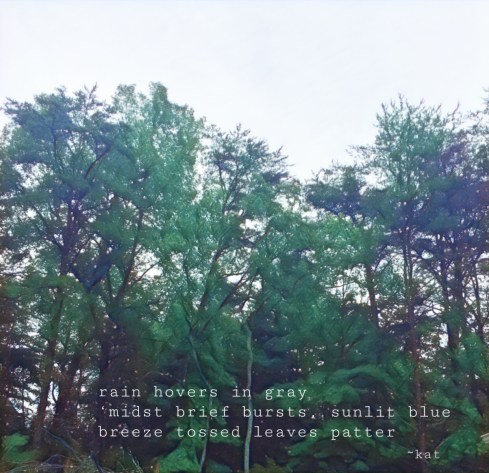
rain hovers in gray
‘midst brief bursts, sunlit blue
breeze tossed leaves patter
~kat
rain hovers in gray
‘midst brief bursts, sunlit blue
breeze tossed leaves patter
~kat
How could I have known last autumn that today I would find myself cocooned in a sea of green having shed mountains of dusty dross along the journey. We hadn’t planned to move, to buy a little house on a hill in the foothills. To sell the city house that had grown too large. And yet it all happened as if preordained. We were well moved in and sold the old house days before the pandemic shut the world down. The timing of it all, breathtaking in precision, though I was not fully sure any of it would happen at the time.
For months now I have sheltered in place in this healing oasis far from the hustling bustle, visited occasionally by deer and squirrels, and roused each morning by the sun peering through the trees and bird song. Who knew I needed to be here in this place in this time? I was certainly clueless at the onset of this upheaval in my life. We hadn’t planned this; most certainly, we did not, and yet…
I am amazed each day by how right it feels, how perfect, how healing. How I love the silence. How my soul swells with each breath. I am learning to how let go and be. It’s a scary thing to consider at first, but little by little this latest of life’s adventures is teaching me to trust that no amount of planning can prepare me for this. Being is powerful and awesome and dare I say, peaceful, like the calm in the eye of a storm. We speak of the calm before a storm, but I am learning that there is also a deep calm that settles to one’s bones after a storm has passed. The questions that haunt me, why, where, when, or how melt away. That there are new lessons to be learned, my teachers singing from the starry canopy at night, from the shaded hollows amist the trees, from the earth rumbling gently beneath my feet. And I am grateful, oh so grateful be here and now.
Peaceful Sunday to you. Stay safe, be well, and always, all ways be kind not only to others but to yourself!
Sunday’s Week in ReVerse – 14 June 2020
I look in the mirror, on the edge
whistling empty in reverence
the breeze…a breath of peace
leaves dance on the breeze
the earth grows wild and free
~kat
A ReVerse poem (a practice I started many years ago) is a summary poem with a single line lifted from each entry of a collection of work over a particular timeframe and re-penned in chronological order as a new poem. Unlike a collaborative poem, the ReVerse features the words of one writer, providing a glimpse into their thoughts over time. I use it as a review of the previous week.
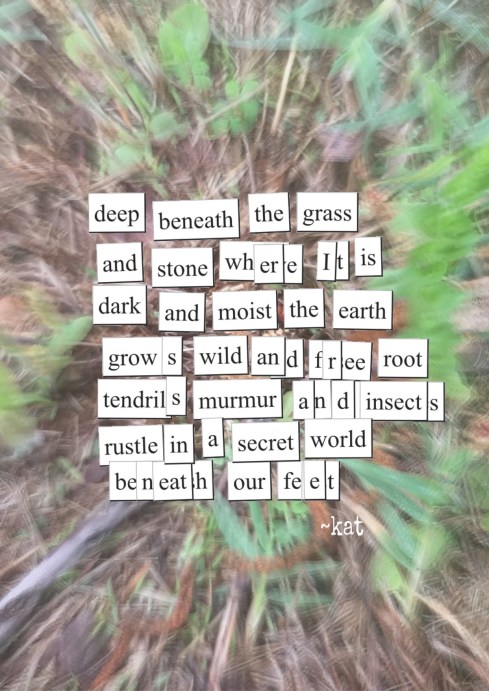
deep beneath the grass
and stone where it is
dark and moist, the earth
grows wild and free…root
tendrils murmur and insects
rustle in a secret world
beneath our feet
~kat
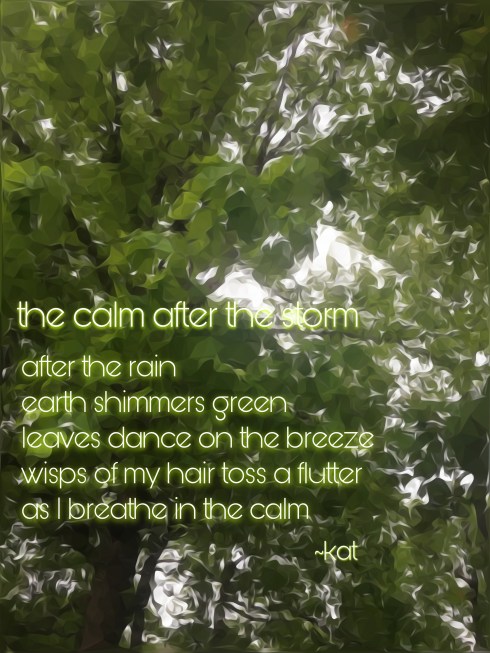
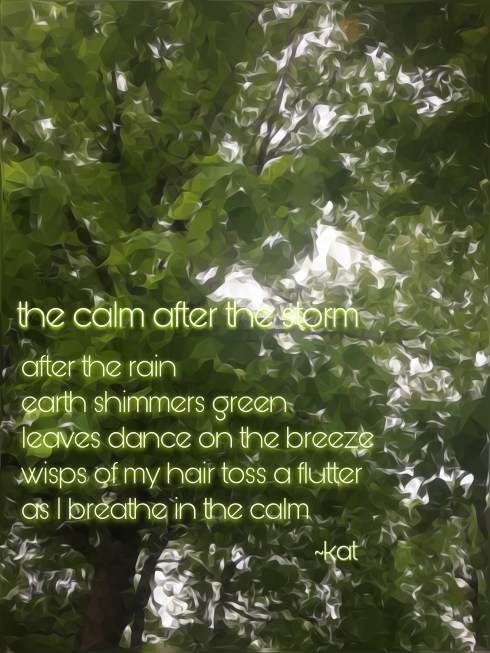
the calm after the storm
after the rain
earth shimmers green
leaves dance on the breeze
wisps of my hair toss a flutter
as I breathe in the calm
~kat
A Gogyohka for today. What a lovely day it is! Peace to you! ❤️
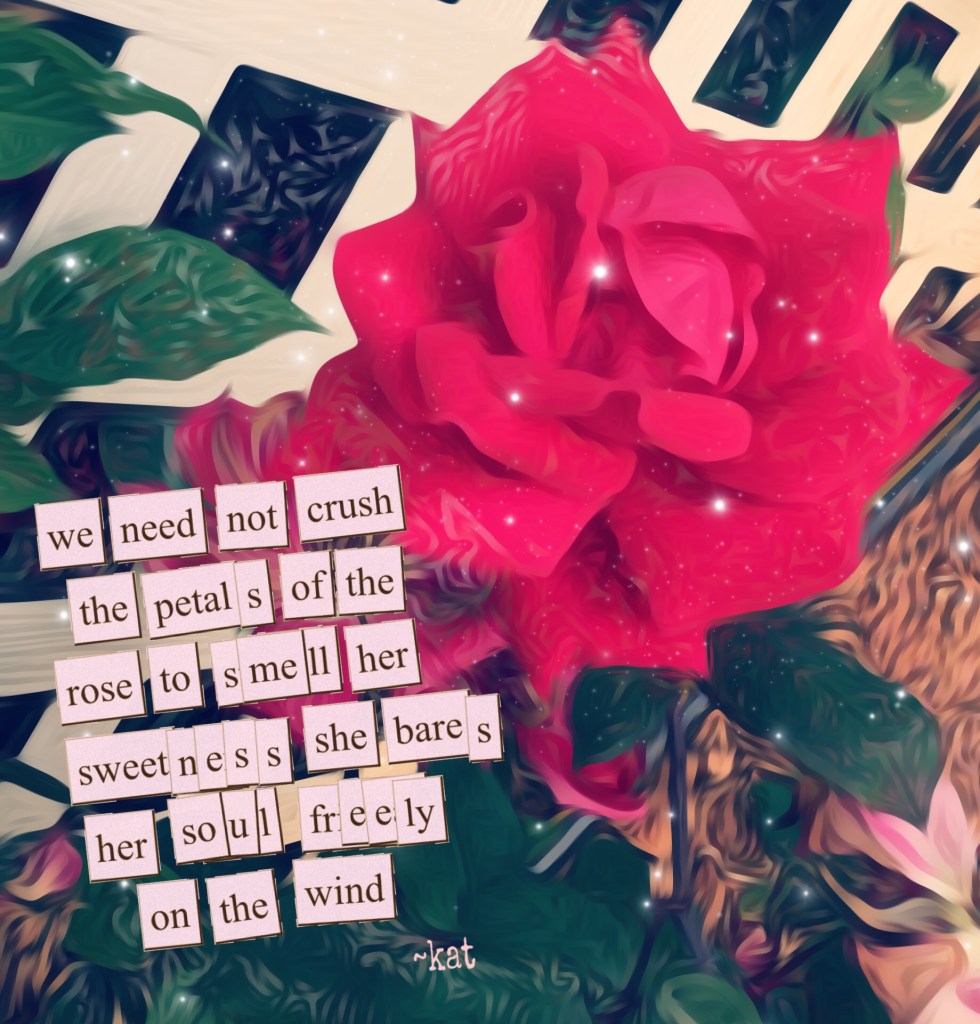
we need not crush
the petals of the
rose to smell her
sweetness...she bares
her soul freely
on the wind
~kat
Magnetic Poetry – Original Kit