Tag Archives: poetry form

April Poetry Month – A Poem a Day #28

Today I am exploring the Reverse Poem. A Reverse Poem is a freeform verse. The masters of this form write lines and lines…I feel lucky to have pulled out 14! Here’s the definition: Reverse poetry is a poem that can be read forwards one way and have a meaning, but also be read backwards and have another different meaning. A type of ‘reverse‘ writing is called a palindrome. Palindrome comes from the Greek words “palin” (again or back) and “dramein” (to run).

As you can imagine it’s a bit tricky. I have seen other variations of this type of poem, the Palindrome (which is a mirror image poem with a break in between) and a form that some of you have tried this week from a NaPoWriMo Poetry challenge that prompted you to write a poem backwards (which also should be read from the bottom up). The Reverse Poem should be read top to bottom and then bottom to top and should have two different meanings. At any rate, here’s my try…I know this is another form that will take a bit of practice to master.

Roses1

Falling In and Out and In Love

I think
I love you
like the very first time
I heard your voice
my heart fluttered and
I caught you watching me
as you looked away, blushing
something changed
I’m not sure when it was, but
you don’t look at me
you hardly speak anymore and
I should tell you
I don’t think
I love you

kat ~28 April 2016


April Poetry Month – A Poem a Day #27

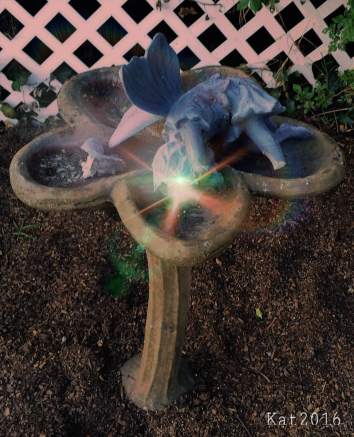
So…true story…my poor birdbath faerie ornament took a tumble and busted her head open. (it didn’t help that the bird bath bowl fell on her…likely the doings of one of the neighborhood cats!) At any rate, like Humpty Dumpty, it is not likely that I will be able to patch her together, but then I thought, maybe, just maybe, there was a “REAL” faerie trapped inside just aching to get out…People who love faeries like I do will get this. You others…yep…it’s a tad loony. But it made me feel better about losing my favorite yard ornament.

Of course I have another poem to write today for Poetry month and I thought, “what a perfect topic for a limerick!” Truth be told, I don’t care much for limericks. We do them in challenges here on WordPress, but the topics are not always whimsical which makes for a very unlimericky limerick. Limericks should be fun or at least slightly far-fetched or unusual.

Here is a description of a proper limerick:
A Limerick consists of five lines. The first line usually begins with ‘There once was a….’ and ends with a name, person or place. The last line of a limerick is normally a little farfetched or unusual. It has a rhyme scheme of aabba. Lines 1,2 and 5 should rhyme and have the same syllable count and lines 3 and 4 should be shorter in length having a different rhyme.


faerie

Escape from Polymeria

There once was a faerie held captive in clay,
her perpetual frolic – a cute garden display
then one day she fell down
cracked a hole in her crown
on the wind now, she’s happily free to this day!

kat ~ 27 May 2016


April Poetry Month – A Poem a Day #26

Happy Day 26 of my challenge to myself to explore a new poetry form each day for Poetry Month. I can’t believe we are nearing the end of this journey. I would be remiss if I did not feature the Haiku.

We have a lot of fun here on WordPress with the Haiku, assigning interesting topic prompts in our challenges to each other. But the Traditional Japanese Haiku is a three-line poem with seventeen syllables writing in a 5/7/5 count written in the present tense with a focus on images from nature. It should emphasize simplicity, intensity, directness of expression and a sudden sense of enlightenment and illumination.

The haiku’s origins can be traced back to thirteenth century Japan and was used as the opening phrase of 100 stanza oral poems called “renga”. It became its own form in the sixteenth century, perfected by the Haiku Master, Matsuo Basho.

Iris

a goddess rises
graced in amaranthine blush
Iris is her name

kat ~ 26 April 2016


April Poetry Month – A Poem a Day #25

I been in love with, and have used alliterations long before I knew there was a word for it. Alliterations are the occurrence of the same letter or sound at the beginning of adjacent or closely connected words.

Some examples of alliterations are: “towering trees”, “bouncing baby”, “fleeting fantasies”…you get the idea. In another example the alliterations are interrupted by non-alliterative words but the effect is the same. From Shakespeare: “From forth the fatal loins of these two foes; A pair of star-cross’d lovers take their life.”

There is something about the repetition of consonants and sounds in a line of poetry or prose that is fun to say and pleasing to hear. Alliterations give verse a lyrical quality. Today I found a fun poetry form called the Alliterisen. It was developed by Udit Bhatia and is a simple seven-lined poem with a specific syllable pattern and two alliterations per line.

The syllable structure for the Complex Alliterisen is as follows allowing for infinite syllable sequences:

1st line- x syllables
2nd line- x+2 syllables
3rd line- x-1 syllables
4th line- (x+2)-1 syllables
5th line- x-2 syllables
6th line- (x+2)-2 syllables
7th line- x syllables

Note: this is Udit Bhatia’s description. I had to smile when I saw the algebraic quality of his structural guides. For example (x+2) – 1, if the x in question were 9 could easily be written, x+1 for the same result…10.  I mention this because I am extremely right-brained and the thought of algebra makes my head hurt! Don’t let the seemingly complicated rules keep you from trying this poetry form.  Here is a kinder, gentler version of the syllable structure:

1st line: x syllables
2nd line: x+2 syllables
3rd line: x-1 syllables
4th line: x+1 syllables
5th line: x-2 syllables
6th line: x syllables
7th line: x syllables

IMG_4619

Dazzling Delusion

I am quite a quixotic, driveling dolt (10)
supposing somehow I possess the wit to write! (12)
Just how hard can four short verses be? (9)
My busy brain’s cacophony concocts a (11)
steady stream of  lovely, lilting, (8)
Rhyming, rhythmic, dazzling delusions, (10)
waxing poetic perfection in words. (10)

kat ~ 25 April 2016


April Poetry Month – A Poem a Day #23

Happy Saturday! I hope you had a wonderful day. Today I am going to try a short like three line poem called the Than-Bauk. It often expresses a witty saying or epigram (Epigrams are also associated with humor or a memorable statement. Early epigrams were used by the Greek in memory of a deceased loved one.)

The Than-Bauk is a three line “climbing rhyme” poem of Burmese origin. Each line has four syllables . The rhyme is on the fourth syllable of the first line, the third syllable of the second line, and the second syllable of the third line.

In Memory of the Sun

At dusk the sun’s
waning runs red
soon comes the night.

kat ~ 23 April 2016