Tag Archives: Poem a Day

April Poetry Month ~ A Poem a Day #17

The Tetractys, is today’s poetry form. It’s an invented form by Ray Stebbing, consisting of at least 5 lines of 1, 2, 3, 4, 10 syllables (total of 20). Tetractys can be written with more than one verse, but must follow suit with an inverted syllable count. Tetractys can also bereversed and written 10, 4, 3, 2, 1. 

Double Tetractys: 1, 2, 3, 4, 10, 10, 4, 3, 2, 1

Triple Tetractys: 1, 2, 3, 4, 10, 10, 4, 3, 2, 1, 1, 2, 3, 4, 10

and so on.

Ray Stebbing had this to say about his inspiration for the Tetractys: “Euclid, the mathematician of classical times, considered the number series 1, 2, 3, 4 to have mystical significance because its sum is 10, so he dignified it with a name of its own – Tetractys. The tetractys could be Britain’s answer to the haiku. Its challenge is to express a complete thought, profound or comic, witty or wise, within the narrow compass of twenty syllables.”

It’s a simple form with no rhyme constraints; just follow the syllable rules. It’s the perfect poetry form for a restful Sunday morning. I came up with a  few.

If there were spiritual advice columns…

“Soul
Seeking
Nirvana”
Find lasting peace
By refusing to entertain Ego.

yielding 

Trees
Extend
To heaven
And burrow deep
Extremes of longing, that bend on a breeze.

Digital Wet Blanket

You
And me
This moment
Eternity….
Love is in bloom; we must take a selfie!

kat ~ 17 April 2016


April Poetry Month – A Poem a Day # 15

It’s Friday!   A special treat each week is going out to a great little Asian restaurant that features Thai, Japanese and Chinese cuisine. It’s become my favorite place. And so for this day’s poetry form I am sharing the Epulaeryu with you. It’s an obscure little form developed by one Joseph Spence, Sr. inspired by the memorable foods he experienced on his Mediterranean and Far East travels. There is literally a poem and poetry form for everything it seems!

Here’s are the details of a proper Epulaeryu:
-First and foremost it is all about delicious food!
-7 lines with 33 syllable
-The syllable scheme is: 7/5/7/5/5/3/1
-It may or may not rhyme
-Each line contains one thought describing the featured course with the last 1 syllable word expressing the writer’s feelings about the dish. To add drama, an exclamation point is always called for at the end.

I dedicate this one to all my foodie friends! 🙂

my-drunken-noodles-ivillage_380

This photo is from Pinterest

Drunken Noodling

Pepper infused, savory
veggies lightly tossed
drunken noodles sweating steam
aromatic pot
culinary treat
slippery
hot!

kat ~ 15 April 2016


April Poetry Month – A Poem a Day #14

Today I’m giving the Luc Bat a go. This poetry form is Vietnamese in origin and means “six-eight.” In fact, the poem consists of alternating lines of six and eight syllables. This poem is interesting in its rhyme scheme that renews at the end of every eight-syllable line and rhymes on the sixth syllable of both lines.

Here’s a diagram of how the first few lines of luc bat poems should rhyme:
xxxxxA
xxxxxAxB
xxxxxB
xxxxxBxC
xxxxxC
xxxxxCxD
xxxxxD
xxxxxDxE

I managed a few luc bats. The rhyme sequence is a bit tricky B but once I got the hang of it I wanted to keep going! Hope you will give this one a try! 😊

creeper 1

Sleep Interrupted

Here at the cusp of dawn
as dark of night moves on, I sigh
half asleep, buying time
Hit the snooze, close my eyes, distressed,
Toss and turn, try to rest
And then the sun, that pest, peeks through
The day awaits anew
There’s nothing left to do but rise.

No Regrets

It’s too late to regret
a deed once done and yet we try
“A do-over!” we cry,
as if we could deny our part
It cuts us to the heart
Releasing is an art, you know
the only way to grow
choose to learn, let it go, move on.

kat ~ 14 April 2016


April Poetry Month – A Poem a Day #13

Happy Poetry Month this 13th day of April! Today’s poetry form, the Sijo originates from Korea and like its cousins, the haiku and tantra, is comprised of three lines. Each line should have 14-16 syllables, pausing in the middle, the first half containing 6 to 9 syllables with the balance in the second. A Sijo may be narrative or thematic. It develops in three parts: introduction of a situation or problem; development or “turn” in line two; and resolution in the third, often employing a twist or surprise in the first half of the line. Sijo is strongly based in nature and may take on religious or metaphysical themes as well. Unlike haiku, sijo relies heavily on the use of metaphors, symbols, puns, allusions and other word play. Some modern print restrictions may show a sijo in six lines.

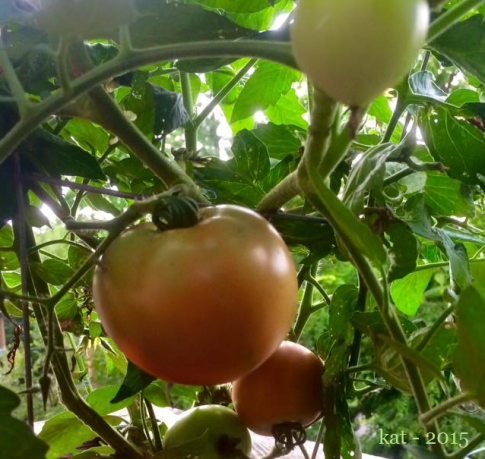
I take my inspiration today from an amazing “volunteer” tomato plant. I found it last summer, thriving in the middle of my compost heap. I am not a gardener. I barely knew what to do with it once I found it. But despite my inadequacy, Nature saw fit to provide me with a dozen or so plump tomatoes.

Nature has a way of surprising us with her wild chaotic unruliness. She has been sustaining life for eons, long before the first human thought to contain her in tidy rows with hoe in hand. It’s comforting to those of us who tend to go with the flow to know that Nature has our back…and a few tomatoes to spare.

tomatoes

This is an actual photo of my wild tomatoes from Summer 2015!

Nature’s Garden

Gardeners, who fancy their thumbs green, primp and prune and toil
Sowing seeds, midst fussy plots of weeds, their empty plates to fill.
My garden thrives in a compost heap, vines bursting tomatoes!

kat ~ 13 April 2016


April Poetry Month – A Poem a Day #12

It is day 12 of Poetry month. Today’s poetry form is all about the number 12. Developed in 12th century Japan, it is a variation of the Haiku.  But instead of three lines in 5-7-5 syllable sequence, it contains four lines of 12 syllables each, pausing mid-line after 7. Called the Imayo, this lyrical form is often employed in Kabuki Japanese theatre, and is associated with the type of song that requires recitation in a high pitch.

Here is the breakdown of an Imayo poem: 4 lines; each line 12 syllables broken by a pause after the 7th syllable.


Parched

Rain settles on parched soil, pooling in puddles,
never to quench thirsty roots, darkness imprisoned.
Truth settles on shuttered minds, spinning in sound bites,
never to be enlightened, prisoners of fear.

kat ~ 12 April 2016