Tag Archives: Poem a Day

April Poetry Month – A Poem a Day #27

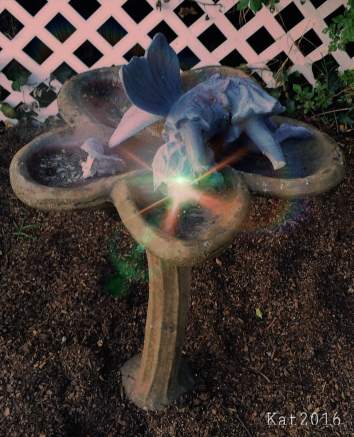
So…true story…my poor birdbath faerie ornament took a tumble and busted her head open. (it didn’t help that the bird bath bowl fell on her…likely the doings of one of the neighborhood cats!) At any rate, like Humpty Dumpty, it is not likely that I will be able to patch her together, but then I thought, maybe, just maybe, there was a “REAL” faerie trapped inside just aching to get out…People who love faeries like I do will get this. You others…yep…it’s a tad loony. But it made me feel better about losing my favorite yard ornament.

Of course I have another poem to write today for Poetry month and I thought, “what a perfect topic for a limerick!” Truth be told, I don’t care much for limericks. We do them in challenges here on WordPress, but the topics are not always whimsical which makes for a very unlimericky limerick. Limericks should be fun or at least slightly far-fetched or unusual.

Here is a description of a proper limerick:
A Limerick consists of five lines. The first line usually begins with ‘There once was a….’ and ends with a name, person or place. The last line of a limerick is normally a little farfetched or unusual. It has a rhyme scheme of aabba. Lines 1,2 and 5 should rhyme and have the same syllable count and lines 3 and 4 should be shorter in length having a different rhyme.


faerie

Escape from Polymeria

There once was a faerie held captive in clay,
her perpetual frolic – a cute garden display
then one day she fell down
cracked a hole in her crown
on the wind now, she’s happily free to this day!

kat ~ 27 May 2016


April Poetry Month – A Poem a Day #24

Today’s I am trying my hand at the Bref Double, a French poetic form consisting of 3 quatrains and a final couplet, making 14 lines.

There are multiple variations when it come to rhyme schemes, though in all versions the scheme consists of three rhymes and 4-5 un-rhymed lines, providing the bref double’s primary distinction from sonnets. The c rhyme ends each quatrain. The a and b rhymes are found twice each somewhere within the three quatrains and once in the couplet.

Some rhyme scheme choices are:
axbc xaxc axab ab
axbc xaxc bxxc ab
axxc bxxc abxc ab
abxc abxc xxxc ab
xaxc xbxc xbac ba
xabc xaxc xbxc ab

…and I’m sure there are others. 😊

There is no requirement of meter in a bref double, but all lines must be consistent in length.

I chose this form to write my poem: xabc xaxc xbxc ab


For Those Who Blog…

There are faces I shall never meet
who write their hearts on cyber pages
just a cursor point and click away
Spanning cultures, miles, zones and time.

I may never know their real names.
Some prefer their anonymity.
It’s their words that draw me to this place.
Simple pseudo-handles work just fine.

We chat, we text message and we tweet
in this place where all the world’s a stage.
Stories weaved of joy and tales of woe…
souls revealed line by beautiful line.

Inspiration here for those who seek.
If you have a voice this is your place!

kat ~ 24 April 2016


April Poetry Month – A Poem a Day #22

IMG_5307

It’s Friday and raining, but a lovely day. I had a course of study that I needed to complete. Done and done. So on to today’s poetry form the Etheree. This poetry form consists of 10 lines of 1-2-3-4-5-6-7-8-9-10 syllables. It can also be reversed, 10-9-8-7-6-5-4-3-2-1 or written as a double, 1-2-3-4-5-6-7-8-9-10-10-9-8-7-6-5-4-3-2-1 or a triple, etc. on to infinity. And that’s all there is to it! 🙂

Here’s my take on the Etheree and the rain…J

Rain,
cleansing,
refreshing,
life sustaining,
pitter pattering
heavy droplets descend
forming tiny dust craters,
infusing the parched earth below
the surface of barren fields with seed
soon to burst into verdant waves of green.

kat ~ 22 April 2016


April Poetry Month – A Poem a Day #19

Today I am looking at two forms, the Katouta and the Sedoka. The Katouta is a three-line unrhymed poem with a syllable count of 5/7/7 that is most often used to declare love for another. When you double a Katouta into a two stanza poem, it becomes a Sedoka. A Sedoka can be used to create a dialog or you can use each stanza to explore a topic from a different point of view.

glass

Photo from Pinterest

The Glass

A pessimist sees
a hypothetical glass,
moaning, it is half empty…

An optimist sees
promise in a glass half full
a reason to celebrate!

~kat – 19 April 2016


April Poetry Month – A Poem a Day # 18

Today’s form come to us from Andrea Dietrich, who created the HexSonetta, a variation of the sonnet that blends elements of Italian and English traditional sonnet forms. Rather than the familiar iambic pentameter, ten syllable/five foot form, the HexSonetta is a trimeter employing an iambic rhythm using only six syllables/three feet. The “hex” stands for the syllable count of each line…six. Like a sonnet it has 14 lines divided into two stanzas. Additionally, there is a final couplet at the end, intended as a summary. Or you may even use the couplet for a “twist” from the theme.

Here are the rules of a HexSonetta:

Meter: Trimeter
Rhyme Scheme: a/b/b/a/a/b  c/d/d/c/c/d  e/e

Here is my take on the HexSonetta:

muse

Muse

She hovers in the mist
at dawn, to whisper her
sweet nothings in my ear
oh, I cannot resist
our secret morning trysts
her voice is bliss to hear.

And in our reverie
she fills my hollow head
with lovely words she’s read
on waves of tranquil seas,
the leaves of ancient trees
and tears of sorrow shed.

No poet can refuse
to entertain a Muse!

~ kat ~ 18 April 2016