Tag Archives: Poem a Day

Autumn – Stanza 30

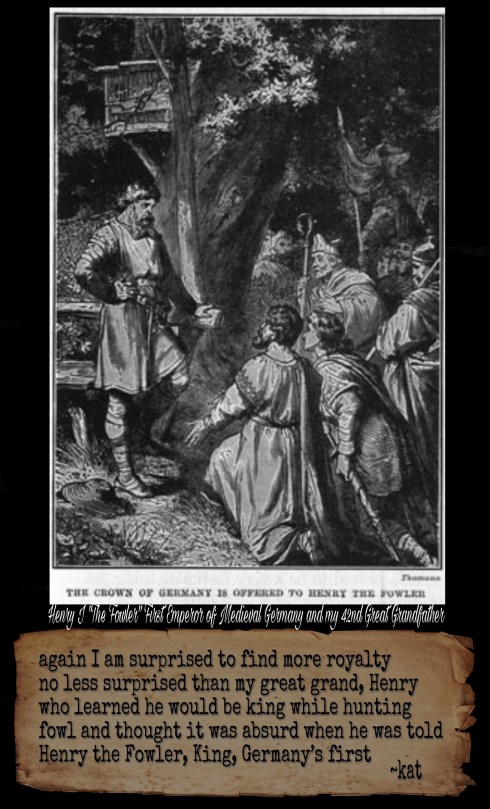
again I am surprised to find more royalty
no less surprised than my great grand, Henry
who learned he would be king while hunting
fowl and thought it was absurd when he was told
Henry the Fowler, King, Germany’s first

~kat

For Jane Dougherty’s August Stanza Challenge. Read more about Henry “The Fowler” HERE.


August – Stanzas 28-29

Another two-fer for yesterday’s and today’s entries for Jane Dougherty’s August Stanza Challenge. As some of you know I’m visiting my two youngest grandchildren this week. To add a little excitement to my visit, as if a newborn and a two year old aren’t enough excitement, I had a nasty encounter with the screen door. It took a chunk out of my ankle. And so a dozen or so stitches later I am propped up with my foot elevated, a newborn napping on my chest while a rambunctious two year old is off to the mall for some special mommy-daddy time away from her new little sissy. Welcome to my life…believe me, I’m not complaining. I am soaking up this grandma time! 😊❤️😊.

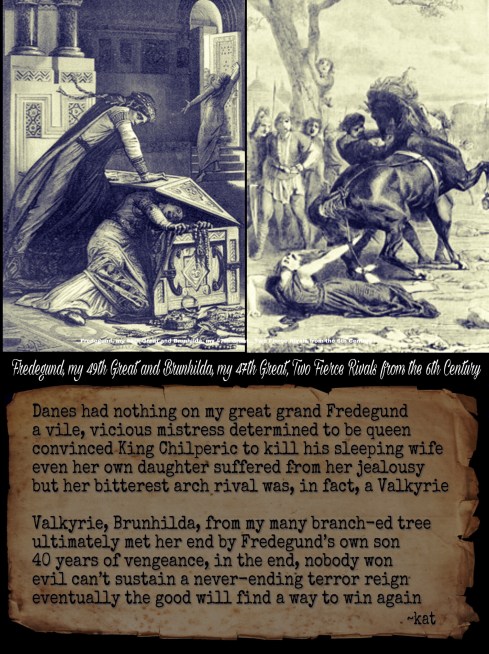
It is fitting then to write about two very strong women from my past. One was a psychopath, and the other, her rival, was a Valkyrie, a mother and grandmother. Badass is a term I have often seen used in accounts referring to them both. I give you Fredegund and Brunhilda…you can read more about their rivalry and their lives HERE.

Danes had nothing on my great grand Fredegund
a vile, vicious mistress determined to be queen
convinced King Chilperic to kill his sleeping wife
even her own daughter suffered from her jealousy
but her bitterest arch rival was, in fact, a Valkyrie

Valkyrie, Brunhilda, from my many branch-ed tree
ultimately met her end by Fredegund’s own son
40 years of vengeance, in the end, nobody won
evil can’t sustain a never-ending terror reign
eventually the good will find a way to win again

~kat


August – Stanzas 26-27

Two stanzas today. Yesterday was spent on the road.

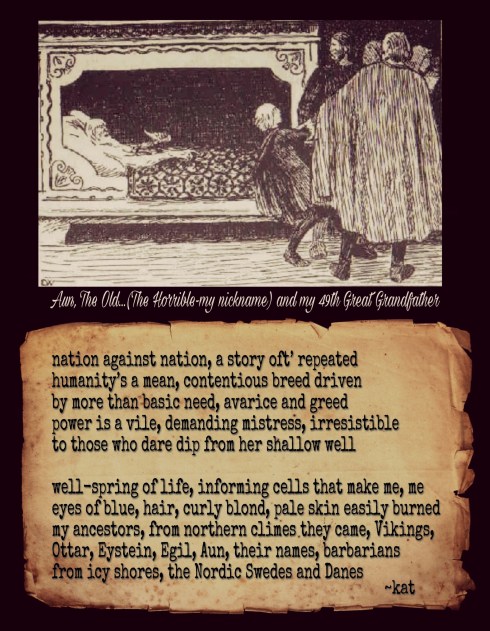
nation against nation, a story oft’ repeated
humanity’s a mean, contentious breed driven
by more than basic need, avarice and greed
power is a vile, demanding mistress, irresistible
to those who dare dip from her shallow well

well-spring of life, informing cells that make me, me
eyes of blue, hair, curly blond, pale skin easily burned
my ancestors, from northern climes they came, Vikings,
Ottar, Eystein, Egil, Aun, their names, barbarians
from icy shores, the Nordic Swedes and Danes

~kat

For Jane Dougherty’s August Stanza Challenge.


From Wikipedia, a story about Aun, of the Yngling Dynasty, King of Uppsala…and allegedly, if the tree leaves on Ancestry.com are correct, my 49th Great Grandfather. Aun was a horrible man, a terrible father who was sick with power….

Ruling from his seat in Uppsala, Aun was reputedly a wise king who made sacrifices to the gods. However, he was not of a warlike disposition and preferred to live in peace. He was attacked and defeated by the Danish prince Halfdan. Aun fled to the Geats in Västergötland, where he stayed for 25 years until Halfdan died in his bed in Uppsala.

Upon Halfdan’s death Aun returned to Uppsala. Aun was now 60 years old, and in an attempt to live longer he sacrificed his son to Odin, who had promised that this would mean he would live for another 60 years. After 25 years, Aun was attacked by Halfdan‘s cousin Ale the Strong. Aun lost several battles and had to flee a second time to Västergötland. Ale the Strong ruled in Uppsala for 25 years until he was killed by Starkad the old.

After Ale the Strong’s death, Aun once again returned to Uppsala and once again sacrificed a son to Odin; this time Odin told the king that he would remain living as long as he sacrificed a son every ten years and that he had to name one of the Swedish provinces after the number of sons he sacrificed.

When Aun had sacrificed a son for the seventh time, he was so old that he could not walk but had to be carried on a chair. When he had sacrificed a son for the eighth time, he could no longer get out of his bed. When he had sacrificed his ninth son, he was so old that he had to feed, like a little child, by suckling on a horn.

After ten years he wanted to sacrifice his tenth and last son and name the province of Uppsala The Ten Lands. However, the Swedes refused to allow him to make this sacrifice and so he died. He was buried in a mound at Uppsala and succeeded by his last son Egil. From that day, dying in bed of old age was called Aun’s sickness.


Autumn ~ Stanza 24

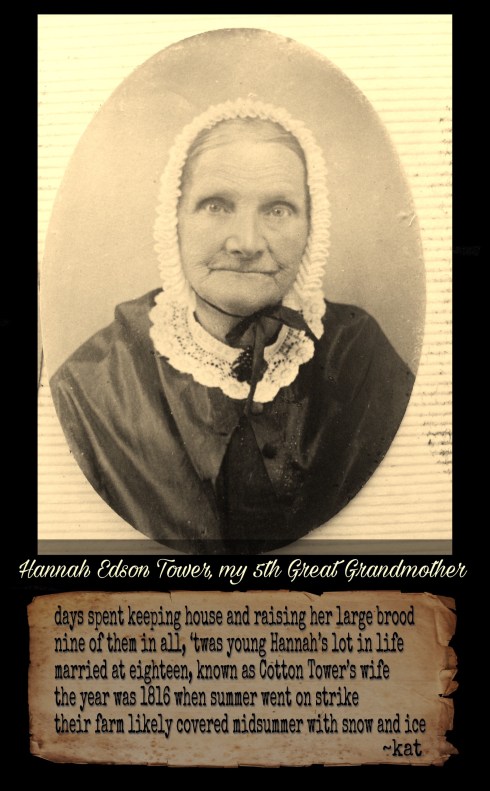
days spent keeping house and raising her large brood
nine of them in all, ‘twas young Hannah’s lot in life
married at eighteen, known as Cotton Tower’s wife
the year was 1816 when summer went on strike
their farm likely covered midsummer with snow and ice

~kat

For Jane Dougherty’s August Stanza Challenge.


History recounts the year 1816 as “The Year Of No Summer”. It was also the year my 5th Great Grandparents, Hannah Edson and Cotton Tower married. Cotton was a Farmer by trade. Hannah, who I am fortunate to have a photograph of, is listed on census records as a housewife. With 9 children I can’t imagine she had much time for anything else besides birthing and tending to her children. They all seem to have been of hearty stock though. Hannah died at the ripe old age of 74, with Cotton following her nearly a decade later at 85. They lived in Leavenworth, Indiana. I imagine the farms in that part of the country felt the chill, along with the rest of the world, caused by the eruption of Mount Tambora in Indonesia. It is said that the atmosphere was thick with volcanic ash, limiting the amount of sunlight, cooling the Earth’s surface, and causing a once-in-a-lifetime event: a year-long winter.

Here is an excerpt I found from The Washington Times Herald :

A year without a summer

Although no documented local records of weather existed in 1816, the summer of 1816 is without question a memorable year, not only locally, but world wide. The year of 1816 is referred to as “the year without a summer.”

In 1961, Frank L. Hartle of Indianapolis was in possession of an 1816 newspaper article describing 1816 as being the coldest summer ever experienced by any person living at that time.

The following are excerpts from the article:

“June was described as the coldest month vegetation had ever experienced in this latitude. Frost and ice was as common as buttercups usually are in June.”

“Mothers made thick mittens for their children and they wore knitted sox of double thickness. Overcoats and gloves were required by farmers as they attempted to do their daily chores.”

“A heavy snowfall on June 17, 1816, was accompanied by a pathetic story. A Vermont farmer turned his sheep to pasture the previous day. Temperatures dropped below freezing over night and snow had begun falling about 9 a.m.”

As the farmer left home, he jokingly remarked to his wife: “Better start the neighbors searching soon for me.”

“It’s the middle of June you know and I may get lost in the snow.” Snow continued to fall in torrents and drifts began to form. By night fall nothing had been heard from him. The wife summoned neighbors and they began to search for him. They continued searching the second day. Only after the third day, was he found lying in a hollow, half-covered with snow, still alive but both feet frozen. The sheep were found nearby, but most of the flock of sheep had lost their lives.

July offered no respite. Ice thicker than window glass required breaking the ice in the livestock water troughs so they could drink.

But to everyone’s surprise August proved worst of all.

“Almost every green thing in the country and Europe was blasted daily by frost. Snow fell in August in London, England. In Quebec City, Canada, on June 10, 1816, they experienced a 12-inch snowfall and 1816 was the coldest year in the northern hemisphere on record.

As a result of these abnormal summer temperatures, parts of Europe experienced a stormier winter in 1816. That, in turn, resulted in the widespread death of much of the livestock.

Cool temperatures and heavy rains resulted in failed harvests in Great Britain and Ireland. Families in Wales traveled long distances as refugees begging for food. Famine was prevalent in North and South West Ireland following the failure of their wheat, oats and potato harvests. Violent demonstrations in front of grain markets and bakeries, followed by riots, arson and looting in many European cities due to food shortages and skyrocketing food prices.

Worldwide, no living person at that time had any recollection of weather creating such havoc throughout history. While it was known that other countries were also experiencing similar weather problems, the actual cause wasn’t known until years later.

A cause is found

Virtually no one in Daviess County, Ind., had ever heard of Indonesia or the small island of Sumatra nor had they any knowledge of Mount Tambora nor would they ever have believed that a volcano half way around the world could have any effect on their lives, especially their weather.

If asked, at the time, if they knew that there was a volcano eruption on Mount Tambora in Indonesia; their answer would probably be, “So who cares?” The science of climate and the factors which contribute to temperatures, the seasons, the air currents and ocean tides were not a part of common knowledge. In fact, if someone were to have suggested that a volcano was to be blamed, even the highly educated in 1816 would label us as a “fruitcake.”

To believe the cause of 12-inch snowfalls in June or world widespread crop failures were a direct result of a volcano in Indonesia would have been truly unbelievable.

Although there are several volcanoes today capable of eruption, the April 1815 Mount Tambora eruption was the largest volcanic eruption in recorded history. The explosion was deafening and was heard on the island of Sumatra more than 1,200 miles away. The estimated death toll exceeded 71,000 people. A team of archaeologists during excavation diggings in 2004 discovered cultural remains buried from the Mount Tambora volcanic explosion still intact beneath 9.9 foot deep pyroclastic lava deposits. Many of the bodies were preserved in the positions they occupied on that fateful day in 1815.

August ~ Stanza 23

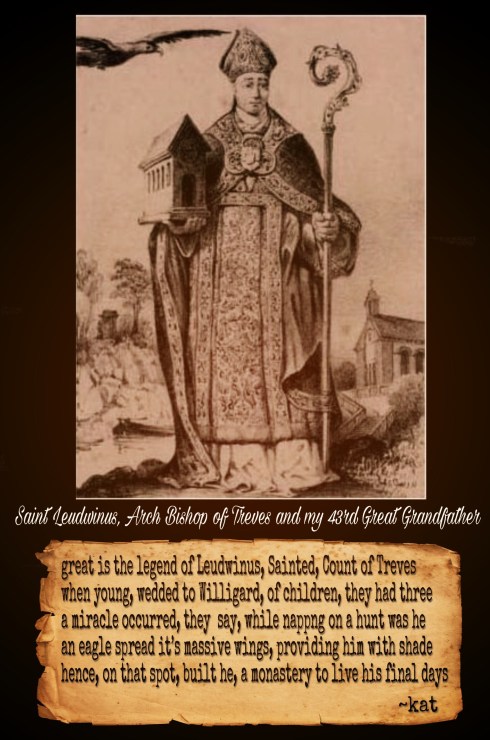
great is the legend of Leudwinus, Sainted, Count of Treves
when young, wedded to Willigard, of children, they had three
a miracle occurred, they say, while nappng on a hunt was he
an eagle spread it’s massive wings, providing him with shade
hence, on that spot, built he, a monastery to live his final days

~kat

For Jane Dougherty’s August Stanza Challenge.


A bit about my 43rd Great Grandfather, Saint Leudwinus from Wikipedia

Leudwinus was born a French nobleman and was a member of one of the most powerful clans in Austrasia. His father, Warinus, was Count of Poitiers and Gunza of Metz. Lambert of Maastricht was his kinsman. His Frankish name is Liutwin. Leudwinus spent his early life at the royal court of Austrasia[ and was styled Count of Treves. He received his education from his maternal uncle, Saint Basinus, Archbishop of Treves. In 697, Leudwinus signed the Deed of Echternach with his uncle.

Initially uninterested in an ecclesiastical career, Leudwinus married Willigard of Bavaria. Their children were:

▪Milo, Count of Treves

▪Wido, Count of Hornbach

▪(Possibly) Chrotrude of Treves (Rotrude), who married Charles Martel and became Duchess of Austrasia.

According to legend, the abbey in Mettlach was founded after Leudwinus went hunting near Saar. He grew tired and fell asleep under the shade of a tree. As he slept the sun changed positions exposing him to its hot rays, but an eagle swept down and sat on Leudwinus with its wings spread out. When Leudwinus woke up, his servant told him how the eagle had protected him from being burnt by the sun.

Coincidentally, Leudwinus happened to be napping at the site of the Miracle Eagle near the chapel of St. Denis of Paris. Leudwinus saw this as a God-sent sign to establish a Benedictine monastery at that site, and it soon developed into a Christian missionary center. At the location of the original Dionysius Chapel now stands the parish church of St. Gangolf in Mettlach.

When Leudwinus became a widower, he joined the monastery he founded at Mettlach as a simple monk.

In 697, Leudwinus was appointed coadjutor of his uncle Basinus von Trier. In 698, he cofounded the Echternack Abbey at Mettlach.

When Archbishop Basinus died on 4 March 705, Leudwinus succeeded him and was consecrated Archbishop of Treve. Leudwinus was also appointed bishop of Laon. This made him one of the most important church dignitaries of the time in the Frankish kingdom.

Leudwinus died on the 29th of September 722 at Reims. He was succeeded as Archbishop of Treve by his son, Milo, who brought his father’s remains to Treve for burial. However, local customs prevented this, so Leudwinus’ family decided to let the dead saint choose his own place of burial. His coffin was placed on a ship without a crew. It sailed by itself first to Moselle, then Saar, and finally docked at Mettlach, where the church bells began to ring.

Leudwinus was buried in St. Mary’s Church at the Abbey at Mettlach. In 990, St. Mary’s Church was replaced by a new structure called the Old Tower, the oldest preserved stone building in Saar.