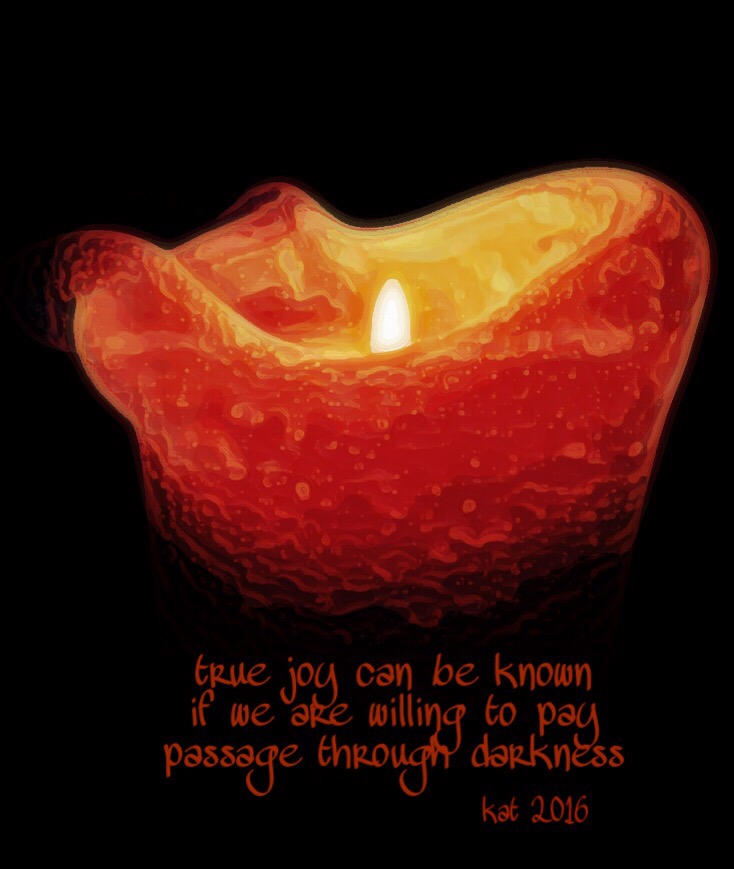
true joy can be known
if we are willing to pay
passage through darkness
kat – 28 December 2016
For Haiku Horizon’s Haiku Challenge, prompt word: Joy.
true joy can be known
if we are willing to pay
passage through darkness
kat – 28 December 2016
For Haiku Horizon’s Haiku Challenge, prompt word: Joy.
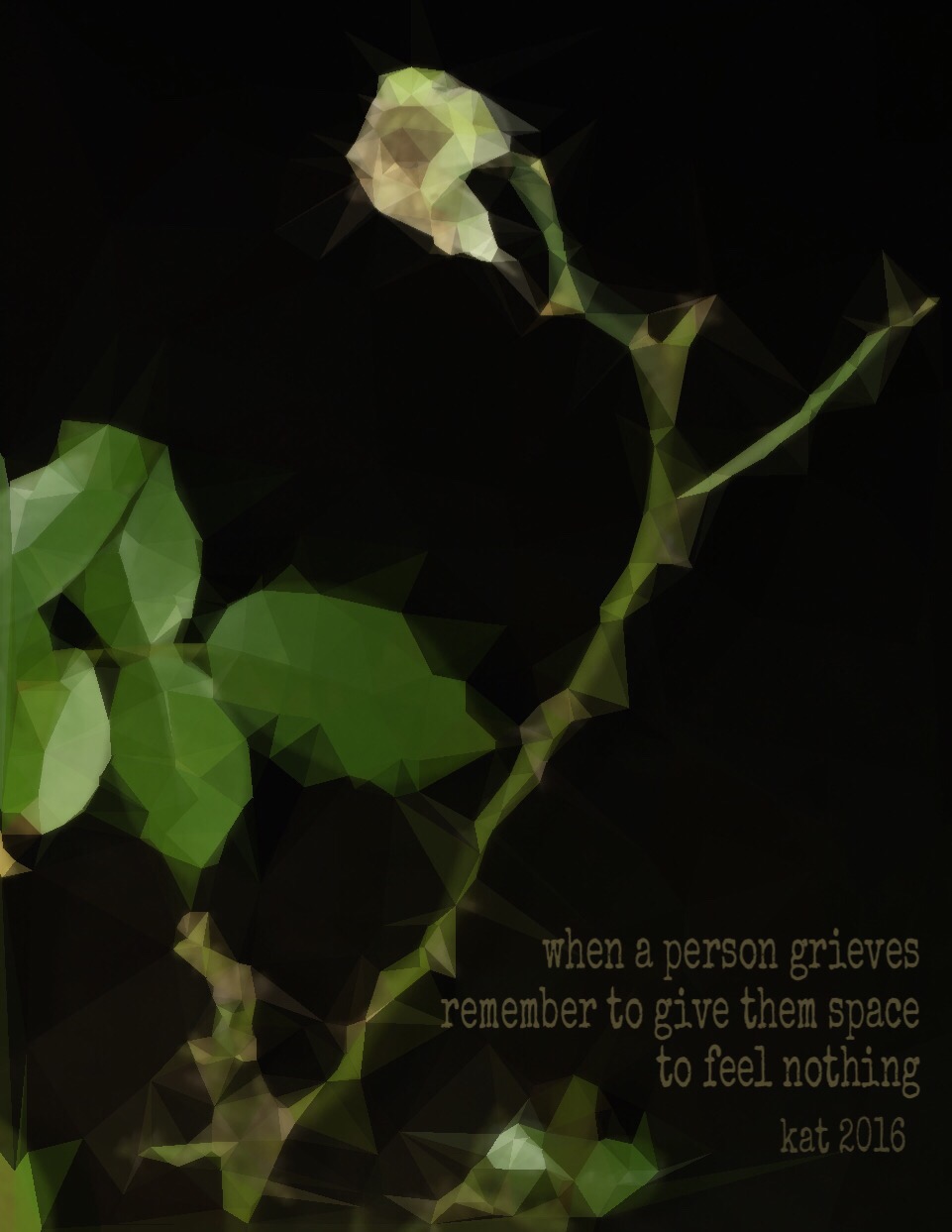
when a person grieves
remember to give them space
to feel nothing
kat ~ 27 December 2016
For Ronovan Writes Haiku Challenge, prompt words: Feel & Space.
O
O Tannenbaum, O Tannenbaum! Today’s dictionary.com Word of the Day is one that we have come to associate with the Christmas season, the Tannenbaum, literally translated from German to mean “fir”.
Today most people have come to accept the Christmas tree as a holiday fixture in homes and town squares the world over. Though it’s modern form traces its roots to 15th and 16th century Germany, the practice of using evergreen branches and trees to celebrate winter festivals, pagan and Christian, dates back many thousand years before Christmas was even a thing. To Pagans, decking their homes and temples with evergreen branches during winter solstice made them think of the coming spring. Romans used evergreen branches to decorate their temples during the winter festival of Saturnalia, in homage to the god Saturn, whose name means “sowing”.
The strong association of the tannenbaum with paganism has faced the ire of fundamentalist christians though, who link the practice all the way back to the prophet Jeremiah. To support their opposition to Christmas trees they refer to his words in chapter 10:1-5:
10 Hear ye the word which the Lord speaketh unto you, O house of Israel:
2 Thus saith the Lord, Learn not the way of the heathen, and be not dismayed at the signs of heaven; for the heathen are dismayed at them.
3 For the customs of the people are vain: for one cutteth a tree out of the forest, the work of the hands of the workman, with the axe.
4 They deck it with silver and with gold; they fasten it with nails and with hammers, that it move not.
5 They are upright as the palm tree, but speak not: they must needs be borne, because they cannot go. Be not afraid of them; for they cannot do evil, neither also is it in them to do good.
King James Version (KJV)
More moderate christians explain away this argument by saying that Jeremiah was speaking about the idolatry of pagans in general. The tree is just for illustrative purposes.
Believe what you will, as I mentioned before, the first known Christmas tree was set up in 1419 in the town of Freiburg, Germany. It was the town bakers who donned a tree in the square with fruits, cakes and nuts as a treat for the children who were allowed remove them from the tree and eat them on New Years Day.
Later in the 16th century, none other than the renowned minister, Martin Luther, is credited for bringing the very first Christmas tree inside. As the story goes, while on an evening walk, he was inspired by the twinkling stars that shone through the branches of a nearby forest. He would later tell his children that the stars through the trees reminded him of Jesus who “left the stars of heaven to come to earth at Christmas”. Next time you’re wrestling with an unruly ball of holiday lights, remember that very first lit Christmas tree!!! Happy Happy Joy Joy!!!! 😜
But back to our word of the day, Tannenbaum. Most of us know the word because it was popularized by a folk song penned by the Leipzig organist, teacher and composer Ernst Anschütz. What you may not know about this happy song is that it was a revised version, with Anschütz adding additional verses to a tragic love song originally written by Joachim August Zarnack who sited the faithful evergreen tree as a contrast in virtue to his faithless lover who jilted him. Here’s Anschütz’s full version in German and a popular English Christmas carol rendering, of which there are dozens!
O Tannenbaum – the Christmas Carol:
O Tannenbaum, o Tannenbaum,
wie treu sind deine Blätter!
Du grünst nicht nur
zur Sommerzeit,
Nein auch im Winter, wenn es schneit.
O Tannenbaum, o Tannenbaum,
wie treu sind deine Blätter!O Christmas Tree, O Christmas Tree,
How steadfast are your branches!
Your boughs are green
in summer’s clime
And through the snows of wintertime.
O Christmas Tree, O Christmas Tree,
How steadfast are your branches!O Tannenbaum, o Tannenbaum!
Du kannst mir sehr gefallen!
Wie oft hat nicht zur Weihnachtszeit
Ein Baum von dir mich hoch erfreut!
O Tannenbaum, o Tannenbaum!
Du kannst mir sehr gefallen!O Christmas Tree, O Christmas Tree,
What happiness befalls me when oft
at joyous Christmas-time
Your form inspires my song and rhyme.
O Christmas Tree, O Christmas Tree,
What happiness befalls meO Tannenbaum, o Tannenbaum!
Dein Kleid will mich
was lehren:
Die Hoffnung und Beständigkeit
Gibt Trost und Kraft
zu jeder Zeit.
O Tannenbaum, o Tannenbaum!
Das soll dein Kleid
mich lehren.O Christmas Tree, O Christmas Tree,
Your boughs can teach a lesson
That constant faith and hope sublime
Lend strength and comfort
through all time.
O Christmas Tree, O Christmas Tree,
Your boughs can teach a lesson.
As you can see, there are many twists ands turns to this beloved tradition. Here’s my haiku then…adding three more lines to all things Tannenbaum!

O Tannenbaum – A Haiku
Dear old Tannenbaum
with boughs dressed in sweets and light,
you’re heaven on earth!
kat ~ 23 December 2016

Dust it with sugar
Serve it up with festive flair
It’s still a fruitcake!
kat ~ 22 December 2016
For Sonya’s Three Line Tale Challenge based on this photo by photo by Jennifer Pallian via Unsplash. Happy Holidays to you and yours! ❤

solstice vespers toll
heralding the longest night
Luna shades her face
kat ~ 22 December 2016
For Ronovan Writes Haiku Challenge, prompt words Bells & Ring.