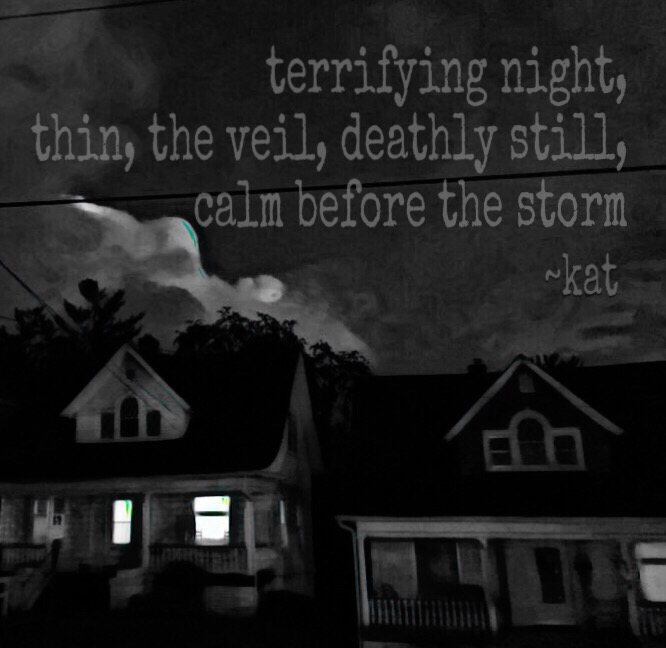
terrifying night,
thin, the veil, deathly still,
calm before the storm
~kat
For Ronovan Writes Haiku Challenge, prompt words: Night and Spooky/Terrifying
terrifying night,
thin, the veil, deathly still,
calm before the storm
~kat
For Ronovan Writes Haiku Challenge, prompt words: Night and Spooky/Terrifying
I missed posting yesterday’s word of the day, but as a bonus, today you shall have two lovely words to wrap your brain around! Friday’s word, Preta, a noun from Hindu Mythology meaning a wandering or disturbed ghost. And Saturday’s word, Guisard, a noun the means a person who wears a mask; mummer.
Given the season and impending dark night of all souls hallow, I thought it would be fitting to combine the two in a Haiku. Here’s a bit of history on the two from Dictionary.com:
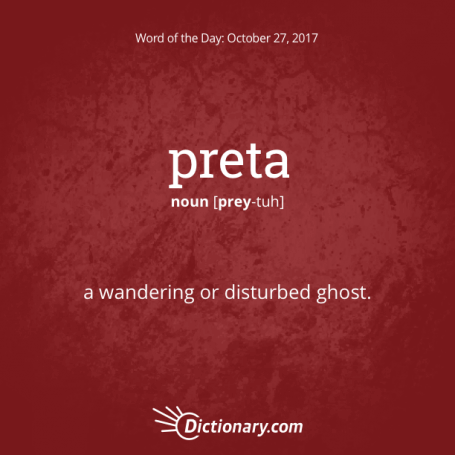
Preta finds its origins In Sanskrit where e is a long vowel ( it is also transliterated as ē). Hindi grammarians correctly analyzed e as a monophthong replacing an earlier dipthong ai; thus the Sanskrit adjective preta, “gone before, deceased” is from an earlier form, ‘praita’, formed from the adverb and prefix ‘pra’ – “forth” and ‘ita’ – “gone”. Pra- is cognate with the Latin and Greek prepositions and prefixes, ‘prō’/‘pró’ (Greek) and ‘prae’, all of them meaning “before; in front of”. The Sanskrit participle ‘ita’ corresponds exactly with the Latin ‘itum’, past participle is the verb ‘īre’, “to go” and the Greek verbal adjective ‘itós’ “passable”, all from the Proto-Indi-European root ‘ei’, ‘i’ -“to go”. Preta entered English in the early 19th century. From wictionary we learn that: a Preta is a hungry ghost (a supernatural being in Buddhist folklore, the spirit of a greedy person whose divine retribution is to never be sated). How many a weary folk has woken to the first day of November the victim of mischievous antics of Pretas whose quest for sweets was not sated, in the form of TP garlands and raw egg peltings?!
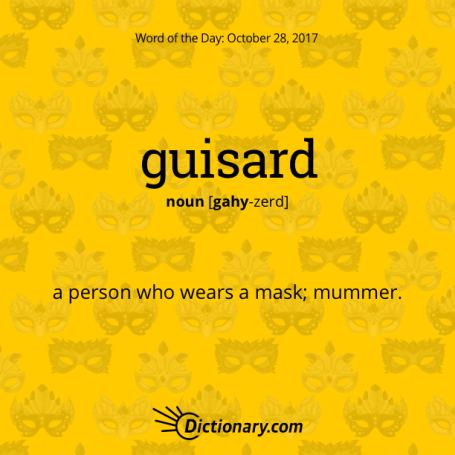
And then there is Guisard, a Scottish and North English word. The first part of the word, guise, in Scotland and northern England means “to appear or go in disguise.” The suffix -ard, occasionally spelled -art, is now used mostly in a pejorative sense for someone who does something habitually or excessively, e.g., drunkard, braggart. Guisard entered English in the 17th century. Soon comes Halloween, when greedy, giddy guisards roam the streets, banging on doors, declaring their mantra, “trick or treat”. A wise somebody will appease these mummers by offering them the sweets they crave lest they transform into scary pretas with a vendetta to settle!
It’s all in good fun of course! An annual ritual that hearkens to an age when the veil between the living and the dead was not quite as pronounced. Our ancestors solemnly remembered and honored the dead more formally; gone but definitely not forgotten. Today we passingly engage this annual ritual in sport, sending our costumed children to the streets for a night of innocent begging. But the thinness of the veil is still there, souls lurking in the shadows, which adds to the drama of this dark, dark time.
These days, I must admit I turn my porch light out, not because I don’t enjoy the onslaught of tiny ghouls and gremlins, but because they terrify my fury housemates. We sit in darkness to the sound of potter-pattering feet outside our door…and entertain the lore of my ancestors, setting a place of honor at my table for loved ones passed. Sometimes I light a candle…or two or three to let them know I remember. I feel their presence ever so near. It could very well be my imagination, but there is something to this ancient dark night of all souls. Something indeed!
this dark night of souls
comes guisards begging for treats
pretas in the mist
~kat

obstinate castle
stone rook girded by tears
impenetrable
~kat
For Haiku Horizons Weekly Challenge, prompt word, Castle

longing to be touched
lonely souls barter with brutes
ardor misconstrued
~kat
For Ronovan Writes Weekly Haiku Challenge, prompt words, Touch & Wrong (Misconstrued).
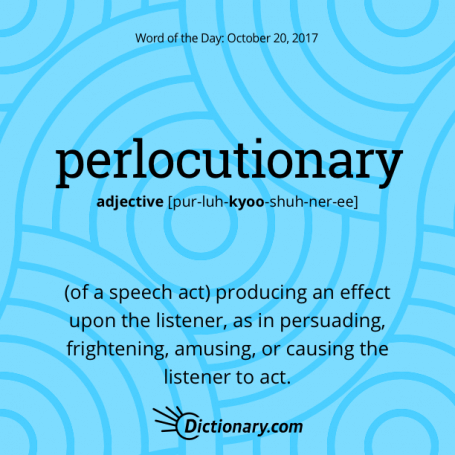
Today’s word of the day on dictionary.com is a whopper, and therefore quite the challenge when constrained by the limited syllable budget of a Haiku. I shall nevertheless give it its due. Perlocutionary is an adjective that describes a type of speech that persuades, enlightens, inspires, frightens, or amuses the listener, causing them to act. Philosopher, J.L. Austin explains it perfectly in this excerpt from “How to Do Things with Words”, written in 1962: “We can similarly distinguish the locutionary act ‘he said that’ …from the illocutionary act ‘he argued that’…and the perlocutionary act ‘he convinced me that’…”
The word perlocution has been around since the 16th century originally meaning the act of speaking. It basis was formed from the Latin locutio, “speech, speaking, discourse”, a derivative of the verb loqui, “to speak”. Its present iteration as a noun and adjective did not enter the English language until the 20th century with the addition of the prefix ‘per’ meaning “through, complete or perfect” (as in brought to completion).
I learned that there are stages in the application of locutionary, illocutionary and perlocutionary acts. While it would seem that the latter is the more refined direct act of the three I was surprised to discover that, in fact, infants between the age of 0-8 months are masters in the art of perlocutionary discourse through the use of sounds and gestures. Every whimper, coo and cry has an affect on the hearer, causing them to act. Eventually the child begins to repeat actual words (locutionary acts) and to apply them with meaning as in the words “no” or “why” (illocutionary acts).
It’s all very interesting of course. And way over my head. I have rarely bothered myself to determine whether a speech or statement is locutionary, illocutionary or perlocutionary, but I do admit to being moved and swayed by words. A simple cry for help raises my adrenaline and propels me into help mode. And a temper tantrum can shut me down in no time flat.
We are so easily convinced by words. I doubt that I’ll take time to analyze the words that move me, next time it happens. Even though I now have a word for it. Perlocutionary acts…my biggest challenge at the moment is figuring out how to fit a six syllable word into a Haiku. But at least now you have a new word to file in your vocabulary drawer under “words that are nice to know”.😊
words of gloom and doom,
perlocutionary acts,
drive fools to folly
~kat
http://www.dictionary.com/wordoftheday/2017/10/20/perlocutionary