Tag Archives: digital art.

Cinqku #3

I hear
faint whispers
the breeze singing
is it the trees, or me
dreaming?

~kat


A cinqku must always have 5 lines and a perfect seventeen-syllable count. The lines typically follow a 2,3,4,6,2 format. There is no title requirement on the second line. As for syntax and diction styles, it follows the free Tanka style originally. There are no metric requirements for a cinqku poem. Additionally, the final line must contain a cinquain or kireji turn for emphasis. 


Oviellejo 27-28

starve a cold…

seasonally challenged am I
I can’t deny

when the first snap of cold air comes
I succumb

to stuffy headed coughing crud
become a slug

drinking hot toddies by the jug
out of commission, days on end
hiding away while on the mend
I can’t deny I succumb, become a slug

and yet there’s something glorious
though I may fuss

red-nosed sniffling, head in a vise
it is so nice

to feel the breezes, cool and dry
to close my eyes

it’s time to bid summer goodbye
this ruddy interlude between
wintery white and summer green
though I may fuss, it is so nice to close my eyes

~kat


True story…pass the spiked tea and honey please….

The Oviellejo is an Old Spanish verse form (derived from ovillo, a ball of yarn). A stanza consists of 10 lines, with a rhyme scheme of AABBCCCDDC. The second line of each rhyme scheme, Line 2,4,6, is short line of up to 5 syllables. The last line is a “redondilla,” a “little round” that collects all three of the short lines.


Oviellejo #26


autumn

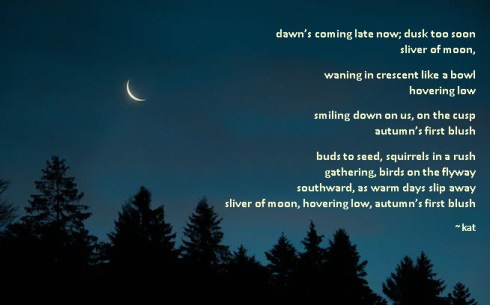
dawn’s coming late now; dusk too soon
sliver of moon,

waning in crescent like a bowl
hovering low

smiling down on us, on the cusp
autumn’s first blush

buds to seed, squirrels in a rush
gathering, birds on the flyway
southward, as warm days slip away
sliver of moon, hovering low, autumn’s first blush

~kat


Busy week…working on catching up on my daily Oviellejos for the Month of August.

The Oviellejo is an Old Spanish verse form (derived from ovillo, a ball of yarn). A stanza consists of 10 lines, with a rhyme scheme of AABBCCCDDC. The second line of each rhyme scheme, Line 2,4,6, is short line of up to 5 syllables. The last line is a “redondilla,” a “little round” that collects all three of the short lines.


Tuesday with the Muse…”mother”

mother

mother

my mother is everywhere
among the things I return to
engrained in memory
forever open to me
then closed, hidden, dark,
mother, spilling everywhere

~kat~


A Blackout poem inspired by the poem “The Question of My Mother” by Robin Ekiss:

The question of my mother is on the table.
The dark box of her mind is also there,
the garden of everywhere
we used to walk together. 

Among the things the body doesn’t know,
it is the dark box I return to most:
fallopian city engrained in memory,
ghost-orchid egg in the arboretum, 

 hinged lid forever bending back and forth
open to me, then closed
like the petals of the paperwhite narcissus.
What would it take to make a city in me?

Dark arterial streets, neglected ovary
hard as an acorn hidden in its dark box
on the table: Mother, I am
out of my mind, spilling everywhere.

Source: Poetry (November 2007)


Oviellejo #25

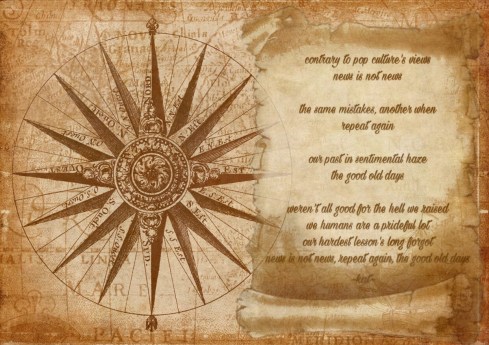
contrary to pop culture’s views
news is not news

the same mistakes, another when
repeat again

our past in sentimental haze
the good old days

weren’t all good for the hell we raised
we humans are a prideful lot
our hardest lesson’s long forgot
news is not news, repeat again, the good old days

~kat


The Oviellejo is an Old Spanish verse form (derived from ovillo, a ball of yarn). A stanza consists of 10 lines, with a rhyme scheme of AABBCCCDDC. The second line of each rhyme scheme, Line 2,4,6, is short line of up to 5 syllables. The last line is a “redondilla,” a “little round” that collects all three of the short lines.