Category Archives: Poetry

April Poetry Month ~ A Poem a Day #29

Day29! Oh my! I can hardly believe this month of poetry is soon ending. But oh, what a journey it has been! I have learned so much about poetry and form, syllables and rhyme.

Today’s form is a Threefer! Not one, not two even, but three poems wrapped neatly in one! I give you the Cleave Poem. This is an interesting form. There is no rhyme or syllable count to bother with. It can be long or short. The best way to describe it is to explain how one reads a cleave poem. Each line spans two columns. Column A is poem #1. Column B (which can be separated by a line or by the use of italic or bold formatting) is poem #2. And wait, you’re not finished yet! One more read across the entire line completes the trio with poem #3.

It can be a bit tricky to write. When choosing a topic, or two as it were, it works well if you choose opposite ideas or images. I have found that writing completely across for two or three lines helps get the ball rolling. Then you can finish one column, and then the other, tweaking it as you go, so it makes sense every which way!

I’m having a bit of fun with this. Can you tell? This form is one of my favorites!

Photo Credit: pixabay.com


Fire and Ice

hungry licks smooth as glass
tongue red hot cold to the touch
sucking the air crystalline shards
to feed his longing once fluid and flowing
fierce and frenzied frozen 
all consuming as the cold wind whips
soon to fade stroking her surface
in sweet surrender sealing her skin
as dying embers pale and lifeless
turn to ash aching for warmth

kat ~29 April 2016
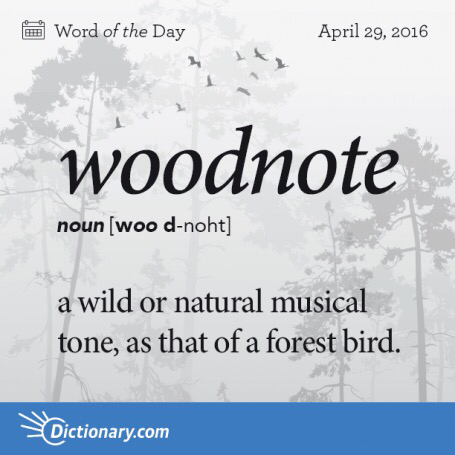

Friday’s Word of the Day Haiku


Happy Friday! What a lovely, lyrical word we have today…”Woodnote!” When I first saw the word this morning, I imagined that it must have had its origin in the mind of some 17th Century poet who penned it on parchment giving it life!

Dictionary.com simply mentioned that it came into use around 1632. And of course that was my cue to dig a little deeper. No other dictionary expounded further on the issue but I was determined to find the poet who first wrote it … I was certain it was a poet…a poet knows these things…😉

How do I love the Internet…oh let me count the ways…not the least of which, it brings the world to one’s computer screen! After a bit of search engine tweaking, I found my bard!!! Oh yes, my hunch was correct. And what was even more spectacular? The man who coined the word woodnote in 1631 (later published in 1645) used it to describe THE quintessential Bard, Shakespeare. Mystery solved!

Who is the poet? He is John Milton who, in “L’Allegro,” refers to Shakespeare as “Fancy’s child” who warbles “his native woodnotes wild.” You can read the entire poem HERE.

From the Encyclopedia Britannica…

L’Allegro, early lyric poem by John Milton, written in 1631 and published in his Poems (1645). It was written in rhymed octosyllabics. A contrasting companion piece to his “Il Penseroso,” “L’Allegro” invokes the goddess Mirth, with whom the poet wants to live, first in pastoral simplicity and then amid the “busy hum of men” in cities full of vitality.

And so, my challenge today is to pen a simple haiku using woodnote as my prompt. I do so hoping to channel a wee bit of Milton who gave us this wonderful word. Oh, if only. But knowing its origin makes my task so much sweeter!

heartsong

Of lilting woodnotes…
birdsong, wind-tossed forest whispers…
these make my heart sing!

kat ~ 29 April 2016


Nana’s Jewel Box -A Haiku

This Haiku is in response to TJ’s Household Haiku Challenge prompt: “Jewel Box”. to read other haiku click HERE.

Photo from Pixabay.com


Pearlescent gems
Sleep on waves of red velvet
nana’s jewel box.

kat ~ 28 April 2016


Her Shadow Looms – A Triolet

For Jane Dougherty’s poetry challenge this week. The prompts are the painting you see here by Munch and the words: winding – moonlight – follow – heavily – path. The theme is “moonlight”. I chose to do a triolet for this challenge. i was able to use all the promp words but one…follow (but it is implied…:)) To read other poems visit Jane’s blog HERE

Moonlight along the winding path
where heavily her shadow looms
leads to the place she saw him last,
moonlight along the winding path,
her dreams of love left in the past
when she was young and flowers bloomed,
moonlight along the winding path
where heavily her shadow looms.

kat ~ 28 April 2016


April Poetry Month – A Poem a Day #28

Today I am exploring the Reverse Poem. A Reverse Poem is a freeform verse. The masters of this form write lines and lines…I feel lucky to have pulled out 14! Here’s the definition: Reverse poetry is a poem that can be read forwards one way and have a meaning, but also be read backwards and have another different meaning. A type of ‘reverse‘ writing is called a palindrome. Palindrome comes from the Greek words “palin” (again or back) and “dramein” (to run).

As you can imagine it’s a bit tricky. I have seen other variations of this type of poem, the Palindrome (which is a mirror image poem with a break in between) and a form that some of you have tried this week from a NaPoWriMo Poetry challenge that prompted you to write a poem backwards (which also should be read from the bottom up). The Reverse Poem should be read top to bottom and then bottom to top and should have two different meanings. At any rate, here’s my try…I know this is another form that will take a bit of practice to master.

Roses1

Falling In and Out and In Love

I think
I love you
like the very first time
I heard your voice
my heart fluttered and
I caught you watching me
as you looked away, blushing
something changed
I’m not sure when it was, but
you don’t look at me
you hardly speak anymore and
I should tell you
I don’t think
I love you

kat ~28 April 2016