Tag Archives: poetry form

April Poetry Month – A Poem a Day #13

Happy Poetry Month this 13th day of April! Today’s poetry form, the Sijo originates from Korea and like its cousins, the haiku and tantra, is comprised of three lines. Each line should have 14-16 syllables, pausing in the middle, the first half containing 6 to 9 syllables with the balance in the second. A Sijo may be narrative or thematic. It develops in three parts: introduction of a situation or problem; development or “turn” in line two; and resolution in the third, often employing a twist or surprise in the first half of the line. Sijo is strongly based in nature and may take on religious or metaphysical themes as well. Unlike haiku, sijo relies heavily on the use of metaphors, symbols, puns, allusions and other word play. Some modern print restrictions may show a sijo in six lines.

I take my inspiration today from an amazing “volunteer” tomato plant. I found it last summer, thriving in the middle of my compost heap. I am not a gardener. I barely knew what to do with it once I found it. But despite my inadequacy, Nature saw fit to provide me with a dozen or so plump tomatoes.

Nature has a way of surprising us with her wild chaotic unruliness. She has been sustaining life for eons, long before the first human thought to contain her in tidy rows with hoe in hand. It’s comforting to those of us who tend to go with the flow to know that Nature has our back…and a few tomatoes to spare.
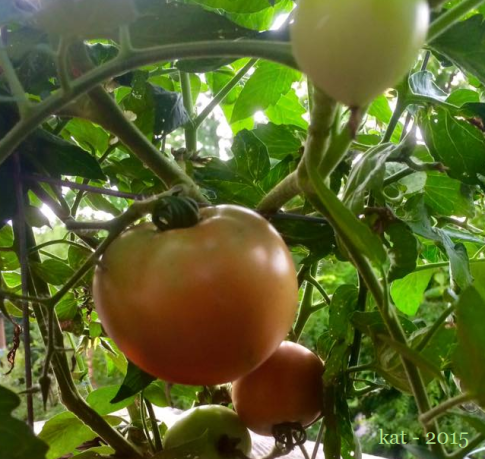
tomatoes

This is an actual photo of my wild tomatoes from Summer 2015!

Nature’s Garden

Gardeners, who fancy their thumbs green, primp and prune and toil
Sowing seeds, midst fussy plots of weeds, their empty plates to fill.
My garden thrives in a compost heap, vines bursting tomatoes!

kat ~ 13 April 2016


April Poetry Month – A Poem a Day #12

It is day 12 of Poetry month. Today’s poetry form is all about the number 12. Developed in 12th century Japan, it is a variation of the Haiku.  But instead of three lines in 5-7-5 syllable sequence, it contains four lines of 12 syllables each, pausing mid-line after 7. Called the Imayo, this lyrical form is often employed in Kabuki Japanese theatre, and is associated with the type of song that requires recitation in a high pitch.

Here is the breakdown of an Imayo poem: 4 lines; each line 12 syllables broken by a pause after the 7th syllable.


Parched

Rain settles on parched soil, pooling in puddles,
never to quench thirsty roots, darkness imprisoned.
Truth settles on shuttered minds, spinning in sound bites,
never to be enlightened, prisoners of fear.

kat ~ 12 April 2016


April Poetry Month-A Word a Day #10

Happy Sunday and Happy 10th day of Poetry Month. Today’s poetry form is a perfect blend of left and right brain…the poem itself, a blend of elements, seasons, earth and sky. It is the perfect poetic storm…at least in my own mind! And you will recognize an old friend, my fairy tree lady.

Because she was so near an oak tree when I first noticed her, I assumed that she was an oak sapling. But this spring I discovered she is, in fact, a dogwood tree!

Serendipitous! Don’t you think? What better form could there be, but the Fibonacci…expanding cyclically into infinity! The whole idea of it makes me smile!

A Fibonacci Poem is a 6-line poem that follows the Fibonacci sequence for syllable count per line. It is expandable if you are mathematically inclined…alas, I am not. So I will stick to the basic form. But for those who want to give the expanded version a try, I’ve included the equation sequence to give you a start! The standard version syllable sequence is 1-1-2-3-5-8. The expanded version is calculated as such:
0+1=1
1+1=2
1+2=3
2+3=5
3+5=8
5+8=13
8+13=21
13+21=34
and so on and so forth…to infinity and beyond

Here then is my take:


Photo Credit: Kat Myrman 2016


The Dogwood Lady

She
whose
bare limbs
weathered winter,
now adorns herself in
a flowing gown of dogwood blooms.

kat ~ 10 April 2016


April Poetry Month – A Poem a Day #9

IMG_5200

..This is Maxwell’s “Mom…MOM…wake UP MAAAMAAA…I have to go potty!!!” look…at 4 am!!!

It is day nine of National Poetry Month. I have chosen a Tercet Cascade for my poetry form today, prompted by a middle of the night wake up call…that has lapsed into early morning. No rest for my weary monkey brain.

I do love my very big puppy Maxwell…but 4 am Max??? Sheesh! Give your old mom a break! As I type he is blissfully snoring at my side. Yep…gotta love him!

At any rate, this poem won’t win any awards. Haha! A bit of whimsy, a touch of angst perhaps, but importantly, true to the prescribed form…hey, what do you expect at 4 am!

A side note…my router went offline in the middle of this, so most of the time was spent FINDING the documentation in order to reconfigure the blasted thing so I could log online to post today’s little ditty! I mention this in case you were wondering if this Cascade poem took me 3 hours to write! 🙂 I will need to revisit this poetry form one day and give it proper homage …but for now, I need coffee!

Here is a description of a basic Cascade. There are no hard fast rules regarding rhyme or meter. It involves taking a line from the first stanza, sequentially, to repeat as the last line of each additional stanza. The number of stanzas depends on the number of lines you use for the initial one. You can set it up as a three-line stanza (Tercet) or a four-line stanza (quatrain). You might even expand to a 5 line or 6 line..the sequence would be the same, looking something like this: for a Tercet – ABC-abA-cdB-efC / for a Quatrain – ABCD-abcA-defB-ghiC-jklD…you get the idea!


Potty Break

Roused awake at 4 am
for my puppy’s potty break
interrupted REM

Off to do our business then
half asleep and fuzzy brained
roused awake at 4 am!

How much longer must he take?
I am losing patience fast
for my puppy’s potty break

Those who call dogs “man’s best friend”
likely never lost a wink
Interrupted REM!

kat~9 April 2016


April Poetry Month – A Poem a Day #6

It’s Wednesday…the in-between day of the workweek for many. With this in mind, I chose the Palindrome Poem form. It’s a tricky bugger. To pull it off requires tweaking and re-tweaking the words and lines; extraneous connectors and fluff just muddy the mirror image you are trying to convey. This form takes a bit of practice. This is my first go at the Palindrome.  I hope I did it justice! 🙂

A Palindrome Poem, also known as Mirrored Poetry, by definition, is a word, phrase, verse, sentence, or even poem that reads the same forward or backward. It stems from the Greek word palindromos: palin, meaning again, and dromos, meaning a running. Combining the two together, the Greek meaning gives us, running back again. The carefully placed words form the same sentence, whether it is read forward or backward. For example, ‘Mirrored images reflect images mirrored’ which includes a word in the center as a reversal point for the sentence or even the poem.

img_5992

Insomnia

sleep
is elusive
dreamless spinning mind
midst consuming darkness
restless weariness but
brilliance in-between
moments of clarity
insomnia…
clarity of moments
in-between brilliance
but weariness restless
darkness consuming midst
mind spinning dreamless
elusive is
sleep

kat ~ 6 April 2016