Tag Archives: Poem a Day

these duplicitous times – NaPoWriMo/GloPoWriMo Challenge Day 3

these duplicitous times

pay close attention to the marginalia
we all must learn to read between the lines
disseminating truth right now is mania
in this, the most duplicitous of times

we all must learn to read between the lines
sift through every boastful sciolism
in this, the most duplicitous of times
to thwart attempts at history’s revision

sift through every boastful sciolism
find the facts, elusive, they may be,
to thwart attempts at history’s revision
don’t believe in everything you see

find the facts, elusive, they may be,
check out all the blather that you hear
don’t believe in everything you see
until trust is restored, we’re lost, I fear

check out all the blather that you hear
disseminating truth right now is mania
until trust is restored, we’re lost, I fear
pay close attention to the marginalia

~kat


A Pantoum for today’s NaPoWriMo/GloPoWriMo 2020 Challenge. (See below for today’s challenge and information about the pantoum poetry form). I chose my words from the last 10 days of dictionary.com’s Word of the Day feature, because hey, I love learning new words! Then I gleaned five rhyming words for each from Rhymezone. I managed to use a half dozen or so words from the resulting “word bank”. Phew! Today’s challenge was a workout!!!


NaPoWriMo/GloPoWriMo 2020 Challenge Day 3 – make use of our resource (online rhyming dictionary) for the day. First, make a list of ten words. You can generate this list however you’d like – pull a book  off the shelf and find ten words you like, name ten things you can see from where you’re sitting, etc. Now, for each word, use Rhymezone to identify two to four similar-sounding or rhyming words. For example, if my word is “salt,” my similar words might be “belt,” “silt,” “sailed,” and “sell-out.”

Once you’ve assembled your complete list, work on writing a poem using your new “word bank.” You don’t have to use every word, of course, but try to play as much with sound as possible, repeating  sounds and echoing back to others using your rhyming and similar words.


The pantoum consists of a series of quatrains rhyming ABAB, BCBC, CDCD, ZAZA. The design is simple:

Line 1
Line 2
Line 3
Line 4

Line 5 (repeat of line 2)
Line 6
Line 7 (repeat of line 4)
Line 8

Last stanza:
Line 2 of previous stanza
Line 3 of first stanza
Line 4 of previous stanza
Line 1 of first stanza


Cinqku Finit

the muse
is silent
there are no words
but for the wind’s taunting
whispers

~kat


I’m afraid I missed a few days of my challenge of a poem a day. Life, I’m afraid, got in the way. But I am trying to be gentle with myself, telling myself it is okay to let the words in my head settle a bit. To rest. To sleep a bit, perhaps even dream a dream or two. I’m not sure if I will challenge myself to a micro-poem a day in October, or just let the Muse lead me where she will. A time to rest…must be the season. 🍂🍁🍂


Cinqku 27

liberty

until
all people
have liberty
there is no liberty…
no peace

~kat


A cinqku must always have 5 lines and a perfect seventeen-syllable count. The lines typically follow a 2,3,4,6,2 format. There is no title requirement on the second line. As for syntax and diction styles, it follows the free Tanka style originally. There are no metric requirements for a cinqku poem. Additionally, the final line must contain a cinquain or kireji turn for emphasis. 


Cinqku’s 24-25-26

detached

it would
be easy
to look away
to live life unaware
detached

easy
but not bliss
apathy costs
bits of soul, hardening
of heart

bliss is
not the be
all, end all goal,
but found in a moment’s
presence

~kat


It’s been another one of those long work-day weeks, where I barely have enough time to eat, sleep and start again. So I’m playing catch up today with three linked cinqkus. Have you noticed, the world is a mess…hurricanes, earthquakes, forest fires, impeachments, Brexit, nuclear accidents, children in cages or slaughtered, emboldened dictators and wannabe oligarchs. As much as I would love to turn it all off, and enjoy the first days of autumn, I can’t. My heart is made to bleed…and the truth is, when I care, and am doing the right thing, and being kind, and helping, my soul is energized. Ignorance is not bliss. Being present, living, participating in this messy life…that is bliss! And moments that take my breath away. Oh…and one more thing…I just noticed that if I combine the last lines of each stanza from above, I get this…

detached
of heart
presence

Peace…


A cinqku must always have 5 lines and a perfect seventeen-syllable count. The lines typically follow a 2,3,4,6,2 format. There is no title requirement on the second line. As for syntax and diction styles, it follows the free Tanka style originally. There are no metric requirements for a cinqku poem. Additionally, the final line must contain a cinquain or kireji turn for emphasis. 


Cinqku #23 – A Trio in Honor of August

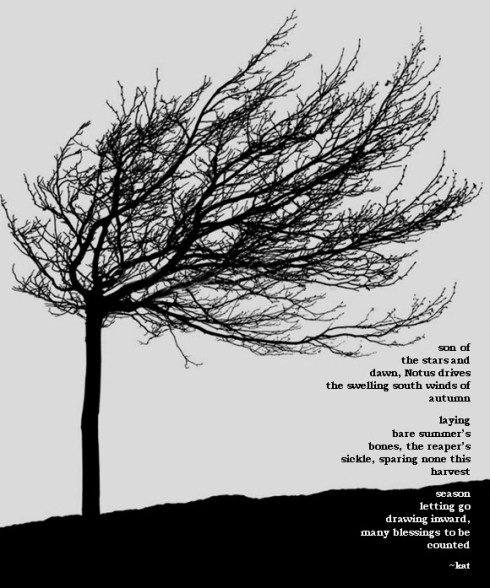
notus

son of
the stars and
dawn, Notus* drives
the swelling south winds of
autumn

laying
bare summer’s
bones, the reaper’s
sickle, sparing none this
harvest

season
letting go
drawing inward,
many blessings to be
counted

~kat
*NOTOS (Notus) was the god of the south wind, one of the four directional Anemoi (WindGods). He was the wet, storm-bringing wind of late summer and early autumn. Notos dwelt in Aithiopia (Ethiopia), the southernmost realm in the geographies of myth.


A cinqku must always have 5 lines and a perfect seventeen-syllable count. The lines typically follow a 2,3,4,6,2 format. There is no title requirement on the second line. As for syntax and diction styles, it follows the free Tanka style originally. There are no metric requirements for a cinqku poem. Additionally, the final line must contain a cinquain or kireji turn for emphasis.