

greying starless nights
cool melancholy musings
raindrops on pavement
~kat
For Haiku Horizons Challenge, prompt word, Star.
greying starless nights
cool melancholy musings
raindrops on pavement
~kat
For Haiku Horizons Challenge, prompt word, Star.
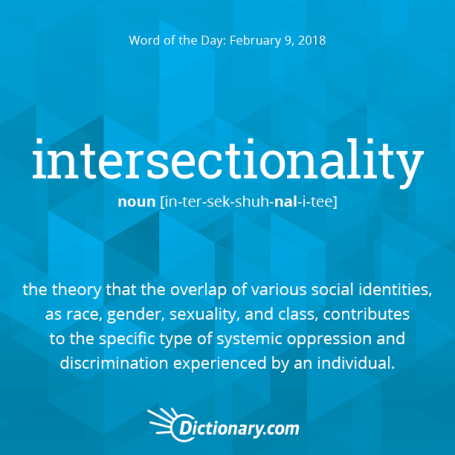
Today’s word of the day at Dictionary.com is a modern word coined by the American feminist legal scholar, critical race theorist, and civil rights activist, Kimberlé Williams Crenshaw in 1989. Intersectionality is the theory that the overlap of various social identities as race, gender, sexuality and class, contributes to the specific type of systemic oppression and discrimination experienced by an individual (often used attributively): Her paper uses a queer intersectionality approach. It is also defined as the oppression and discrimination resulting from the overlap of an individual’s various social identities: the intersectionality of oppression experienced by black women.
From Wikipedia:
In her work, Crenshaw discussed Black feminism, which argues that the experience of being a black woman cannot be understood in terms of being black and of being a woman considered independently, but must include the interactions, which frequently reinforce each other. Crenshaw mentioned that the intersectionality experience within black women is more powerful than the sum of their race and sex, and that any observations that do not take intersectionality into consideration cannot accurately address the manner in which black women are subordinated.
Intersectionality is a theory which considers that the various aspects of humanity, such as class, race, sexual orientation and gender, do not exist separately from each other, but are complexly interwoven, and that their relationships are essential to an understanding of the human condition. When systems of justice or other entities attempt to look at each aspect in isolation, then misconceptions may occur and essential understandings may be lost. The theory proposes that individuals think of each element or trait of a person as inextricably linked with all of the other elements in order to fully understand one’s identity.
In 2011 Columbia Law School, under the direction of Professor Crenshaw, established the Center for Intersectionality and Social Policy Studies. “The Center’s existing projects focus on race, gender, and incarceration; substandard education and low-wage work; race, sexuality, and masculinities; and the generation of new disabilities and illnesses among communities of color.” You can read more about their work HERE.
Kimberlé Crenshaw is also featured in a variety of lectures and TED talks. A quick Google search will give you an opportunity to learn more about intersectionality from Dr. Crenshaw herself.
Here’s a quick haiku (which wasn’t easy, considering that this is a SEVEN syllable word!)
Have a great weekend…
it’s just a theory
intersectionality
unless it’s your life
~kat
Oh my dear… my little Haiku for Ronovan’s Challenge caused quite a fluster…and I did not mean for it to. The prompt words shy and blush and their interesting synonyms definitely took me on a tangent. But you must understand, that for a woman my age, flushing and blushing have more to do with menopausal dips and dives than anything sultry! My mind sooooo did not go where some of yours did! 😳
At any rate, a do-over is in order…g-rated and straight to the point. I also flush crimson when I am steaming mad…which is what I meant to say and should have. 🤪
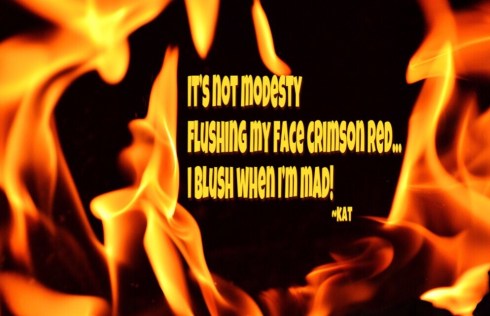
It’s not modesty
flushing my face crimson red…
I blush when I’m mad!
Of course you could take madness down any number of paths…fuming perhaps? Burned? Irate? Full of rage…some might say passion as I did…but that is easily misconstrued. Pissed! Now that’s a fine word. But I did say this Haiku is rated G. Still…substitute it for mad if you like…at least pissed can’t be confused with being bat-shit crazy! Okay now…don’t you dare go there! 😜
I hope you don’t mind me having a bit of fun with today’s silly Haiku. You all gave me a good laugh when I read the comments. It’s all in good fun that I am carrying on the conversation! 😉
kat
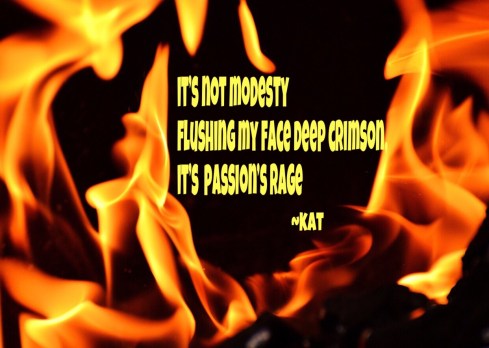 it’s not modesty
flushing my face deep crimson,
it is passion’s rage
~kat
For Ronovan Writes Haiku Challenge, Prompt words: shy (modest) & blush (flush).

Today’s word of the day at dictionary.com is oblivescence which means: forgetting; state of being forgotten; the condition or fact of failing to remember or having failed to remember or of being absent-minded.
According to dictionary.com,
Oblivescence dates from the late 19th century and is a later spelling of obliviscence, which dates from the late 18th century. The spelling oblivescence arose by influence of the far more common suffix -escence. The English noun is a derivative of the Latin verb oblīviscī “to forget,” literally “to wipe away, smooth over.” The Latin verb is composed of the prefix ob- “away, against” and the same root as the adjective lēvis “smooth.”
There are a number of references to this word in psychology that deal with memory. Oblivescence is a theory described as a means of self-preservation in our propensity to forget the disagreeable things we have experienced while preserving the pleasurable aspects of the same event.
Until I learned this word I never thought much about it, but how true it is. Upon meeting their newborn baby, many mothers completely forget the pain of labor. Holidays and family gatherings in the past are remembered only as happy occasions and completely forgotten are family tensions and arguments that may have erupted at the very same event. Memories of a loved one, now passed away become more and more positive as the years go by and we slowly forget the things about them that drove us batty. Interestingly, this phenomenon seems to happen unconsciously. It is not the same thing as having selective memories of a person, place or thing.
As I often do, I found a fun reference to this word in modern times. There is a spell or charm in the Harry Potter series as explained in this reference index excerpt:
oblivescence
The process of forgetting.
obliviate
A memory charm or spell in the Harry Potter books that makes someone forget.
obliviator
The act of memory modification which can be used by any wizard, by using the spell, “Obliviate” as described in the fictional universe of the Harry Potter series as written by J.K. Rowling.
An Obliviator is the designation for a Ministry of Magic employee who has the task of modifying the memory of a Muggle after witnessing incidents belonging to the magic world.
A Muggle is a term, sometimes used in a pejorative manner, from the fictional Harry Potter series of books that refers to a human who is a member of the non-magical community.
Here’s a wiki-link for the various occasions when this spell was used.
I often wonder why I remember some things and not others (which I am only reminded of through the recollections of others). Now I have a word for it. It’s as if random years of my life have been erased like they never happened. I suppose that is why the memories I have retained are so precious.
barely a feeling
fading to oblivescence
days of loving you
~kat



 like mercury colliding...