
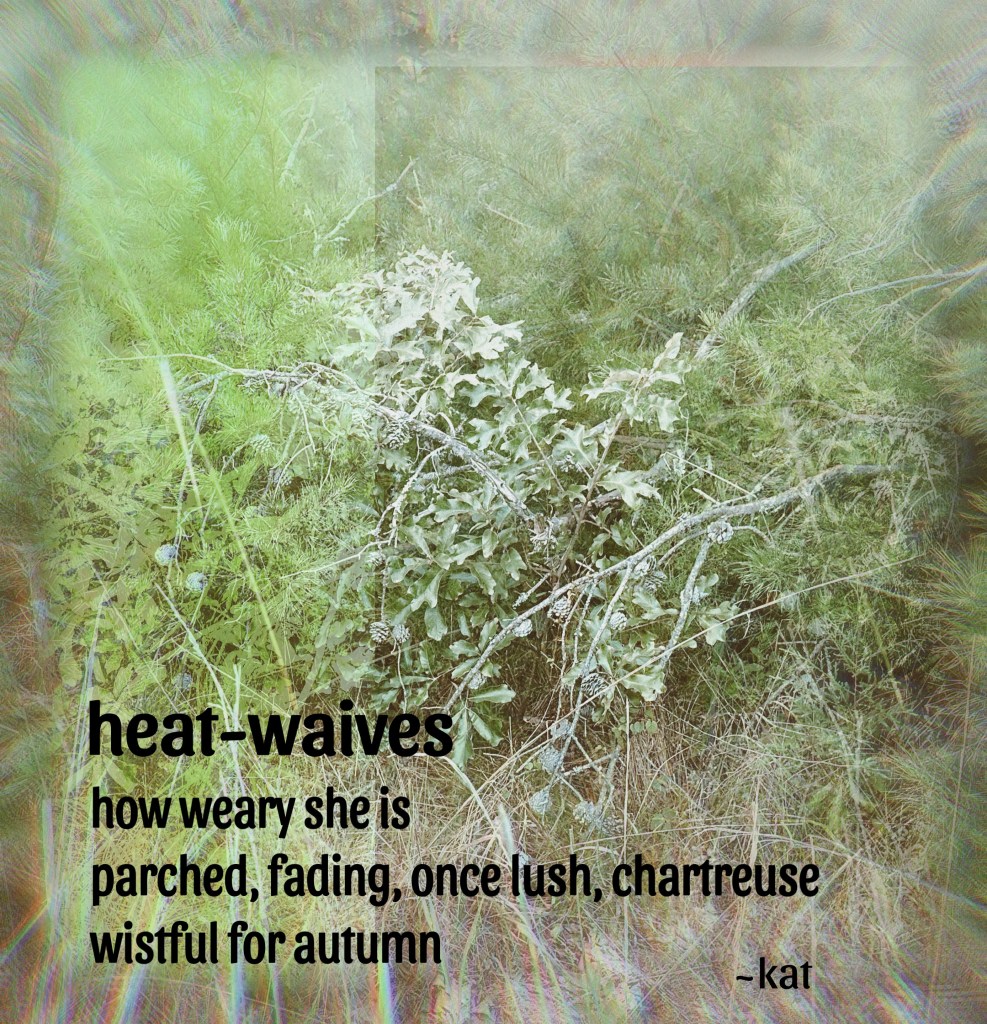
heat-waives
a haiku

how weary she looks
parched, fading, lush to chartreuse
wistful for autumn

~kat
heat-waives
a haiku
how weary she looks
parched, fading, lush to chartreuse
wistful for autumn
~kat
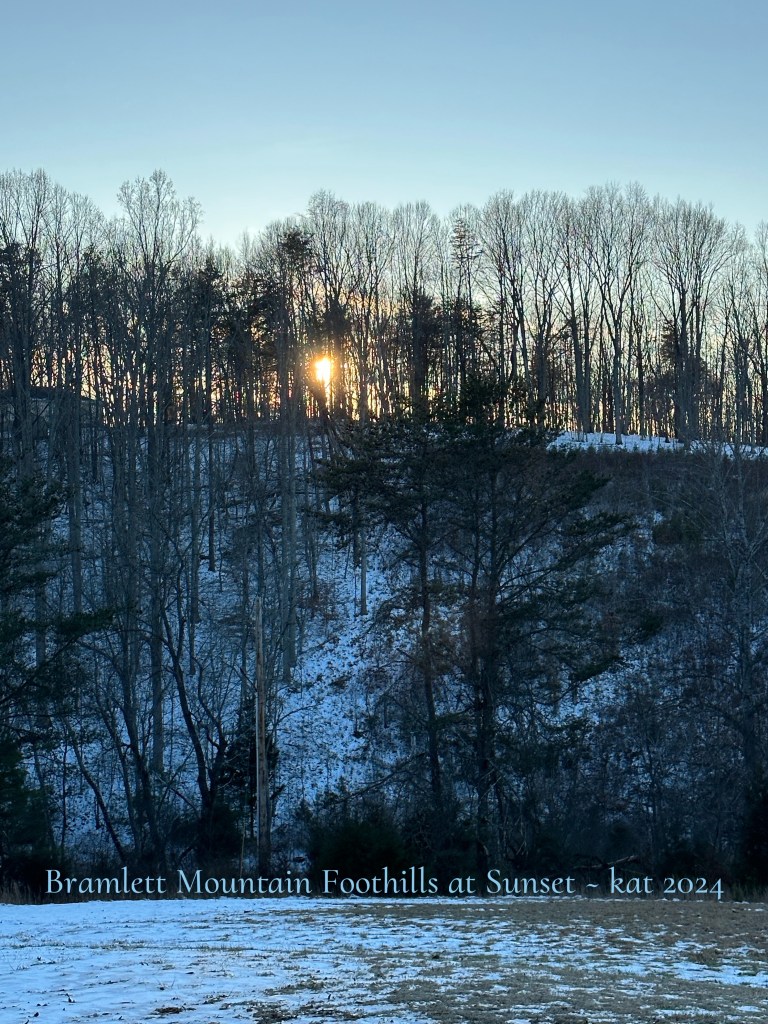
I’m a bit late to the 2024 party. As fate would have it, I was exposed to not just one, but two nasty viruses on Christmas Day at a family gathering. First to darken my door was the flu…a nasty strain this year…and then, just as I was feeling human again a week later, on New years Day, COVID finally got me (a first for me). I suppose I’ve joined the herd. If not for the booster I got last November, the doc said I might not have faired as well as I did. Still it was not how I planned on ringing in the new year! Anyhow…we’ve been snowed in for a bit…things finally melting, and I snapped this view out my front door this evening. It blew me away. I am so grateful for the beauty that surrounds me. For each sunrise and sunset. I hope you and yours are well.
Before I close out this post, I must share another view of the photo above. I applied a mirror filter to it and lo and behold, there she was right there reminding me Gaia, (as I imagine her at this time of year) sleeping amongst the roots, deep underground waiting for spring! What a gift this slight of photo editing produced! Isn’t she amazing!!! If you look at the original, you’ll see her peeking out at you. Sometimes it takes a mirror to see things more clearly.
It’s a reminder to me that it’s okay to rest (I’ve rested a lot this year). A new year need not be tackled all at once. We have 365 (actually 366 days this year) to live the promise of 2024.
I wrote a little haiku too. Of course I did! Peace and much love to you!

gaia suspended

deep beneath the snow
she slumbers, dreaming of spring
winter lingers long

~kat~
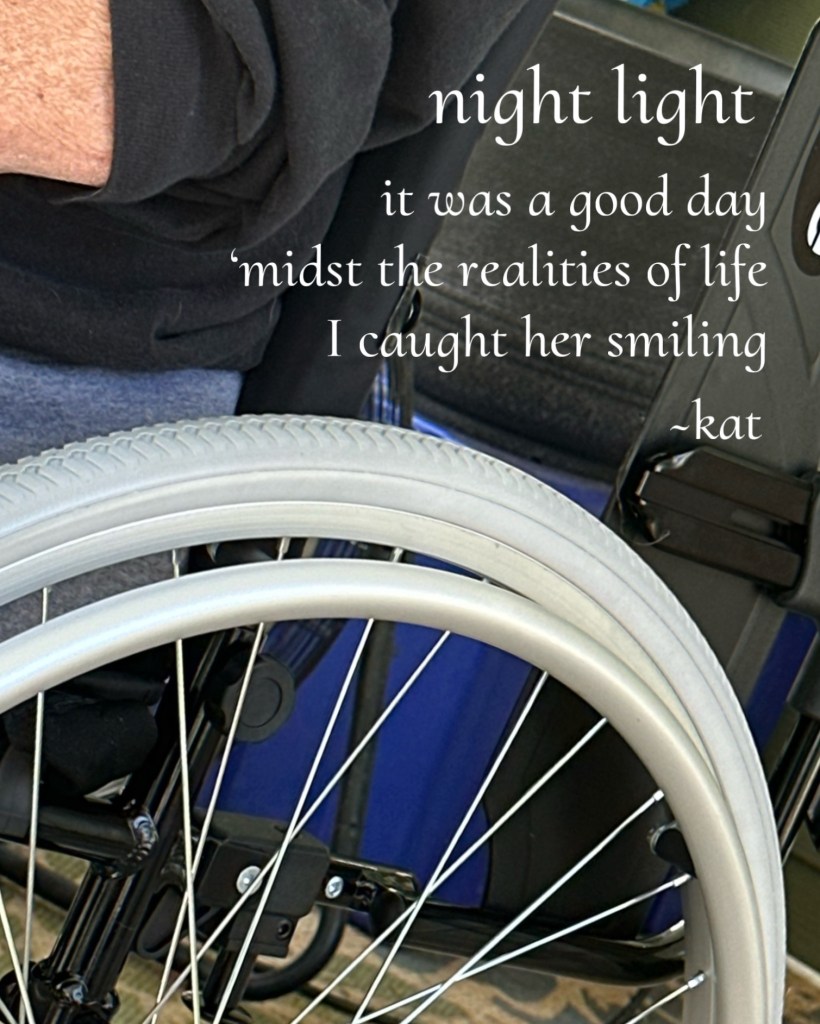
night light

it was a good day
‘midst the realities of life
I caught her smiling

~kat

It’s the small things that keep me going. I collect these moments, keeping them close to my heart and at the ready to draw upon when the going is rough. Like a candle in the distance on a dark, dark night. Yes, it was a very good day.

Zephyrus

he softly whispered
tossed my hair, kissed my bare neck
warm breath on my skin

the ancients named him
Zephyrus, god of the west wind
warm breath on my skin
gentlest of the Anemoi
deadly when he is jealous

~kat
I have enjoyed this past week’s practice of the Hainka. Familiar and yet nuanced. This coming week’s micropoetry form will be the Bob and Wheel. It incorporates a trifecta of rules: line, syllable and rhyme, which should be challenging and fun…if you like a good challenge like I do. Until then, enjoy your week end.
The Hainka
The 17-syllable haiku is the shortest form of poetry, and the 31-syllable tanka is probably the second shortest format of verse. Precisely the new form of poetry, hainka, is an assimilation of objective sensitivity of haiku with the more subjective oriented of tanka poetry. The synthesis in hainka is based on the image linking (the ‘fragment’ of haiku acting as the ‘pivot line’ of the following tanka) to explore and interweave human nature, love, emotion, humor in a broader sense by juxtaposition of the imageries.
It is also interesting to see the syllabic coherency between the ‘fragment’ (5-syllable words) with the 5-syllable words of the ‘pivot line’ of tanka. The final structural configuration would be 5/7/5/5/7/5/7/7 (s/l/s/s/l/s/l/l) with the significance of the image linking. A breathing gap (swinging space) is preferred between the haiku and tanka for the reader to imagine and experience the essence of poetry.
This image-linking across time and space is the art of painting an integrated poetic expression and exhibiting the fervent elucidation of hainka writing. Moreover, it retains its focus on the beauty of genetic image-linking to explore the poetic spell within the broader structural framework of the aesthetic essence and rhythms of Japanese short forms of poetry. Echoing the spirit of Basho’s ‘atarashimi’ (newness), I wish that the new verse will entwine the art of gratitude encompassing nature, living beings, non-living beings, and humanity as a whole.
Read more about the evolution of this form at Poetry Digest here: https://www.writersdigest.com/write-better-poetry/hainka-haiku-tanka-new-genre-of-poetic-form
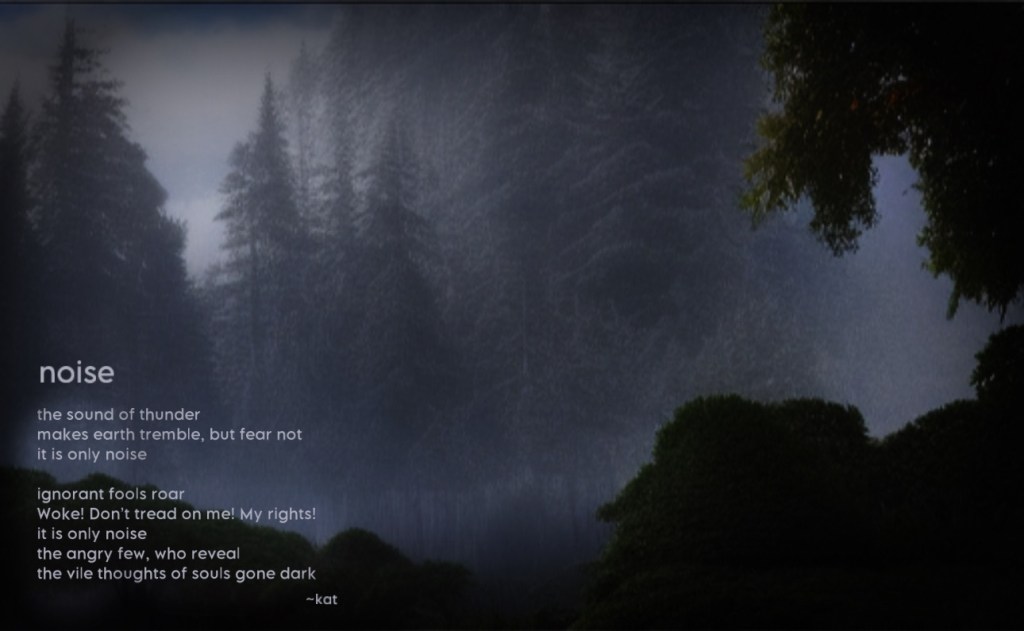
noise

the sound of thunder
makes earth tremble, but fear not
it is only noise

ignorant fools roar
Woke! Don’t tread on me! My rights!
it is only noise
the angry few, who reveal
the vile thoughts of souls gone dark

~kat
The Hainka
It is also interesting to see the syllabic coherency between the ‘fragment’ (5-syllable words) with the 5-syllable words of the ‘pivot line’ of tanka. The final structural configuration would be 5/7/5/5/7/5/7/7 (s/l/s/s/l/s/l/l) with the significance of the image linking. A breathing gap (swinging space) is preferred between the haiku and tanka for the reader to imagine and experience the essence of poetry.
This image-linking across time and space is the art of painting an integrated poetic expression and exhibiting the fervent elucidation of hainka writing. Moreover, it retains its focus on the beauty of genetic image-linking to explore the poetic spell within the broader structural framework of the aesthetic essence and rhythms of Japanese short forms of poetry. Echoing the spirit of Basho’s ‘atarashimi’ (newness), I wish that the new verse will entwine the art of gratitude encompassing nature, living beings, non-living beings, and humanity as a whole.
Read more about the evolution of this form at Poetry Digest here: https://www.writersdigest.com/write-better-poetry/hainka-haiku-tanka-new-genre-of-poetic-form





 like mercury colliding...