Tag Archives: digital art

August – Stanzas 26-27

Two stanzas today. Yesterday was spent on the road.

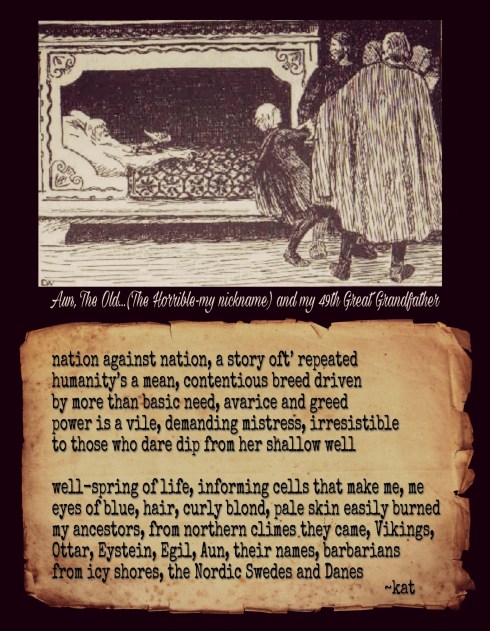
nation against nation, a story oft’ repeated
humanity’s a mean, contentious breed driven
by more than basic need, avarice and greed
power is a vile, demanding mistress, irresistible
to those who dare dip from her shallow well

well-spring of life, informing cells that make me, me
eyes of blue, hair, curly blond, pale skin easily burned
my ancestors, from northern climes they came, Vikings,
Ottar, Eystein, Egil, Aun, their names, barbarians
from icy shores, the Nordic Swedes and Danes

~kat

For Jane Dougherty’s August Stanza Challenge.


From Wikipedia, a story about Aun, of the Yngling Dynasty, King of Uppsala…and allegedly, if the tree leaves on Ancestry.com are correct, my 49th Great Grandfather. Aun was a horrible man, a terrible father who was sick with power….

Ruling from his seat in Uppsala, Aun was reputedly a wise king who made sacrifices to the gods. However, he was not of a warlike disposition and preferred to live in peace. He was attacked and defeated by the Danish prince Halfdan. Aun fled to the Geats in Västergötland, where he stayed for 25 years until Halfdan died in his bed in Uppsala.

Upon Halfdan’s death Aun returned to Uppsala. Aun was now 60 years old, and in an attempt to live longer he sacrificed his son to Odin, who had promised that this would mean he would live for another 60 years. After 25 years, Aun was attacked by Halfdan‘s cousin Ale the Strong. Aun lost several battles and had to flee a second time to Västergötland. Ale the Strong ruled in Uppsala for 25 years until he was killed by Starkad the old.

After Ale the Strong’s death, Aun once again returned to Uppsala and once again sacrificed a son to Odin; this time Odin told the king that he would remain living as long as he sacrificed a son every ten years and that he had to name one of the Swedish provinces after the number of sons he sacrificed.

When Aun had sacrificed a son for the seventh time, he was so old that he could not walk but had to be carried on a chair. When he had sacrificed a son for the eighth time, he could no longer get out of his bed. When he had sacrificed his ninth son, he was so old that he had to feed, like a little child, by suckling on a horn.

After ten years he wanted to sacrifice his tenth and last son and name the province of Uppsala The Ten Lands. However, the Swedes refused to allow him to make this sacrifice and so he died. He was buried in a mound at Uppsala and succeeded by his last son Egil. From that day, dying in bed of old age was called Aun’s sickness.


an empty nester’s CHARADE – A Cleave Poem

For Mind Love Misery’s Menagerie Sunday Writing prompt: “From one place to another – A argument that goes back and forward.”

Today’s challenge is the perfect setting for a cleave poem. you know the rules: read the FIRST COLUMN FIRST, then the second, then ALL THE / way across.


an empty nester’s CHARADE

I AM FIERCE / i am terrified
AN INDEPENDENT WOMAN / of dying alone
I DON’T NEED ANYONE / that you will forget
I AM A SURVIVOR / i existed
LIFE’S CHALLENGES / most importantly
I’VE OVERCOME EACH ONE / i am afraid
I’M A WINNER / you don’t believe
I’M MAKING A MARK / you were the best part
LEAVING A LEGACY / the biggest thing i ever did
FOR FUTURE GENERATIONS / i have loved you fiercely
REMEMBER ME / more than life itself

~kat


Sunday’s Week in ReVerse – 26 August 2018

Weird ReVerse this week. I guess that’s what happens when you try to mix the present with the past, fire with ice, religion with politics. There’s a reason people don’t like to discuss the latter two.

As for religion, seeing all things through the lens of faith is a shaky premise to hang one’s hat on. Faith trusts in things unseen and in most cases unproven. We can get so caught up in the details and our differences that we forget the principles that are the best of religion. That’s my two cents’ worth.

And politics? Well it’s a beast. People like to keep their political allegiances secret. We cast our votes on “secret” ballots (that are number coded with our check-in ID#). Those so-called secret ballots are traceable back to you as sure as every search you make online adds to your electronic profile, ready for the picking by marketers and manipulators seeking to own your patronage and your allegiance.

It is true I am learning a lot about my ancestors this month. But it is also true that what I’m gleaning is a collection of notable bits and pieces of evidence that have lasted over time. In contrast, future generations will likely have access to troves of useless information to wade through if they are interested in knowing about me. A lot of information that amounts to nothing really. Mind blowing oblivion. I’m gonna end on that happy note. 🤣

Have a great week. I shall be bonding with a few of my grandchildren this week. Making memories…the only data worth sharing in this age of TMI.


Sunday’s Week in ReVerse – 26 August 2018

what mystery meld of genes informs my flesh and blood
the thunder, the storm,
one day i know i’ll be just a fleeting memory
days of rain
trouble tells me
good and fair and wise
while revolutionary battles raged, a great awakening time
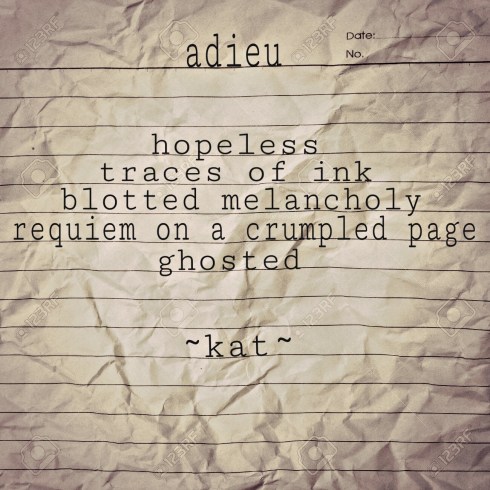
requiem on a crumpled page
an eagle spread it’s massive wings,
the status quo’s nemesis
days spent keeping house and raising her large brood
ice and fire don’t mix anymore than church and state
the dark, velvet sky opened up its heart

~kat

A ReVerse poem is a summary poem with a single line lifted from each entry of a collection of work over a particular timeframe and re-penned in chronological order as a new poem. Unlike a collaborative poem, the ReVerse features the works of one writer, providing a glimpse into their thoughts over a period time. I use it as a review of the previous week.


August – Stanza 25

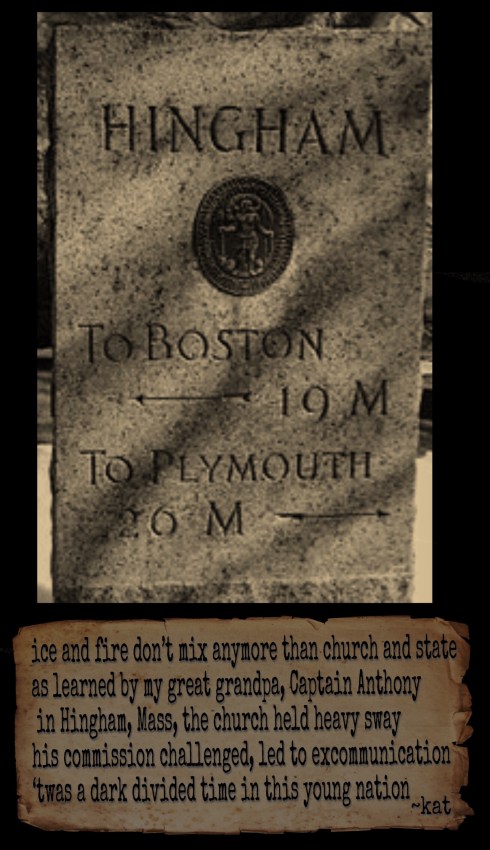
ice and fire don’t mix anymore than church and state
as learned by my great grandpa, Captain Anthony
in Hingham, Mass, the church held heavy sway
his commission challenged, led to excommunication
‘twas a dark divided time in this young nation

~kat

For Jane Dougherty’s August Stanza Challenge.


Below is a bit of history that included a snippet of my 12 Great Grandfather Captain Anthony Eames. He and his wife Marjory (Pierce) were among the first to settle in Hingham , Massachusetts. They had 9 children. Anthony was a sea captain, a Freeman at Hingham and Marshfield MA, a church warden at Fordington, MA, deputy to general court at Marshfield MA and Captain in the militia. Though the commission of Captain was much disputed by opposing groups in Hingham…

From Wikipedia:

The town of Hingham was dubbed “Bare Cove” by the first colonizing English in 1633, but two years later was incorporated as a town under the name “Hingham”. The land on which Hingham was settled was deeded to the English by the Wampanoag sachem Wompatuck in 1655.[8] The town was within Suffolk County from its founding in 1643 until 1803; and Plymouth County from 1803 to the present. The eastern part of the town split off to become Cohasset in 1770. The town was named for Hingham, a village in the English county of Norfolk, East Anglia, whence most of the first colonists came, including Abraham Lincoln‘s ancestor Samuel Lincoln (1622–90), his first American ancestor,[9] who came to Massachusetts in 1637. A statue of President Lincoln adorns the area adjacent to downtown Hingham Square.

Hingham was born of religious dissent. Many of the original founders were forced to flee their native village in Norfolk with both their vicars, Rev. Peter Hobart and Rev. Robert Peck, when they fell foul of the strict doctrines of Anglican England. Peck was known for what the eminent Norfolk historian Rev. Francis Blomefield called his “violent schismatical spirit”. Peck lowered the chancel railing of the church, in accord with Puritan sentiment that the Anglican church of the day was too removed from its parishioners. He also antagonized ecclesiastical authorities with other forbidden practices.

The bitter trainband controversy dragged on for several years, culminating in stiff fines. Eventually a weary Eames, who was in his mid-fifties when the controversy began and who had served Hingham as first militia captain, a selectman, and Deputy in the General Court, threw in the towel and moved to nearby Marshfield where he again served as Deputy and emerged as a leading citizen, despite his brush with the Hingham powers-that-be.


Autumn ~ Stanza 24

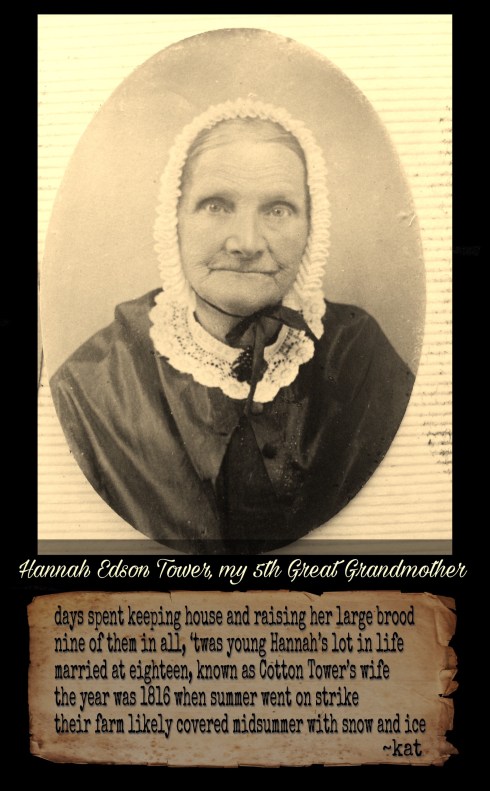
days spent keeping house and raising her large brood
nine of them in all, ‘twas young Hannah’s lot in life
married at eighteen, known as Cotton Tower’s wife
the year was 1816 when summer went on strike
their farm likely covered midsummer with snow and ice

~kat

For Jane Dougherty’s August Stanza Challenge.


History recounts the year 1816 as “The Year Of No Summer”. It was also the year my 5th Great Grandparents, Hannah Edson and Cotton Tower married. Cotton was a Farmer by trade. Hannah, who I am fortunate to have a photograph of, is listed on census records as a housewife. With 9 children I can’t imagine she had much time for anything else besides birthing and tending to her children. They all seem to have been of hearty stock though. Hannah died at the ripe old age of 74, with Cotton following her nearly a decade later at 85. They lived in Leavenworth, Indiana. I imagine the farms in that part of the country felt the chill, along with the rest of the world, caused by the eruption of Mount Tambora in Indonesia. It is said that the atmosphere was thick with volcanic ash, limiting the amount of sunlight, cooling the Earth’s surface, and causing a once-in-a-lifetime event: a year-long winter.

Here is an excerpt I found from The Washington Times Herald :

A year without a summer

Although no documented local records of weather existed in 1816, the summer of 1816 is without question a memorable year, not only locally, but world wide. The year of 1816 is referred to as “the year without a summer.”

In 1961, Frank L. Hartle of Indianapolis was in possession of an 1816 newspaper article describing 1816 as being the coldest summer ever experienced by any person living at that time.

The following are excerpts from the article:

“June was described as the coldest month vegetation had ever experienced in this latitude. Frost and ice was as common as buttercups usually are in June.”

“Mothers made thick mittens for their children and they wore knitted sox of double thickness. Overcoats and gloves were required by farmers as they attempted to do their daily chores.”

“A heavy snowfall on June 17, 1816, was accompanied by a pathetic story. A Vermont farmer turned his sheep to pasture the previous day. Temperatures dropped below freezing over night and snow had begun falling about 9 a.m.”

As the farmer left home, he jokingly remarked to his wife: “Better start the neighbors searching soon for me.”

“It’s the middle of June you know and I may get lost in the snow.” Snow continued to fall in torrents and drifts began to form. By night fall nothing had been heard from him. The wife summoned neighbors and they began to search for him. They continued searching the second day. Only after the third day, was he found lying in a hollow, half-covered with snow, still alive but both feet frozen. The sheep were found nearby, but most of the flock of sheep had lost their lives.

July offered no respite. Ice thicker than window glass required breaking the ice in the livestock water troughs so they could drink.

But to everyone’s surprise August proved worst of all.

“Almost every green thing in the country and Europe was blasted daily by frost. Snow fell in August in London, England. In Quebec City, Canada, on June 10, 1816, they experienced a 12-inch snowfall and 1816 was the coldest year in the northern hemisphere on record.

As a result of these abnormal summer temperatures, parts of Europe experienced a stormier winter in 1816. That, in turn, resulted in the widespread death of much of the livestock.

Cool temperatures and heavy rains resulted in failed harvests in Great Britain and Ireland. Families in Wales traveled long distances as refugees begging for food. Famine was prevalent in North and South West Ireland following the failure of their wheat, oats and potato harvests. Violent demonstrations in front of grain markets and bakeries, followed by riots, arson and looting in many European cities due to food shortages and skyrocketing food prices.

Worldwide, no living person at that time had any recollection of weather creating such havoc throughout history. While it was known that other countries were also experiencing similar weather problems, the actual cause wasn’t known until years later.

A cause is found

Virtually no one in Daviess County, Ind., had ever heard of Indonesia or the small island of Sumatra nor had they any knowledge of Mount Tambora nor would they ever have believed that a volcano half way around the world could have any effect on their lives, especially their weather.

If asked, at the time, if they knew that there was a volcano eruption on Mount Tambora in Indonesia; their answer would probably be, “So who cares?” The science of climate and the factors which contribute to temperatures, the seasons, the air currents and ocean tides were not a part of common knowledge. In fact, if someone were to have suggested that a volcano was to be blamed, even the highly educated in 1816 would label us as a “fruitcake.”

To believe the cause of 12-inch snowfalls in June or world widespread crop failures were a direct result of a volcano in Indonesia would have been truly unbelievable.

Although there are several volcanoes today capable of eruption, the April 1815 Mount Tambora eruption was the largest volcanic eruption in recorded history. The explosion was deafening and was heard on the island of Sumatra more than 1,200 miles away. The estimated death toll exceeded 71,000 people. A team of archaeologists during excavation diggings in 2004 discovered cultural remains buried from the Mount Tambora volcanic explosion still intact beneath 9.9 foot deep pyroclastic lava deposits. Many of the bodies were preserved in the positions they occupied on that fateful day in 1815.