life’s unpredictable lightning strikes where it will leveling best laid plans lost in the aftermath… learning to navigate life’s plot twists is key to letting go…unbroken
~kat
It’s been a lovely week exploring the Pleiades. Tomorrow begins a new week and a new form to chew on. It’s elements are familiar to all who enjoy the brevity of short form. It combines Haiku and Tanka creating a new form called the Hainka! Yes, it’s a real thing with some specific nuanced rules that make it wonderful. You’ll see. Until then, enjoy your weekend! 😊
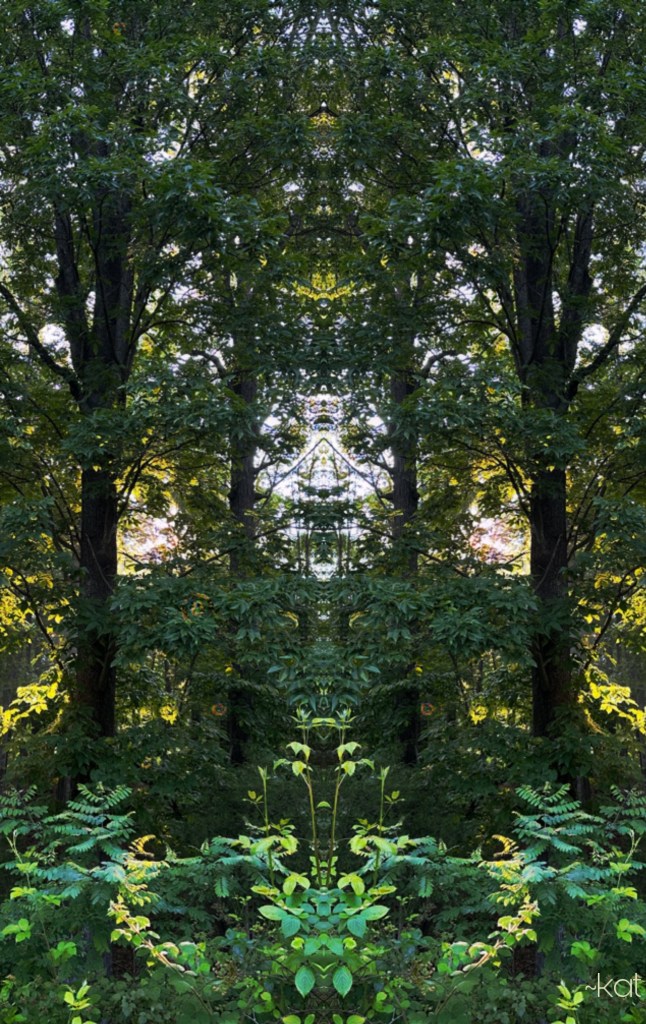
So, this has been a creative endeavor. While playing around with a recent photo of the forest in my back yard I stumbled upon the face of the goddess herself, smiling at me through the trees…or maybe I just have an overactive imagination. At any rate it made for an interesting poem and an even more interesting graphic to accompany it. I’m posting the original and then the enhanced mirrored version. Do you see her? Or maybe it’s just me! 🥰
Dawn on Bramlett Mountain ~ kat 2023Dawn on Bramlett Mountain ~ through the looking glass ~ kat 2023
Gaia

Grecian immortal
goddess, primordial
great-breasted nurturer,
gift-giver, earth mother,
green-adorned sustainer
giving birth to the sky…
generations, extolled

~kat
Pleiades
This titled form was invented in 1999 by Craig Tigerman, Sol Magazine’s Lead Editor. Only one word is allowed in the title followed by a single seven-line stanza. The first word in each line begins with the same letter as the title. Hortensia Anderson, a popular haiku and tanka poet, added her own requirement of restricting the line length to six syllables.
Background of the Pleiades: The Pleiades is a star cluster in the constellation Taurus. It is a cluster of stars identified by the ancients, mentioned by Homer in about 750 B.C and Hesiod in about 700 B.C. Six of the stars are readily visible to the naked eye; depending on visibility conditions between nine and twelve stars can be seen. Modern astronomers note that the cluster contains over 500 stars. The ancients named these stars the seven sisters: Alcyone, Asterope, Celaeno, Electra, Maia, Merope, and Tygeta; nearby are the clearly visible parents, Atlas and Pleione.
The poetic form The Pleiades is aptly named: the seven lines can be said to represent the seven sisters, and the six syllables represent the nearly invisible nature of one sister.
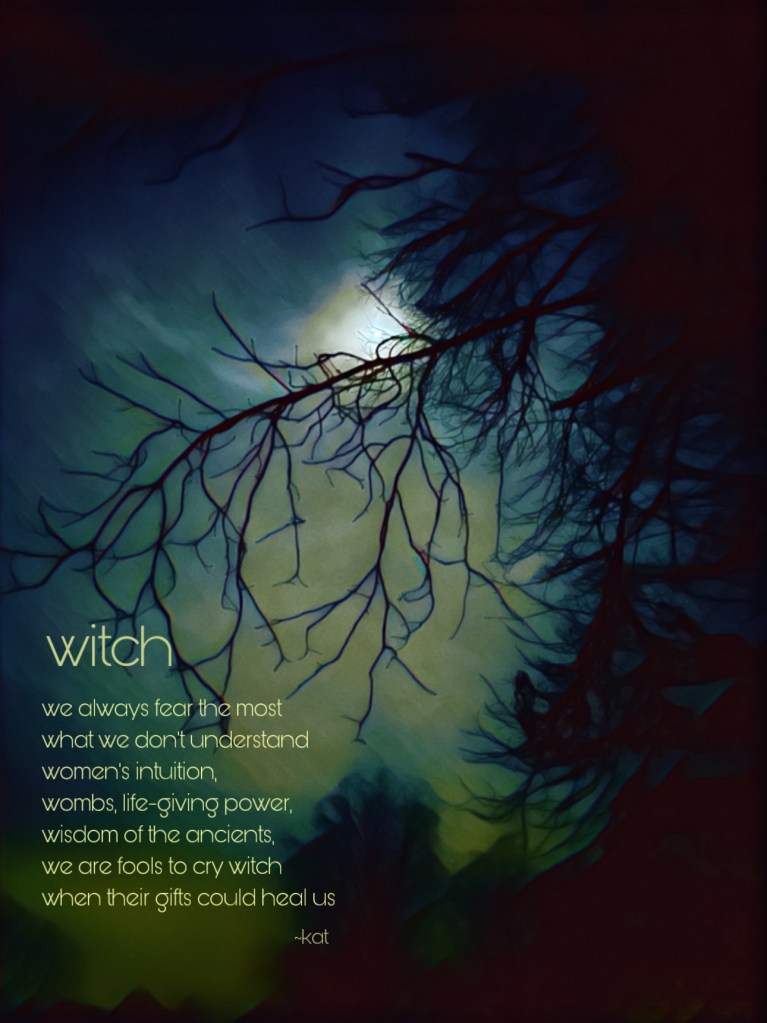
we always fear the most what we don’t understand women’s intuition, wombs, life-giving power, wisdom of the ancients, we are fools to cry witch when their gifts could heal us
~kat
Pleiades
This titled form was invented in 1999 by Craig Tigerman, Sol Magazine’s Lead Editor. Only one word is allowed in the title followed by a single seven-line stanza. The first word in each line begins with the same letter as the title. Hortensia Anderson, a popular haiku and tanka poet, added her own requirement of restricting the line length to six syllables.
Background of the Pleiades: The Pleiades is a star cluster in the constellation Taurus. It is a cluster of stars identified by the ancients, mentioned by Homer in about 750 B.C and Hesiod in about 700 B.C. Six of the stars are readily visible to the naked eye; depending on visibility conditions between nine and twelve stars can be seen. Modern astronomers note that the cluster contains over 500 stars. The ancients named these stars the seven sisters: Alcyone, Asterope, Celaeno, Electra, Maia, Merope, and Tygeta; nearby are the clearly visible parents, Atlas and Pleione.
The poetic form The Pleiades is aptly named: the seven lines can be said to represent the seven sisters, and the six syllables represent the nearly invisible nature of one sister.
compassion, her raiment, caring for those she loves cheerful, long suffering, committed to service, calm in the midst of storms carrying on in grace candle blazing, both ends
~kat
Pleiades
This titled form was invented in 1999 by Craig Tigerman, Sol Magazine’s Lead Editor. Only one word is allowed in the title followed by a single seven-line stanza. The first word in each line begins with the same letter as the title. Hortensia Anderson, a popular haiku and tanka poet, added her own requirement of restricting the line length to six syllables.
Background of the Pleiades: The Pleiades is a star cluster in the constellation Taurus. It is a cluster of stars identified by the ancients, mentioned by Homer in about 750 B.C and Hesiod in about 700 B.C. Six of the stars are readily visible to the naked eye; depending on visibility conditions between nine and twelve stars can be seen. Modern astronomers note that the cluster contains over 500 stars. The ancients named these stars the seven sisters: Alcyone, Asterope, Celaeno, Electra, Maia, Merope, and Tygeta; nearby are the clearly visible parents, Atlas and Pleione.
The poetic form The Pleiades is aptly named: the seven lines can be said to represent the seven sisters, and the six syllables represent the nearly invisible nature of one sister.
with favorite pen primed words swirling in my head when inspiration strikes write, write, and write some more wet the page, peacock blue weave the strands into verse whisperings from the muse
~kat
Pleiades
This titled form was invented in 1999 by Craig Tigerman, Sol Magazine’s Lead Editor. Only one word is allowed in the title followed by a single seven-line stanza. The first word in each line begins with the same letter as the title. Hortensia Anderson, a popular haiku and tanka poet, added her own requirement of restricting the line length to six syllables.
Background of the Pleiades: The Pleiades is a star cluster in the constellation Taurus. It is a cluster of stars identified by the ancients, mentioned by Homer in about 750 B.C and Hesiod in about 700 B.C. Six of the stars are readily visible to the naked eye; depending on visibility conditions between nine and twelve stars can be seen. Modern astronomers note that the cluster contains over 500 stars. The ancients named these stars the seven sisters: Alcyone, Asterope, Celaeno, Electra, Maia, Merope, and Tygeta; nearby are the clearly visible parents, Atlas and Pleione.
The poetic form The Pleiades is aptly named: the seven lines can be said to represent the seven sisters, and the six syllables represent the nearly invisible nature of one sister.
So it is easier for you to find all the parts/chapters of my ongoing fiction series, I created a new page that lists all the links. You can check it out HERE!
Unauthorized use and/or duplication of this material without express and written permission from this site’s author and/or owner is strictly prohibited. Excerpts and links may be used, provided that full and clear credit is given to Kat Myrman and Like Mercury Colliding with appropriate and specific direction to the original content.









 like mercury colliding...