

they are afraid
truth cannot penetrate their hearts
they are afraid
placing their faith in barricades
setting themselves above, apart
consumed by hate, lost in the dark…
they are afraid.
kat ~ 9 July 2016
(A Rondelet- AbAabbA)
they are afraid
truth cannot penetrate their hearts
they are afraid
placing their faith in barricades
setting themselves above, apart
consumed by hate, lost in the dark…
they are afraid.
kat ~ 9 July 2016
(A Rondelet- AbAabbA)
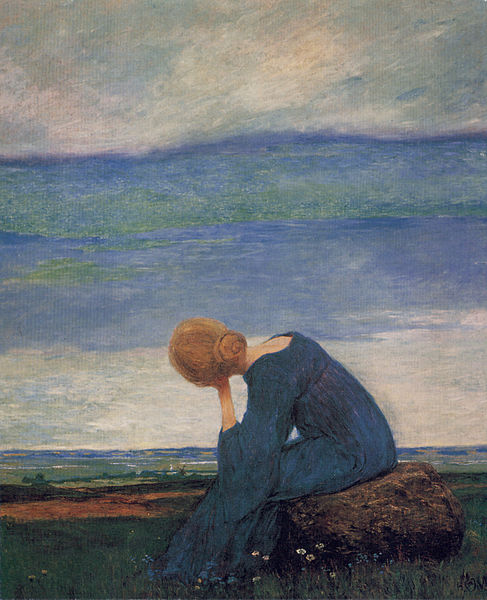
Painting by Heinrich Vogeler Sehnsucht (Traumerei) c1900
Dreary morning veiled in white
from darkest night
at break of day
she comes to pray
for hope, for healing grace, for peace
for hate to cease
for love’s pure balm
to bring us calm
from endless nights of terror’s rage
to turn this page
of history
to set us free.
What are you thinking Lady Blue
as you peruse
horizon’s wake
this bleak daybreak?
is your fair lover ‘cross the sea
oh could it be
that your heart yearns
for their return?
or is it wanderlust’s appeal
seeking to steal
your soul away
this break of day?
kat ~ 8 July 2016
A couple of Minute Poems for Jane Daugherty’s writing prompt, “Daybreak” and the painting you see above.
The Minute Poem is rhyming verse form consisting of 12 lines of 60 syllables written in strict iambic meter. The poem is formatted into 3 stanzas of 8,4,4,4; 8,4,4,4; 8,4,4,4 syllables. The rhyme scheme is as follows: aabb, ccdd, eeff.
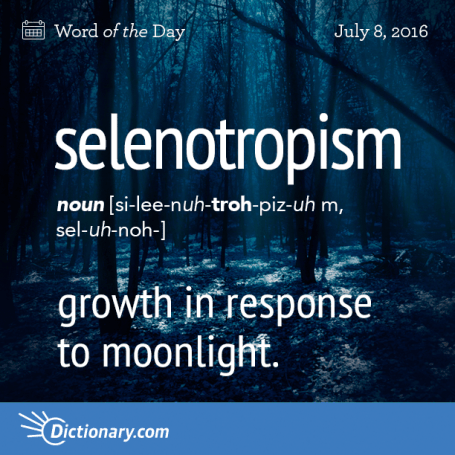
Today’s Dictionary.com Word of the Day is Selenotropism. It’s a whopper of a word comprised of six syllables. This presents quite a challenge when tasked with writing a Haiku! I decided to use the adjective form giving me another syllable to work with and I also opted to take further creativity liberty in the application of the word. Selenotropism is a Biology term that refers to plant growth and movement in response to moonlight. The word entered English in the 1880’s and comes from the Greek “se”ēnē” for “moon” and trópos which means “turn”.
A bit about the biological term…
Most of us know that plants will lean toward light. If you place a plant in a window, you will find that you need to turn it every so often to keep it from leaning to one side. This phenomenon is called “heliotropism” (helio referring to the sun). A biologist by the name of M. Musset, intrigued by the heliotropic movement of plants decided to conduct experiments on the influence of the reflected light of the moon. He chose three nights in February of 1883 to test his theory, exposing young plants to direct moonlight from 9 pm to 3 am. Almost immediately the buds of the plants bent the stalks in the direction of the moonlight and remained in a leaning position until the moon disappeared from view. He coined the term selenotropism, a nocturnal counterpart to the established heliotropism to name his discovery.
Source: Journal of the Royal Microscopical Society, Ser. II–Vol. III, 1883)
So now that you have a new bit of random information to log away in your brain, I am going to take this word on another twist. I propose that our dreams are inspired by the cool light of the moon. At least when I saw the Greek influence of the word, that is where my mind went…a “turning toward the Moon” and the way that moon glow influences our subconscious thoughts as we sleep. I suppose I’m taking full advantage of artistic liberty and freedom here, but then I am also prone to coloring outside of the lines too. Blame it on the moon!
To Dream Selentropic
Adrift in sleepy
selenotropic currents
dreams flood the gray void.kat ~ 8 July 2016

Photo by Kat Myrman 2015
dazzling summer…
sultry days, sizzling nights,
steamy sapphire sky.
kat – 5 July 2016
A Haiku for Ronovan Writes Haiku Challenge, Prompt Words: Dazzle & Sky.






 like mercury colliding...