Category Archives: Essays

Shi Sai Sunday’s Week in ReVerse – 6 August 2017


Most of you know I have a day job. Sometimes the day job encroaches my free time, launching me into an exhausting week of all work and no play, or in my case no time for writing. I managed to scribble out a few lines but I admit even the magnetic words felt overwhelming to me by week’s end.

Fortunately, since I began blogging, I have grown to appreciate the effectiveness of a 6 word story or a tweet. I’m bummed that I missed several of my favorite challenges this week. They were all good ones. I just couldn’t even…

But it makes me pay attention all the more to the words that did spill out of my brain this week, finding voice in prose or poetry. Six lines made it to the finish. There’s that number again. And today is the 6th day of August. Six…you have my attention. What are you trying to tell me? (So of course I am pausing here to look it up…be right back!)

From the site, mysticalnumbers, I learned:

*The number 6 is a symbol of completeness.
*Number 6 symbolizes beauty and high ideals.
*Number 6 is A Perfect Number. The *Pythagoreans acknowledged number 6 to be the first perfect number.
*Number 6 is the symbol of luck, the highest number of the dice.
*The number 6 is the symbol of Venus, the goddess of love.
*In the Tarot, six is the card of the Lover – The Lovers naturally symbolizes anything to do with the heart; love and also inner peace and harmony.
*June is the 6th month. (my birth month)
*The number 6 is the atomic number for carbon.
*The standard flute has six holes.
*The standard guitar has six strings.
*Insects have six legs.
*In the beehive honeycomb, the cells are six-sided.

And as I shared this week, I have lived on this planet 6 decades. It seems like such a small number but it is a perfect number. It is a symbol of completeness. What I glean from all this is that even though I was not allowed to spend more time writing, the words that I did find, and my simple little six line ReVerse, are a perfect representation of my life this past week.

My boss told me to be ready to hit the ground running this coming week. Looks like another week chasing a dollar. If only I didn’t need food and shelter to survive, I could spend all my hours writing. But would more words tell my story any more eloquently? I’ll hang onto that thought when I find only a moment, here and there, to write. There is perfection in brevity.

Peace out! Have a magical week! I’m ready. Here we go…to infinite perfection and beyond!

Shi Sai Sunday’s Week in ReVerse – 6 August 2017

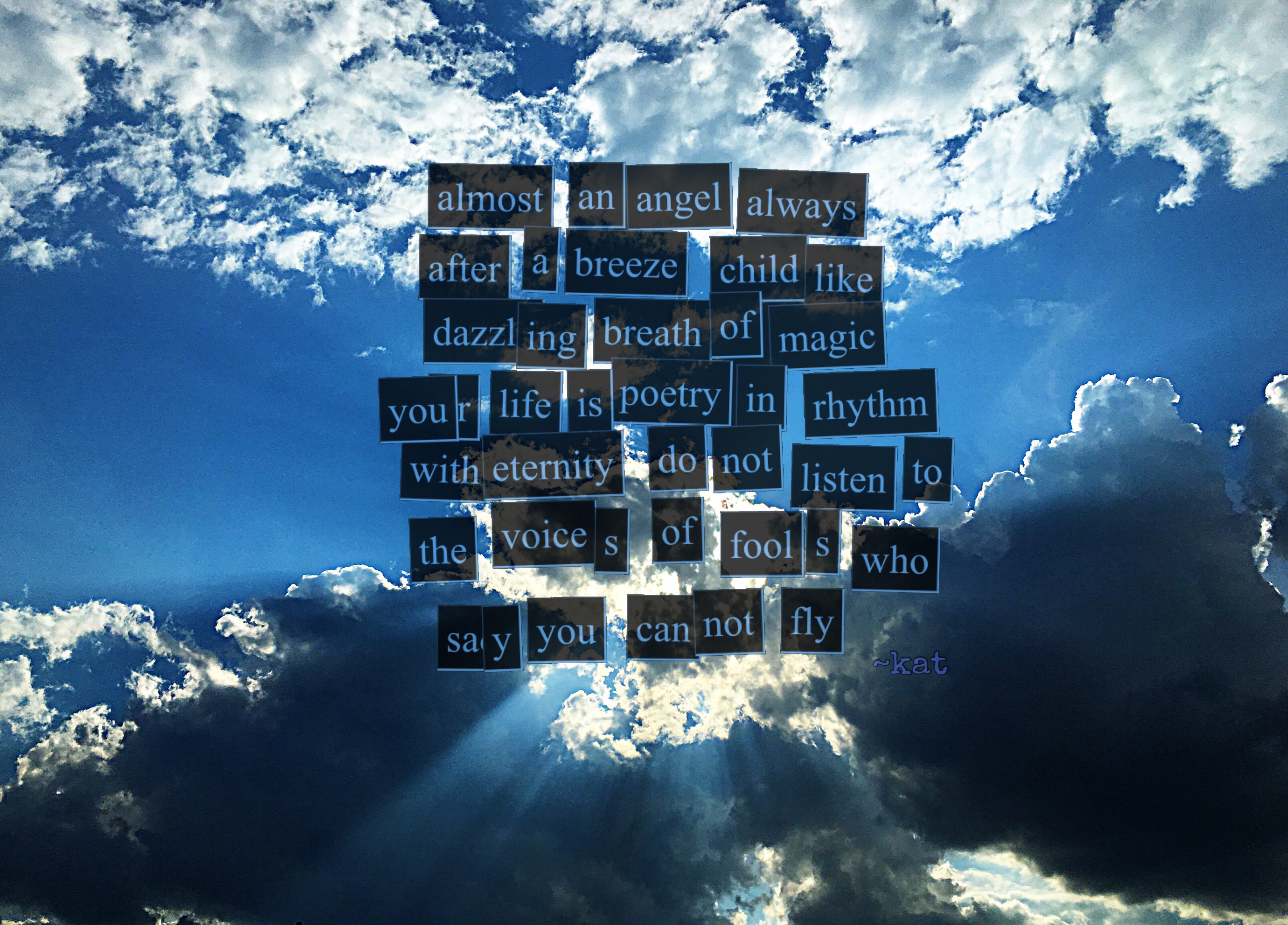
your life is poetry in rhythm
Morning, you. I made coffee
cut flowers die
I don’t need to know all the answers
my tack is a pen
full moon dusking

~kat

A shi sai or ReVerse poem is a summary poem with a single line lifted from each entry of a collection of work over a particular timeframe and re-penned in chronological order as a new poem. Unlike a collaborative poem, the shi sai features the words of one writer, providing a glimpse into their thoughts over time. I use it as a review of the previous week.


Hobbyhorse – Friday’s Word of the Day


When I think of a hobbyhorse I imagine a stick with a horse’s head or a rocking horse, ridden by children, which is, in fact the second definition for today’s word of the day on dictionary.com. The first definition, a pet idea or project is not something I ever associated with the word hobbyhorse. 

A look at the word’s origin tells a different story. According to etymology online the word hobby actually means a “small, active horse,” from hobi short for hobyn (mid-14c.; late 13c. in Anglo-Latin), and was probably originally a proper name for a horse that is now extinct. Hobby as a shortening of hobbyhorse also was used in the “morris horse” sense (1760), or as Dictionary.com states “in the 16th century hobbyhorse meant several things, e.g., a figure of a horse made of wicker worn in morris dances, pantomimes, and burlesques; a child’s toy consisting of horse’s head on the end of a stick or a rocking horse; a horse on a merry-go-round or a carousel in the 1680’s. By the 17th century hobbyhorse developed the meaning “pet project, favorite pastime.” Hobbyhorse entered English in the 16th century.”

Is it just me or does the term hobbyhorse sound a bit redundant? Basically one is saying horse (hobby) horse. But I digress.

Painting of a hobby horse with Morris dancers beside the River Thames at Richmond, London, c.1620


Hobbyhorses were associated with May Day celebrations, Mummers plays and the aforementioned Morris dance in England in the 17th and 18th centuries. Wikipedia explains that there were several types of hobbyhorses:

*Tourney horses- meant to look like a person riding a small horse that is wearing a long cloth coat or caparison (as seen in medieval illustrations of jousting knights at a tourney or tournament)

* Sieve horses – a simpler version of the tourney horse. Known only in Lincolnshire, made from a farm sieve frame, with head and tail attached, suspended from the performer’s shoulders. The performer wears a horse blanket (the kind that includes a headpiece with holes for the eyes and ears) that covers them and the sieve.

* Mast horses – are meant to represent the horse (or other animal) itself. They had a head made of wood, or sometimes an actual horse’s skull was used; it usually has hinged jaws that can be made to snap. The head is attached to a stick about 1 m (3 ft) long. The person acting the creature is covered by a cloth attached to the back of its head; he (or, rarely, she) bends over forwards or crouches, holding the head in front of their own and resting the other end of the stick on the ground. A tail may be attached to the back of the cloth.

And this is only a sampling of the types of hobbyhorses used in Great Britain. In fact many countries and cultures have used a form of hobbyhorse in ceremonial dance, festivals, customs and theatre for centuries. You can read all about them at Wikipedia HERE.

So how did the word hobbyhorse become associated with an obsession? According to Wikipedia the term “hobby horse” came from the expression “to ride one’s hobby-horse”, meaning “to follow a favourite pastime”, and in turn, the modern sense of the term hobby. Makes perfect sense to me! 😉

Of course there is also the literary reference to the word penned by none other than the Bard himself, “Cal’st thou my love Hobbi-horse?” (Translation: A loose woman or strumpet) – William Shakespeare, Loves Labour’s Lost, in 1588. And there is the ‘velocipede’ (sounds like a very fast many-legged slug…the stuff of nightmares!)…also called a ‘pedestrian hobbyhorse’ or ‘dandy horse’. it was a two wheeled ‘bicycle’ that the rider propelled by pushing the ground with each foot alternately. This modern marvel, a forerunner to the modern pedaled version was all the rage in the early 19th century. It was featured in The Gentleman’s Magazine, February 1819.


So there you have it; a glimpse into today’s word of the day. And here’s a little Haiku to bring it all home…

this blogs a hobby
could say, it’s my hobbyhorse
my tack is a pen

~kat


Shi Sai Sunday’s Week in ReVerse – 30 July 2017


I love this week’s Shi Sai ReVerse poem! It tells such a story.

Once upon a time there was such a thing as decorum, civility and grace. People had manners and treated others with respect; but no more. Now anything goes. We are insulated from the consequences of our meanness because we can release the dark side of our souls in posts and tweets and voice messages. What was once whispered in private is now broadcast around the world never to be erased, taken back or atoned for.

I am the first to say that I miss the days when we were nicer to each other. But there is a part of me that is grateful for our recent fall from grace.

Just because we didn’t speak our minds back in the day, doesn’t mean that those ugly things didn’t exist. We just hid them better. The recent divide that has torn my country down the middle has been rumbling under the surface for a long time. Back in the day before we lost our filters, people seemed friendlier, more respectful and tolerant. But those things were just skin deep.

While it’s shocking to see our true selves erupt, it also brings things out into the open, where we can deal with the fear, lack of empathy and downright hatefulness. It is true I have lost friends and family members in the past year. But I am coming to terms with the reality that these people who were nice to my face were not really my friends after all.

So yes, I am grateful. My life is enriched all the more by relationships built on trust. And when I miss those who are no longer part of my circle, I remind myself that I only miss the illusion of what we had. How can you miss something that never was?

Have a great week. Be true to you and yours in this brave new world we live in where authenticity is a priceless treasure. Peace!

Shi Sai Sunday’s Week in ReVerse – 30 July 2017

if only we’d lingered,
forever bound
basking in warm memories
to create lives worth living
because actions speak louder
heaven bending near
getting nowhere very fast
with a spot of rouge
I laughed it off at the time as crazy
heartless fools can’t see
pie is all about the crust, honey
suspended, graceful,
in the here and now
dance with me my love
poison devouring us
the world grows restless

~kat

A shi sai or ReVerse poem is a summary poem with a single line lifted from each entry of a collection of work over a particular timeframe and re-penned in chronological order as a new poem. Unlike a collaborative poem, the shi sai features the words of one writer, providing a glimpse into their thoughts over time. I use it as a review of the previous week.


Ballon -Friday’s Word of the Day


Today’s word of the day at Dictionary.com is a French word: “ballon”. At first I wondered if it was a typo. “Shouldn’t that be ‘balloon’?” I thought. And then I looked at the definition and especially the origin of the word. It all began to make sense. From dictionary.com:

Origin of ballon
Ballon is a French term used especially in ballet, describing a dancer who appears to be floating in the air while executing a jump or other movement, like “His Airness,” Michael Jordan. Earlier English spellings of the word include balonne, baloune, and balloone as well as balloon. The original sense of the word in the early 17th century was “ball,” specifically a large, sturdy, inflated leather ball hit with the arms protected with wooden boards or kicked like a soccerball. By the late 17th century ballon and balloon had developed the meaning “a large globular glass vessel” used for chemical distillation; and by the late 18th century, balloon (thus spelled) also meant “a round, flexible, airtight bag that rises into the air when inflated with heated air or gas.” Balloon becomes the standard English spelling in the late 17th century. Ballon, as a ballet term, entered English in the 19th century.

So, ballon in ballet is about floating on air, and balloons? Well they are floaty orbs, unless they’re filled with water or made of glass. I got the impression that the original balloon was more about its shape than its floating qualities. And then I started to think of round, inflated ballerinas bursting at the seams of their leotards, tutus stretched tight and stiff around their middles, and I couldn’t help but giggle.

Which came first the ballon or the balloon? The latter, of course. Ballon, in ballet, entered the English vocabulary rather late to the dance in the 19th century. We humans had been filling animal bladders and other hollow bulbous things for centuries.

Somewhere between heaven and earth the idea of floating on air became associated with balloons and voila! We now have ballon to help us describe the amazing acrobatic, gravity-defying leaps of ballerinas. Being inflated and puffy not required!

I’m feeling silly today. I best give you my Haiku. Have a great weekend!

suspended, graceful,
the skilled ballon of dancers
defies gravity

~kat


Shi Sai Sunday’s Week in ReVerse – 23 July 2017


Grief likes to sneak up on us when we least expect it. Or at least that’s what we tell ourselves when it taps us on the shoulder to remind us it’s still hanging around. Whatever the loss, there are consequences for having cared about someone or something.

Some of us try to outsmart this inevitable reality of life. We detach from anything that might cause us pain.

But, we lose things every day. Ask me how many times I’ve lost my car keys in the past year…more than a few! We may lose an opportunity, our place in line at the grocery store, because we forgot to grab peanut butter when we were on aisle 5, or we might lose our way when the gps isn’t working and tells us to turn right…right into a corn field. We may even lose our marbles…well…maybe that last one is for another discussion…though I do remember how distressed I was at age 5 or 6 when I lost my prized blue cat’s eye beauty…

But of course, these not the types of loss I am referring to. In order to grieve it is required to have loved. I am certain that life would not be worth living if not for love. And there’s the rub.

What do we do when we love, but the object of that love leaves us? What do we do with the “maybe if’s”, the “wonder why’s”, the “if only’s”, the remorse we feel if we never had the chance to say goodbye…and the anger. What do we do with that?

We always think we need closure, but closure is not a cure for grief. There is no closure when we have fully loved. There is only figuring out what to do with that love when there’s nowhere to put it and no one to receive it. That’s grief.

But it doesn’t answer my question. What do we do? Especially if we believe a life without love is a life not worth living. Do we stop living? That’s a bit drastic, but sadly it is what some of us choose to do.

Now I am speaking from experience. I’ve been grieving of late and this is what I’ve learned. Just because the person or thing you lost isn’t here anymore does not mean you stopped loving them. (Read that last line again. Do you see it? You are still loving.)

When I find myself engulfed by waves of grief, I remember how fortunate I am. I acknowledge the fact that I have the capacity for a love so deep and wide that it hurts. Sure I miss the object of my affection, but oh how grand it was to have loved them. In fact, I love them still. That’s precisely why I am grieving…for love’s sake.

Finally, here’s the thing. Though it may sound a bit pie-in-the-sky delusional (I admit it); all this grateful, positive self-talk I’m gushing, there is one more thing I do when grief catches me by surprise. I let go and have a good cry. Sometimes I even rant and scream and get mad. And that’s okay. I let the pain wash over me. Then I remind myself why it hurts so much. Love. It’s worth it you know. Love is always worth living for.

Peace and Love everyone! Yes Love, with a capital L! “Blessed are those who mourn, for they will be comforted.” ❤️

Shi Sai Sunday’s Week in ReVerse – 23 July 2017

baring her raw sweetness
…oh shit!
dancing with death, like lovers,
roots never mingling,
wishes fade like ash…
so get me that beer
al desko gourmets
echo from her pearl pink pith
withering on the vine
rhapsody in muted blue
then let me be
to offer sweet
relief from
summer’s bitter
stillness

~kat

A shi sai or ReVerse poem is a summary poem with a single line lifted from each entry of a collection of work over a particular timeframe and re-penned in chronological order as a new poem. Unlike a collaborative poem, the shi sai features the words of one writer, providing a glimpse into their thoughts over time. I use it as a review of the previous week.