
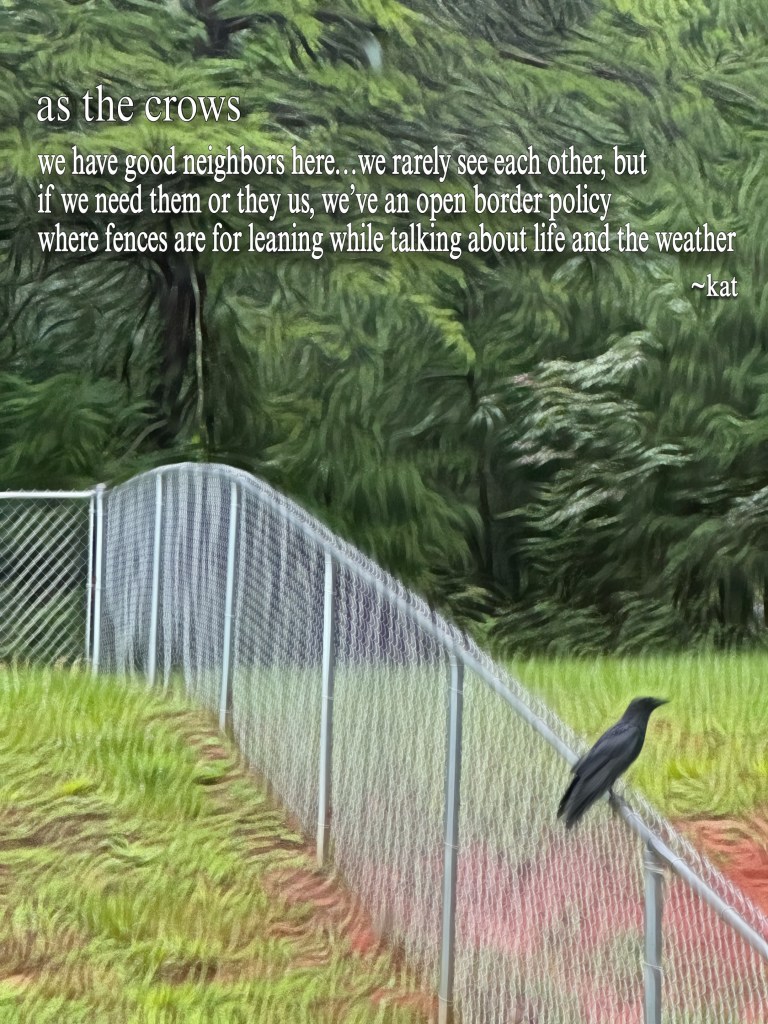
as the crow

we have good neighbors here…we rarely see each other, but
if we need them or they us, we’ve an open border policy
where fences are for leaning while talking about life and the weather

~kat
Living in the hills is a breath of fresh air (literally). Unlike our urban friends whose homes are packed tightly into neighborhoods, with walls and windows mere feet apart, artificially lit by humming street lamps, the scent of exhaust fumes and hot rubber settle in the air, the rural space I call home are green, our neighbors, acres away, rarely seen but occasionally heard on crisp quiet nights when sounds carry in the mist…blips of muffled conversation, laughter, the sound of tires crunching gravel driveways.
It it understood, that we look out for one another. Not in the creepy, peer through shades, nosy neighbor way, filling one’s head with juicy gossip to share at the quick stop. I may only see my neighbors these days a few times a year, but we are community.
Isn’t that what we all want after all? A place to call home, to live out our pursuit of liberty and happiness in peace. Somewhere in this devolution of our humanity we’ve lost our way. It’s ironic to me that living so far from civilization makes me feel less alone than I ever felt in the city. Here where scarce neighbors are neighborly and kindness is an unspoken code.
much love, peace, and glimmers of community to you!
~kat ✨✨✨💚💚💚✨✨✨
Sijo
A sijo is a traditional Korean poetic form, characterized by its three-line structure. Each line typically contains 14-16 syllables, resulting in a total of 44-46 syllables for the entire poem. The first line is introduces a theme or situation, the second line develops it, and the third line introduces a twist or unexpected turn, providing the poem’s conclusion.



 like mercury colliding...
July 18th, 2025 at 9:59 am
The best sort of neighbours by far!
LikeLiked by 1 person
July 18th, 2025 at 9:39 pm
We are very lucky to have them close enough to know they are there! 😊
LikeLiked by 1 person
July 19th, 2025 at 10:38 am
Some of the crows that visit here are HUGE! In fact, some are bigger than the herring gulls.
LikeLiked by 1 person
July 19th, 2025 at 12:21 pm
Wow! Ours are good sized, but I don’t believe that big. We have encountered a Ravens here…they are massive. Like small turkey vultures in size.
LikeLiked by 1 person
July 19th, 2025 at 1:16 pm
I’ve noticed an increase in jackdaw numbers but the carrion crows (Nature’s dustbins) are big.
LikeLiked by 1 person