Tag Archives: Poem a Day

August – Stanza 31 – Finit

I must say this has been an eye-opening month for me. I had the opportunity to delve a bit deeper into the names and faces that make up my family tree…and I even discovered a few new characters along the way.

Thanks to Jane Dougherty who inspired this month’s pem a day exercise. What we have below is more of an epic poem. Not sure if it makes any sense altogether, but then again, I suppose it makes perfect sense. It is reflective of me, a patchwork quilt made up of my ancestors and the times in which I live. Somehow it all works, because after all, here I am. Thanks for taking this journey with me. The story continues…
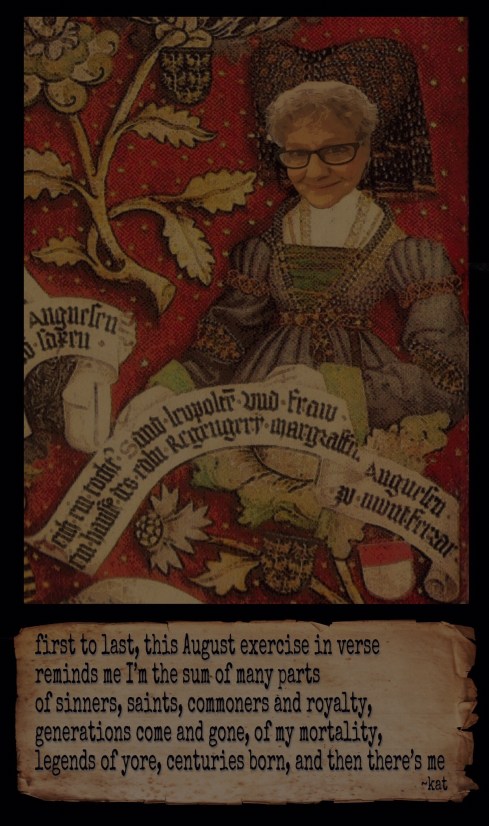
first to last, this August exercise in verse
reminds me I’m the sum of many parts
of sinners, saints, commoners and royalty,
generations come and gone, of my mortality,
legends of yore, centuries born, and then there’s me

~kat

August in Stanzas

August Gregorious, father
of my father’s father’s father left
Sweden’s shore, Amerika bound decades
before the harbor maiden raised her beacon
to refugees and immigrants seeking a dream

a dream of valkyries, sinners, saints,
pilgrims, paupers, royalty, generations
come and gone, sparks of light,
however brief, whispering tales from
where I hail, as I lay sound asleep

asleep, in graves, silent shuttered
vaults, eroded epitaphs, markers where
lay the bones, worm-stripped bare, no trace
but for their surnames penned on census
rolls, proof that they existed once 

once upon a time lived a viking maiden fair,
princess, Kievan queen, woman scorned, a saint,
who settled scores, who buried men alive,
set flocks affire, razed a town, my dear great
grandma, Olga, was the baddest fox around

around the time when separatists sought freedom
from the crown, a ship, the Mayflower, set sail across
the ocean blue, amongst its passengers, a girl named Mary,
of renown, so claimed, the first to step on Plymouth’s rocky shore

shore along the Biscay Bay in olde Aquitaine,
came first of many troubadours, Guillaume
was his name, a roving love philanderer
crusader, duke and count but his true call,
his legacy, the poems and songs he penned

penned in history’s tomes the story of a clan
who’s roots trace back to greatness, to the loins
of Charlemagne; a certain noble lineage
Trowbridge, one such name, of  Thomas and
Elizabeth, great grands from whence I came

came on horseback through the town, they say, naked
as the day that she was born, a selfless act, the debt she paid
to lift the tolls her husband waged on townsfolk, how she
pitied them, Lady Godgifu, whilst they hid, their windows shut
but for a tailor so called Thomas who rued his choice to peep

peep beneath Kyffhäuser hills where Barbarossa
makes his bed, alive for centuries, not dead
he waits to serve his countrymen, to unify
them once again, with ravens, circling
‘round his lair and flowing locks of ruddy hair

hair of red, and a rotten tooth of blue
Harald son of Gorm the Old built a bridge or two
one the oldest, longest known in Scandinavia’s
Ravning meadow; the other ‘tween Danes
and Norse; hence ended by his bastard son, poor fellow

fellow genealogists would certainly agree
that finding distant relatives, a generation,
maybe two, or if you’re lucky, three’s a testament
that most of us will fade into obscurity, i must
admit a lucky thread runs through my family tree

tree strong, sure, with roots meandering deep
elusive broken chains, some stories silenced
ever undisturbed to sleep between the lines
of history’s pages, glimmers only glimpsed
by those remembering, distant reminiscing kin

kin can be elusive, notorious in fact with
legacies to be recalled by generations hence
more curious than how they lived, accounts
of how they died, some of causes natural
while others met the sword midst battle cries

cries of horror surely wailed at William’s
messy burial beneath Abbaye aux Hommes,
his tomb, ‘twas found to be too small to hold
his corpse’s expanding girth; so ensued a gruesome
scene…they forced him in, until he burst

burst forth in salutations for these pious few of note
grace, humility, compassion stirred their hearts and
souls; some were royal born, some were royal wed,
a full life they all lived then to the nunnery they fled
sainted, miracles post-death, their legacies are legend

legend has it, have you heard, so they say…
from inconceivable to the absurd, tales
of the notorious evolve from voice to page
fantastical, believe it or nots, boring history
rewritten, embellished, ne’er to be forgot

forgotten? I think not! with these great monikers…
Offa, Wermund, Ermingarde, Gruffydd, Tilka, Rhys,
Ingilrat, Theobald, Helga, Poppa, Cleph,
Dode, Thibault, Ludmilla, just to name a few
Tom’s, Dick’s and Mary’s, though plain Jane, they’re in there too

too many links on this tree fade, obscure
with nary a flicker of those who’ve gone before
the only living proof of their existence,
their progeny, who share their dna, who’ll likewise
live and die, no answer for the age-old question…”why?”

why do I have eyes of blue and curly golden locks
what mystery meld of genes informs my flesh and blood
am I just the sum of kin who’ve lived and died before
wondering what makes me, me, and makes you, you
our histories’ hold a glimpse, hard to ignore

ignore the past and risk repeating it they say
the past is good well but I’m distracted on this day
one day i know i’ll be a fleeting memory
to this bundle in my arms,  we call her Ashby Quinn
a good old family name, and so a life begins

begins the life of Isabel, an heiress, good and fair and wise
wedded at age seventeen, King Henry’s ward, arranged
to William, a knight’s templar with no land to call his own
a power couple of their time, who made Old Ross their home
reviving castle Kilkenny, on River Nore, three towers

towers of history? Nay, they hardly made a blip
settling in Rutland, Mass, the center of the state
a preacher, he, a wife, who bore a strapping brood of nine
while revolutionary battles raged, a great awakening time
when Daniel lived with Sarah, my grand parents, eight great

great is the legend of Leudwinus, Sainted, Count of Treves
when young, wedded to Willigard, of children, they had three
a miracle occurred, they  say, while nappng on a hunt was he
an eagle spread it’s massive wings, providing him with shade
hence, on that spot, built he, a monastery to live his final days

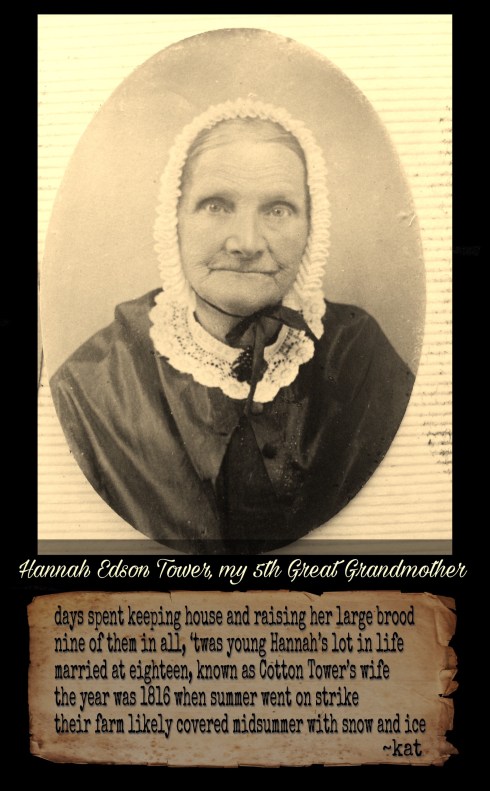
days spent keeping house and raising her large brood
nine of them in all, ‘twas young Hannah’s lot in life
married at eighteen, known as Cotton Tower’s wife
the year was 1816 when summer went on strike
their farm likely covered midsummer with snow and ice

ice and fire don’t mix anymore than church and state
as learned by my great grandpa, Captain Anthony
the church held sway in Hingham, Mass
his commission challenged, led to excommunication
‘twas a dark divided time in this young nation

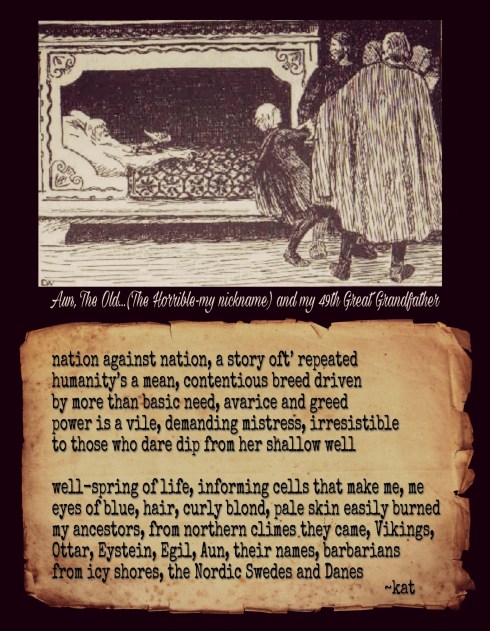
nation against nation, a story oft’ repeated
humanity’s a mean, contentious breed driven
by more than basic need, avarice and greed
power is a vile, demanding mistress, irresistible
to those who dare dip from her shallow well 

well-spring of life, informing cells that make me, me
eyes of blue, hair, curly blond, pale skin easily burned
my ancestors, from northern climes they came, Vikings,
Ottar, Eystein, Egil, Aun, their names, barbarians
from icy shores, the Nordic Swedes and Danes

Danes had nothing on my great grand Fredegund
a vile, vicious mistress determined to be queen
convinced King Chilperic to kill his sleeping wife
even her own daughter suffered from her jealousy
but her bitterest arch rival was, in fact, a Valkyrie 

Valkyrie, Brunhilda, from my many branch-ed tree
ultimately met her end by Fredegund’s own son
40 years of vengeance, in the end, nobody won
evil can’t sustain a never-ending terror reign
eventually the good will find a way to win again

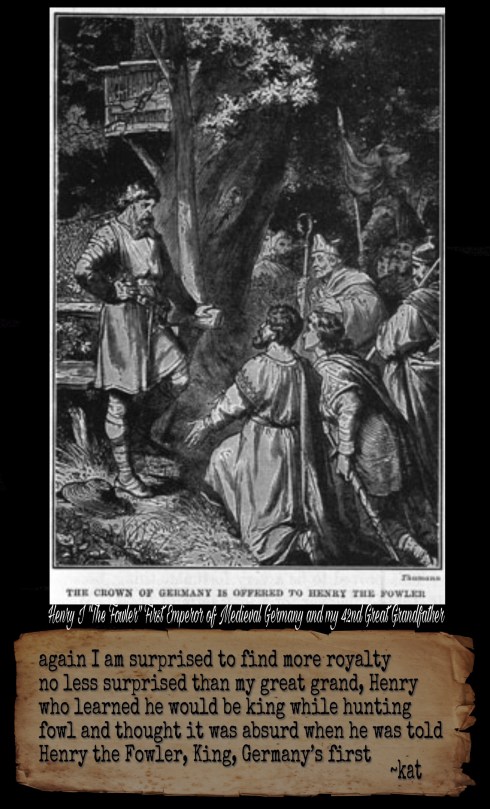
again I am surprised to find more royalty
no less surprised than my great grand, Henry
who learned he would be king while hunting
fowl and thought it was absurd when he was told
Henry the Fowler, King, Germany’s first 

first to last, this August exercise in verse
reminds me I’m the sum of many parts
of sinners, saints, commoners and royalty,
generations come and gone, of my mortality,
legends of yore, centuries born, and then there’s me

~kat

Autumn – Stanza 30

again I am surprised to find more royalty
no less surprised than my great grand, Henry
who learned he would be king while hunting
fowl and thought it was absurd when he was told
Henry the Fowler, King, Germany’s first

~kat

For Jane Dougherty’s August Stanza Challenge. Read more about Henry “The Fowler” HERE.


August – Stanzas 28-29

Another two-fer for yesterday’s and today’s entries for Jane Dougherty’s August Stanza Challenge. As some of you know I’m visiting my two youngest grandchildren this week. To add a little excitement to my visit, as if a newborn and a two year old aren’t enough excitement, I had a nasty encounter with the screen door. It took a chunk out of my ankle. And so a dozen or so stitches later I am propped up with my foot elevated, a newborn napping on my chest while a rambunctious two year old is off to the mall for some special mommy-daddy time away from her new little sissy. Welcome to my life…believe me, I’m not complaining. I am soaking up this grandma time! 😊❤️😊.

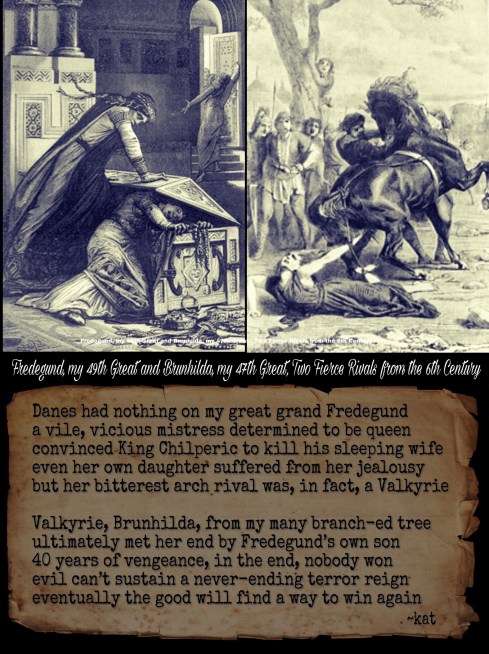
It is fitting then to write about two very strong women from my past. One was a psychopath, and the other, her rival, was a Valkyrie, a mother and grandmother. Badass is a term I have often seen used in accounts referring to them both. I give you Fredegund and Brunhilda…you can read more about their rivalry and their lives HERE.

Danes had nothing on my great grand Fredegund
a vile, vicious mistress determined to be queen
convinced King Chilperic to kill his sleeping wife
even her own daughter suffered from her jealousy
but her bitterest arch rival was, in fact, a Valkyrie

Valkyrie, Brunhilda, from my many branch-ed tree
ultimately met her end by Fredegund’s own son
40 years of vengeance, in the end, nobody won
evil can’t sustain a never-ending terror reign
eventually the good will find a way to win again

~kat


August – Stanzas 26-27

Two stanzas today. Yesterday was spent on the road.

nation against nation, a story oft’ repeated
humanity’s a mean, contentious breed driven
by more than basic need, avarice and greed
power is a vile, demanding mistress, irresistible
to those who dare dip from her shallow well

well-spring of life, informing cells that make me, me
eyes of blue, hair, curly blond, pale skin easily burned
my ancestors, from northern climes they came, Vikings,
Ottar, Eystein, Egil, Aun, their names, barbarians
from icy shores, the Nordic Swedes and Danes

~kat

For Jane Dougherty’s August Stanza Challenge.


From Wikipedia, a story about Aun, of the Yngling Dynasty, King of Uppsala…and allegedly, if the tree leaves on Ancestry.com are correct, my 49th Great Grandfather. Aun was a horrible man, a terrible father who was sick with power….

Ruling from his seat in Uppsala, Aun was reputedly a wise king who made sacrifices to the gods. However, he was not of a warlike disposition and preferred to live in peace. He was attacked and defeated by the Danish prince Halfdan. Aun fled to the Geats in Västergötland, where he stayed for 25 years until Halfdan died in his bed in Uppsala.

Upon Halfdan’s death Aun returned to Uppsala. Aun was now 60 years old, and in an attempt to live longer he sacrificed his son to Odin, who had promised that this would mean he would live for another 60 years. After 25 years, Aun was attacked by Halfdan‘s cousin Ale the Strong. Aun lost several battles and had to flee a second time to Västergötland. Ale the Strong ruled in Uppsala for 25 years until he was killed by Starkad the old.

After Ale the Strong’s death, Aun once again returned to Uppsala and once again sacrificed a son to Odin; this time Odin told the king that he would remain living as long as he sacrificed a son every ten years and that he had to name one of the Swedish provinces after the number of sons he sacrificed.

When Aun had sacrificed a son for the seventh time, he was so old that he could not walk but had to be carried on a chair. When he had sacrificed a son for the eighth time, he could no longer get out of his bed. When he had sacrificed his ninth son, he was so old that he had to feed, like a little child, by suckling on a horn.

After ten years he wanted to sacrifice his tenth and last son and name the province of Uppsala The Ten Lands. However, the Swedes refused to allow him to make this sacrifice and so he died. He was buried in a mound at Uppsala and succeeded by his last son Egil. From that day, dying in bed of old age was called Aun’s sickness.


Autumn ~ Stanza 24

days spent keeping house and raising her large brood
nine of them in all, ‘twas young Hannah’s lot in life
married at eighteen, known as Cotton Tower’s wife
the year was 1816 when summer went on strike
their farm likely covered midsummer with snow and ice

~kat

For Jane Dougherty’s August Stanza Challenge.


History recounts the year 1816 as “The Year Of No Summer”. It was also the year my 5th Great Grandparents, Hannah Edson and Cotton Tower married. Cotton was a Farmer by trade. Hannah, who I am fortunate to have a photograph of, is listed on census records as a housewife. With 9 children I can’t imagine she had much time for anything else besides birthing and tending to her children. They all seem to have been of hearty stock though. Hannah died at the ripe old age of 74, with Cotton following her nearly a decade later at 85. They lived in Leavenworth, Indiana. I imagine the farms in that part of the country felt the chill, along with the rest of the world, caused by the eruption of Mount Tambora in Indonesia. It is said that the atmosphere was thick with volcanic ash, limiting the amount of sunlight, cooling the Earth’s surface, and causing a once-in-a-lifetime event: a year-long winter.

Here is an excerpt I found from The Washington Times Herald :

A year without a summer

Although no documented local records of weather existed in 1816, the summer of 1816 is without question a memorable year, not only locally, but world wide. The year of 1816 is referred to as “the year without a summer.”

In 1961, Frank L. Hartle of Indianapolis was in possession of an 1816 newspaper article describing 1816 as being the coldest summer ever experienced by any person living at that time.

The following are excerpts from the article:

“June was described as the coldest month vegetation had ever experienced in this latitude. Frost and ice was as common as buttercups usually are in June.”

“Mothers made thick mittens for their children and they wore knitted sox of double thickness. Overcoats and gloves were required by farmers as they attempted to do their daily chores.”

“A heavy snowfall on June 17, 1816, was accompanied by a pathetic story. A Vermont farmer turned his sheep to pasture the previous day. Temperatures dropped below freezing over night and snow had begun falling about 9 a.m.”

As the farmer left home, he jokingly remarked to his wife: “Better start the neighbors searching soon for me.”

“It’s the middle of June you know and I may get lost in the snow.” Snow continued to fall in torrents and drifts began to form. By night fall nothing had been heard from him. The wife summoned neighbors and they began to search for him. They continued searching the second day. Only after the third day, was he found lying in a hollow, half-covered with snow, still alive but both feet frozen. The sheep were found nearby, but most of the flock of sheep had lost their lives.

July offered no respite. Ice thicker than window glass required breaking the ice in the livestock water troughs so they could drink.

But to everyone’s surprise August proved worst of all.

“Almost every green thing in the country and Europe was blasted daily by frost. Snow fell in August in London, England. In Quebec City, Canada, on June 10, 1816, they experienced a 12-inch snowfall and 1816 was the coldest year in the northern hemisphere on record.

As a result of these abnormal summer temperatures, parts of Europe experienced a stormier winter in 1816. That, in turn, resulted in the widespread death of much of the livestock.

Cool temperatures and heavy rains resulted in failed harvests in Great Britain and Ireland. Families in Wales traveled long distances as refugees begging for food. Famine was prevalent in North and South West Ireland following the failure of their wheat, oats and potato harvests. Violent demonstrations in front of grain markets and bakeries, followed by riots, arson and looting in many European cities due to food shortages and skyrocketing food prices.

Worldwide, no living person at that time had any recollection of weather creating such havoc throughout history. While it was known that other countries were also experiencing similar weather problems, the actual cause wasn’t known until years later.

A cause is found

Virtually no one in Daviess County, Ind., had ever heard of Indonesia or the small island of Sumatra nor had they any knowledge of Mount Tambora nor would they ever have believed that a volcano half way around the world could have any effect on their lives, especially their weather.

If asked, at the time, if they knew that there was a volcano eruption on Mount Tambora in Indonesia; their answer would probably be, “So who cares?” The science of climate and the factors which contribute to temperatures, the seasons, the air currents and ocean tides were not a part of common knowledge. In fact, if someone were to have suggested that a volcano was to be blamed, even the highly educated in 1816 would label us as a “fruitcake.”

To believe the cause of 12-inch snowfalls in June or world widespread crop failures were a direct result of a volcano in Indonesia would have been truly unbelievable.

Although there are several volcanoes today capable of eruption, the April 1815 Mount Tambora eruption was the largest volcanic eruption in recorded history. The explosion was deafening and was heard on the island of Sumatra more than 1,200 miles away. The estimated death toll exceeded 71,000 people. A team of archaeologists during excavation diggings in 2004 discovered cultural remains buried from the Mount Tambora volcanic explosion still intact beneath 9.9 foot deep pyroclastic lava deposits. Many of the bodies were preserved in the positions they occupied on that fateful day in 1815.