Tag Archives: Haibun

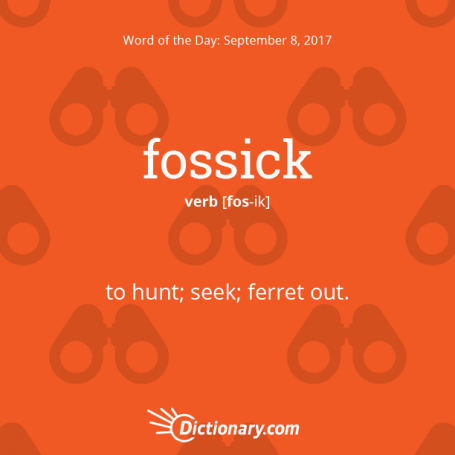
Fossick – Friday’s Word of the Day

Fossick is today’s word of the day at Dictionary.com. It’s an Aussie word…as in primarily used and originating in Australia. It means to hunt; seek; ferret out and is also a mining term that means to undermine another’s digging; search for waste gold in relinquished workings, washing places, etc.

Dictionary.com explains: The verb fossick is confined pretty much to Australia and New Zealand. As with many regional and dialect words, its etymology is unclear: the verb seems to be a regional British term fussock, fursick meaning “to fuss, fidget, bustle.” In Australia and New Zealand fossick originally meant to hunt for gold or other precious metals or precious stones by digging with a knife or by studying the ground for overlooked fragments. Fossick has an additional sense of hunting for or foraging for small items e.g., to fossick through a drawer for scissors. Fossick entered English in the 19th century.

Did you know that there is an entire tourist industry devoted to fossicking in Australia? Intrepid explorers need a license to fossick, and there are a number of rules and responsibilities to be followed. But for those who choose to plan for a day of fossicking on their itinerary, there are is treasure waiting to be found.

Australia has a long history when it comes to fossicking. Depending on the site, fossickers may find a treasure trove of gems including opals, topaz, garnets, diamonds, sapphires, zircon, and gold. There are designated areas devoted to the pastime. Here’s a LINK to learn more.

So, I’ve learned something new. Who knew fossicking was a thing? Apparently the Aussies knew! I guess you had to be there…down under, that is!

Have a great weekend. Happy fossicking! A few Haiku…

seasoned fossickers
are ferreting gold-diggers
treasure ‘midst rubble

tourists down-under
plan fossicking excursions
for nuggets of gold

dusty nooks, cluttered,
second-hand tomes to fossick
where book mongers swoon

~kat


Waiting to Soar

Waiting to Soar

I’m waiting…for tomorrow’s sun…for the rainbow’s somewhere…for truth’s consequences…for the stars to grant my wishes…for my turn to cross troubled water’s bridge…for a glimmer…for a sign…for a hero…for angels…for the best, yet to come…for the impossible dream…for a snowball’s chance…for justice…for peace…for the other shoe to drop…for people to wake up…for someone to give a f- …I’m waiting…feet planted firmly, rooted in fear, dogma, culture, tradition…a girl can dream.

excruciating, the wait,
baited shallow breath, fading
cruel, fickle mistress, Hope,
eternal spring seductress,
fluent in vain sweet nothings

settling for dross
soaring wingless on what if’s
nothing ventured gained

~kat

A Haibun/Tanka/Haiku trio for Colleen Chesebro’s Weekly Poetry Challenge, prompt works “Soar” and “Wait”.

img_8616


Septenary – Friday’s Word of the Day Haibun

septenary

Today’s Word of the Day at dictionary.com is Septenary. If you are familiar with Latin roots you may deduce that this word is linked to the number 7, and you would be correct. In fact, septenary is an adjective that means all things seven: relating to the number seven or forming a group of seven; a period of seven years; the number 7. Here is Dictionary.com’s bit on its etymology:

In Latin, the adjective septēnārius “consisting of seven,” a derivative of septem “seven,” has limited use: numerus septēnārius means “the number seven.” Its “least uncommon” usage is versus septēnārius “seven-part verse, septenarius,” for a verse form in Latin comedy. In English septenary is of limited use as well: it has been applied to the seven sacraments of the Christian church, the seven days of the week, and, in music, the seven notes of the diatonic scale. Septenary entered English in the 16th century.

Apparently, we humans love this optimus prime number (no, I’m not talking about the Transformer). We love seven so much that we have applied it over the centuries in every manner possible, from mathematics to religion to modern culture. Even the universe has accommodated our obsession!

So, let’s get to it. This is by no means an exhaustive list. If I attempted that it would be exhausting. I’ll start with numerology…because, I’m thinking out loud here, I just might be a “7”, which is okay with me. We can’t all be 10’s… 😉

The number 7 is the seeker, the thinker, the searcher of Truth (notice the capital “T”). The 7 doesn’t take anything at face value — it is always trying to understand the underlying, hidden truths. The 7 knows that nothing is exactly as it seems and that reality is often hidden behind illusions.

Being the seeker that I am, here we go…there are:

  • seven colors in the rainbow (red, orange, yellow, green, blue, indigo, violet)
  • seven wonders of the ancient world (Great Pyramid of Giza, Hanging Gardens of Babylon, Temple of Artemis, Statue of Zeus at Olympia, Mausoleum at Halicarnassus, Colossus of Rhodes, and the Lighthouse of Alexandria)
  • seven classical planets or luminaries (which means visible to the naked eye from earth: Moon, Mercury, Venus, the Sun, Mars, Jupiter, and Saturn)
  • in Old Testament/Judaism: seven days to create the world, seven vengeances suffered by Cain for killing his brother, Seven pairs of clean animals – the number Noah was commanded to load into the ark (I have a question though…how did we get pigs over unicorns?), seven blessings (at weddings), seven year cycles around the Year of Jubilee, seven days to the feast of Passover, the Menorah – a seven-branched candelabrum, seven candles or orifices of the face (think about it…2 eyes, 2 nostrils, 2 ears, and the mouth), seven things that are detestable to the Lord according to Proverbs 6:16-19: haughty eyes, a lying tongue, hands that shed innocent blood, a heart that devises wicked schemes, feet that are quick to rush into evil, a false witness who pours out lies, and a person who stirs up conflict in the community…hmmm, thinking out loud here…on second thought, let’s move on…
  • in New Testament Christianity: seven deadly sins, seven virtues, seven gifts of the Holy Spirit, seven sacraments, seven sorrows, seven joys, seven heavens, seven seals (from the book of Revelation, not the mammal kind, though wouldn’t that be an interesting twist?), seventy time seven (you know the drill)…there are more…
  • in Islam: seven heavens, seven hells, seven layers of the Earth, seven big sins or vices, seven doors to hell (heaven has eight), seven circumambulations (counterclockwise circling) as part of Tawaf rituals, seven Ayat (signs or “remarkable events”)
  • in Taoism: 7 Colors and the 7th Element is Qi
  • in Hinduism, the term Sanskrit literally means seven, and there are: seven octats in music (sa re ga ma pa dha ni), 7 chakras, Seven Promises [Saptapadi], Seven Rounds in Hindu Wedding and Seven Reincarnation, Seven Matrka (mothers or matriarchs)
  • in Bahá’i teaching: Seven Valleys – Search, Love, Knowledge, Unity, Contentment, Wonderment and Poverty and Absolute Nothingness
  • in Mythology: Seven Lucky Gods (Japanese), seven archangels (several cultures), and seven blunders, according to Ghandi, that cause violence
  • seven stars in the Big Dipper
  • seven cervical vertebrae in almost all mammals
  • in Physics: seven basic physical properties: metre, kilogram, second, ampere, kelvin, mole, candela
  • Seven continents, seven seas, a handful a seven hills scattered around the world, seven sages, wise masters, kings and or emperors (according to various cultures)
  • in modern Pop Culture: Seven Dwarfs, 007, 7- Eleven, Seven Brides for Seven Brothers, the Seven Year Itch, Seven Faces of Dr. Lao, Seven Days in May, Seven Years in Tibet, The Magnificent Seven…indeed!
  • in Literature: 7 Ages of Man (Shakespeare), seven books in the Harry Potter series (Rowling): seven players in the game of Quidditch, seven horcruxes (objects containing parts of Voldemort’s soul), Seven Habits of Highly Effective People (Covey), Seven Pillars of Wisdom (Lawrence)…and there are more…too numerous to mention,
  • in Mathematics, Seven is associated with all sorts of interesting terminology: Seven is the first integer reciprocal (multiplicative inverse), seven frieze groups, seven fundamental types of catastrophes, vulgar fractions with 7 in the denominator, 7 is the lowest dimension of a known exotic sphere
  • seven metals of antiquity: gold, silver, copper, tin, lead, iron, and mercury

Seven this and seven that. We love the number seven and all things septenary. One might even say we are obsessed with seven. As for me, though I’ve always gravitated toward the number 3 or 5 when asked to name a favorite number, I’m adding 7 to the top of my list. As the most often cited favorite number according to polls, I am in good company.

And…if you’ve read this far, you’ve given me enough of your precious time on this first Friday of September. The seventh card in the Tarot deck is The Chariot…which indicates a need to move forward…so without further ado…here’s a quick Haiku! Have a great weekend!

consider seven
septenary perfection
so optimus prime

-kat


Hearts of Stone

Hearts of Stone

I remember the crunching sound of my feet shuffling, scattering pebbles about, as I walked that morning. The sun was barely tree-top high in the sky, the leaves were sparkling, and there was a fragrant breeze; honeysuckle and wild garlic. For whatever reason, I don’t even recall it now, I was distraught. I felt totally alone, unloved and hopeless.

And then my toe smacked into a perfectly honed, heart-shaped stone. As I bent down to pick it up, the sun crested the tops of the trees and I felt its warmth on my back. It occurred to me in that moment, I was not alone and that someone, a Great Spirit, Faeries, the Universe, God (I’ll leave the naming to you), had left it there to stub my toe and stop me in my melancholy tracks. I felt loved. I felt hope. I kept that heart-stone on a window ledge so I could look at it and remember.

Eventually, I was called upon to do the unthinkable; to give my beloved heart-shaped stone away…to someone who loved it as dearly as me, maybe even more.

Now, please don’t be sad for me, dear reader, because on that very day I found three more heart-shaped stones, and another, and several more.

Everywhere I turn I find them now; big, small, shiny, rough, perfectly formed, some with tiny flaws. To some, they are just rocks, but to me, they are undeniably hearts, one and all.

I keep them in my pockets these days, to remember…and just in case I have an opportunity to give one away to someone who needs to know they are not alone, that they are loved, and that there is hope.

If you should ever happen to find a heart-shaped stone of your very own, I hope you’ll remember too.

life to death to life
skeletal fragments turned cold
chiseled stones remembering
love requires letting go
a heart surrenders, knowing

~kat

A haibun/tanka For Colleen Chesebro’s Weekly Poetry Challenge, prompt words, stone and turn.


Incogitant

Today’s Word of the Day at dictionary.com is incogitant. Not to be confused with incognizant or incognito, which google presented as possibilities. Incognitant is definitely a word, originating in the 17th century, though it does seem to be less popular than its cousins.

All three words have a common root, the Latin cōgitāre “to think” and the Latin negative prefix in-. it is when we add the suffix -ant “inclined to, tending to” that tweaks the meaning. Incogitant is defined as thoughtless; inconsiderate; not having the faculty of thought. While incognizant implies a sense of being unaware of something or unknowing, it is more in a passive or clueless sort of way, and incognito has to do with disguised identity, incogitant, with its tiny change in suffix -tant involves an element of willfulness. In fact, wiktionary simply defines incogitant as ignorant.

These days the streets are swarming with incogitant people. People who are not the least bit interested in knowing the truth, and worst of all, those who act on that ignorance to an extreme. Sound familiar? Maybe it’s just me. 🤔

Anyhoo…before I close this wordplay, I found one other reference while researching today’s word. A shout out to French philosopher and mathematician René Descartes’ (1596–1650) who coined the famous line, “cōgitō ergō sum” (“I think therefore I am”). Does that mean if I don’t think, I am not? Best to leave that one alone…along with the incogitant people of the world, unless of course, you engage them while incognito…just to be safe. My guess is they are incognizant that they are incogitant, precisely because they don’t care that they are either!

Here are a few Haiku then. Reminds me of another quote…”Never have a battle of wits with an unarmed person.” 😊 okay…I’m done now. Have a great weekend!

“Let them eat brioche!”
an incogitant retort
spoken from privilege

Covfefe…say what?
Incogitant tweet perhaps,
or sly like a fox?

~kat