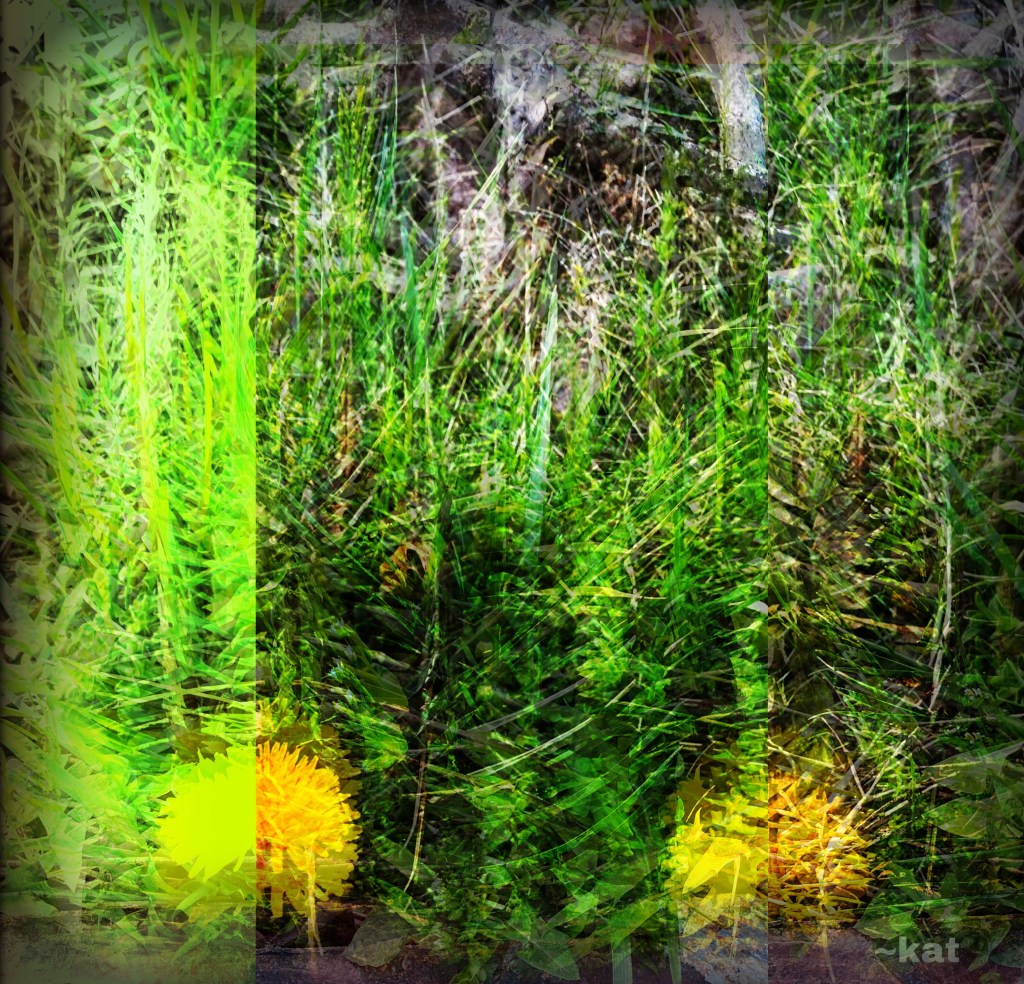
fair dandelion golden face turned toward the sun to frost at dawn fades
footprints rain remnants to mop
such stillness peepers choked by frost in hiding
only to be nipped by latent cold snaps at dawn first flowers still rise
~kat
For Tanka Tuesday Challenge to explore the haiku and the senryu, a handful of each in various metered forms: 2/3/2, 3/5/3, 5/7/5 . I love writing little poems!
when I was young and still unsung, with dreams far-flung, nothing but time life’s harsh demands spoilt all my plans, setting my hands to earn a dime my family kept me busy, no longer free with no downtime in just a blink here on the brink, no time to think regret, I find in retrospect my thoughts reflect a life, perfect, ev’ry choice mine
Broken into Stanzas:
in retrospect
when I was young and still unsung with dreams far-flung nothing but time
life’s harsh demands spoilt all my plans setting my hands to earn a dime
soon family kept me busy no longer free with no downtime
in just a blink here on the brink no time to think regret, I find
in retrospect my thoughts reflect a life, perfect ev’ry choice mine
~kat
Tried a new form, the Rhupunt, for Napowrimo 2021 Day 2 Challenge: Today’s (optional) prompt. In the world of well-known poems, maybe there’s no gem quite so hoary as Robert Frost’s “The Road Not Taken.” Today, I’d like to challenge you to write a poem about your own road not taken – about a choice of yours that has “made all the difference,” and what might have happened had you made a different choice.
The rhupunt, a Welsh poetic form, has some variability to it, but also some rigid rules as well. Here are the guidelines for the rhupunt: · The form can be broken down into lines or stanzas · Each line or stanza contains 3 to 5 sections · Each section has 4 syllables · All but the final section rhyme with each other · The final section of each line or stanza rhymes with the final section of the other lines or stanzas
Catching up on my NaPoWriMo challenge – Day 1. This is no way to start the month, but yesterday was UTTER chaos! I am using the Lune (The Lune is a short form: 5/3/5 – no other rules, may rhyme, any topic) as my form of choice in response to the challenge: Daily prompt (optional, as always)! Sometimes, writing poetry is a matter of getting outside of your own head, and learning to see the world in a new way. To an extent, you have to “derange” yourself – make the world strange, and see it as a stranger might. To help you do that, I’d like to challenge you to write a poem inspired by this animated version of “Seductive Fantasy” by Sun Ra and his Arkestra. If you don’t feel after watching it a little bit like the top of your head’s been taken off, and your thoughts given a good stir – well, maybe you are already living in a state of heightened poetic awareness!
The NaPoWriMo 2021 Early Bird Challenge: Today, we’d like to challenge you to spend a few minutes looking for a piece of art that interests you in the online galleries of New York’s Metropolitan Museum of Art. After you’ve selected your piece, study the photographs and the accompanying text. And then – write a poem!
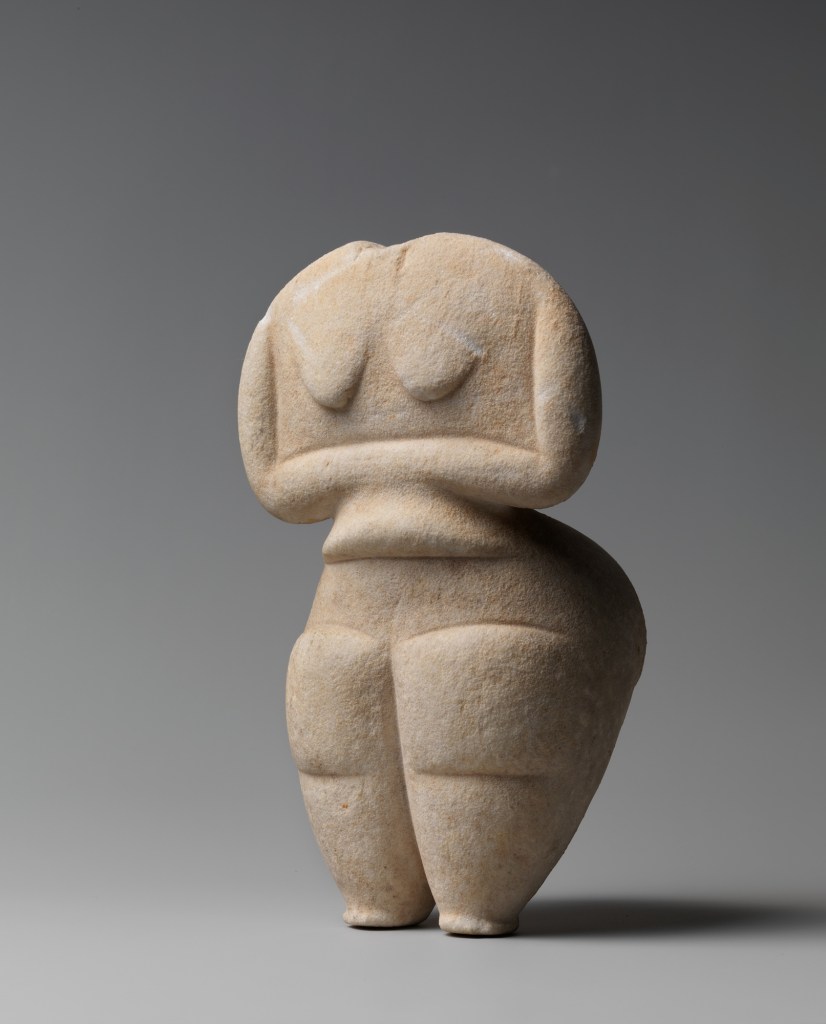
Marble female figure 4500 – 4000 B.C. – On view at The Met Fifth Avenue in Gallery 150 The figure represents a rare type known as steatopygous, characterized by particularly full legs and buttocks, and is undoubtedly indicative of fertility.
headless women

how fitting that she has no head
body, voluptuous
her legs and booty amply spread
her brain superfluous
prized for her shape, this nameless nude
a fertile femme, as seen by dudes
prized for her shape
prized for her shape
objectified, imagined lewd

centuries passed, now civilized
fair ladies fully dressed
enhanced their breasts and rears to size
by wearing buttresses
they’ve bought the lie, dominated
by their men, their worth negated
they’ve bought the lie
they’ve bought the lie
the patriarchs are quite elated

and here we are in modern times
sexualized, sad to say
with silicone pumped plump behinds
bootylicious boo-tays
not much has changed, here men still reign
liberated only in name
not much has changed
not much has changed
for babes and chicks and ‘ho’s and dames

~kat
The Poetry Form: The Trijan Refrain, created by Jan Turner, consists of three 9-line stanzas, for a total of 27 lines. Line 1 is the same in all three stanzas, although a variation of the form is not to repeat the same line at the beginning of each stanza. In other words, the beginning line of each stanza can be different. The first four syllables of line 5 in each stanza are repeated as the double-refrain for lines 7 and 8. The Trijan Refrain is a rhyming poem with a set meter and rhyme scheme as follows:
Rhyme scheme: a/b/a/b/c/c/d,d refrain of first 4 words of line five /c
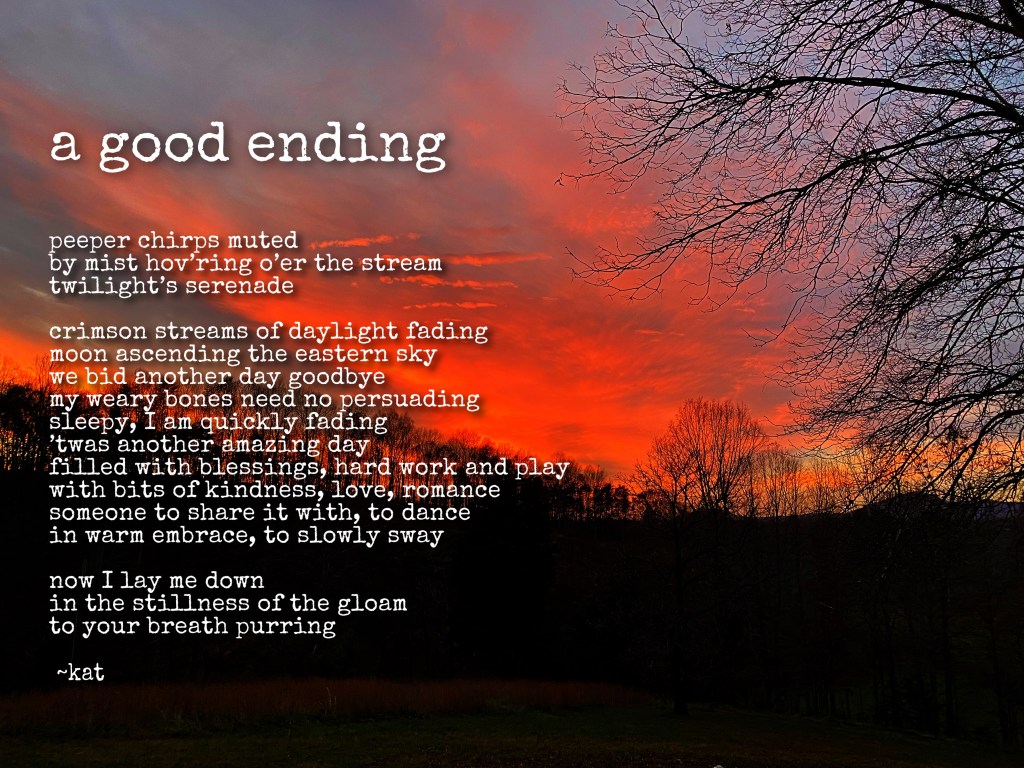
peeper chirps muted by mist hov’ring o’er the stream twilight’s serenade
crimson streams of daylight fading moon ascending the eastern sky we bid another day goodbye my weary bones need no persuading; sleepy, I am quickly fading ’twas another amazing day filled with blessings, hard work and play with bits of kindness, love, romance someone to share it with, to dance in warm embrace, to slowly sway
now I lay me down in the stillness of the gloam to your breath purring
Décima poetry is a 10 line stanza with 8 syllables per line. The rhyming pattern is abbaaccddc. Using the 10 lines there are generally two ways to organize: The 10 lines, or breaking the 10 lines into two stanzas using abba/accddc.
The abba/accddc requires either a period or semicolon after the fourth line break.
So it is easier for you to find all the parts/chapters of my ongoing fiction series, I created a new page that lists all the links. You can check it out HERE!
Unauthorized use and/or duplication of this material without express and written permission from this site’s author and/or owner is strictly prohibited. Excerpts and links may be used, provided that full and clear credit is given to Kat Myrman and Like Mercury Colliding with appropriate and specific direction to the original content.








 like mercury colliding...