Category Archives: Poetry

A Lifetime of Goodbyes

twins

My twins, Jennifer and Mindy. ❤

This poem is dedicated to my twin daughters who share a birthday today. I will never forget the 24+ hours of labor, their premature birth, where I was, how I felt. And I shall cherish every moment that time has given me with them since. There have been many little goodbyes…that moment they took their first breath, when they hopped happily onto the bus without looking back on their first day of school, when they learned to drive, and when they moved out to start a life of their own. A mother’s heart never forgets those moments.

The moment of that first goodbye
a mother’s heart never forgets
her heart remembers where and when
she heard her newborn baby’s cry
the first goodbye of many yet
a mother’s heart with each year grows
for mothers know that in the end
goodbyes are temporary woes.  

kat ~ 21 April 2016

For Jane Dougherty Writes Poetry Challenge…this week the San San. The repeating terms I chose are Mother, Goodbye and Heart. (See a description of the San San below.)

The san san has some things in common with the tritina, including repetition and rhyme. In particular, the san san repeats, three times, each of three terms or images. The eight lines rhyme in the pattern a-b-c-a-b-d-c-d.


April Poetry Month – A Poem a Day #21

Happy Thursday! Our 21st poetry form is the Tanka, an ancient Japanese poetry form consisting of five lines with the syllable sequence: 5/7/5/7/7 for a total of 31 syllables. The word Tanka, means “little song” and was often presented as one continuous line or stream of thought. The modern American version breaks the tanka into 5 separate lines.

7th century nobles in the Japanese Imperial court engaged in tanka writing competitions and it was also a popular form of love note given to partner after an evening spent together.

Tankas can be written about any topic and should also contain an emotional element. It is not necessary to give a Tanka poem a title.

cropped-img_33902.jpg
I woke to birdsong
between cool silken bedsheets
still damp from our tryst,
hoping to glimpse you sleeping
but you had already gone.

~kat – 21 April 2016


April Poetry Month – A Poem a Day #20

I have a busy day tomorrow so I’m posting poetry month, day 20 a day early. The Minute Poem is a rhyming verse form consisting of 12 lines of 60 syllables written in strict iambic meter. The poem is formatted into 3 stanzas of 8,4,4,4; 8,4,4,4; 8,4,4,4 syllables. The rhyme scheme is as follows: aabb, ccdd, eeff.

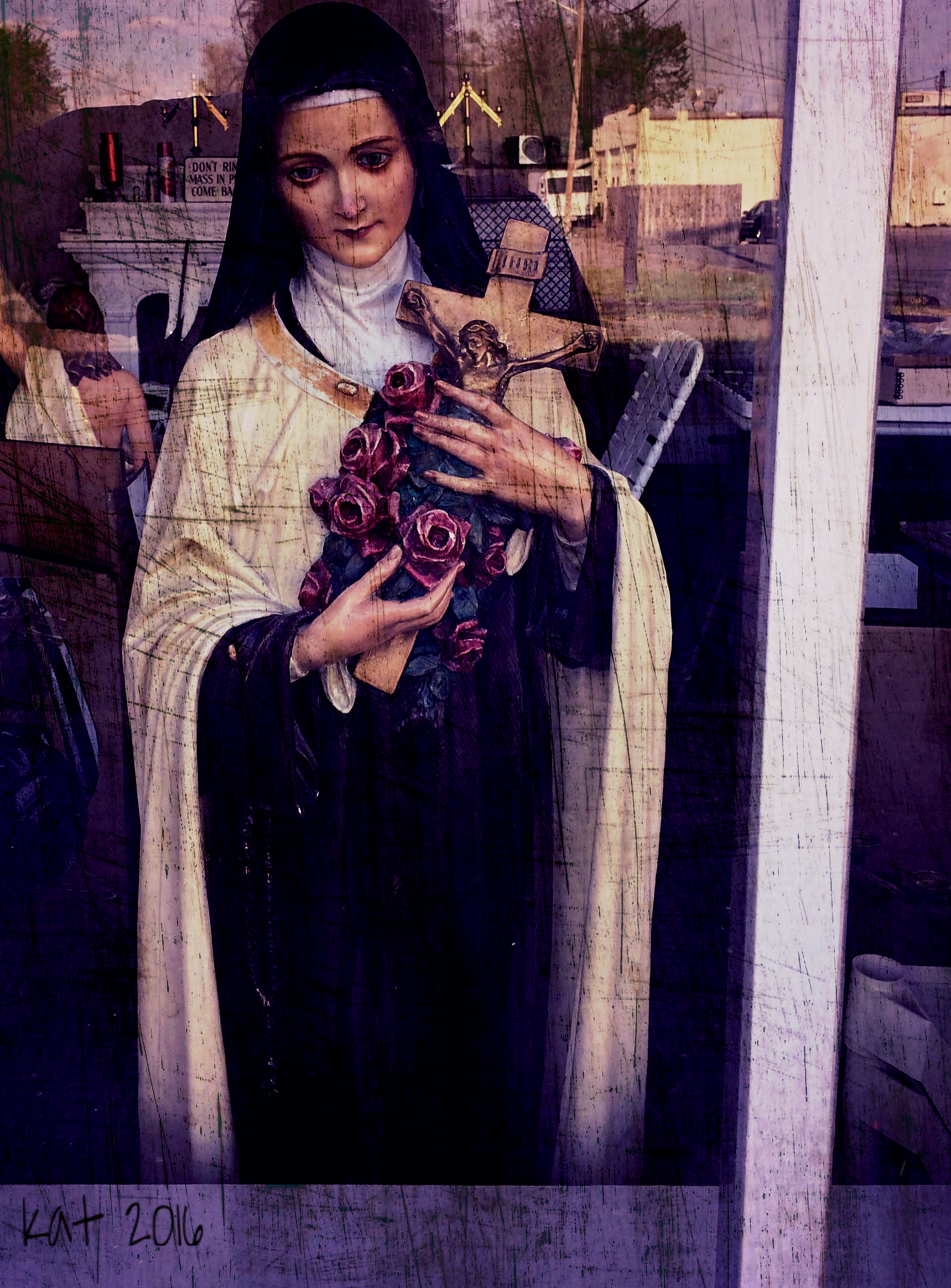
While on my way to work this morning a strange storefront caught my eye, in particular the statue in the window. I knew I needed to stop by on my way home to explore it a bit more.

It is a strange, verging on creepy, little place. A small sign on a side window says it’s a Catholic museum. The statues and relics contained within share the space with lawn chairs, debris and dust.

I couldn’t help feeling a bit nostalgic, remembering the unfailing devotion of my grandmother who attended Novena Masses every morning and taught me to believe in the mystical and miraculous.

Odd as it all was, I felt blessed by those memories of my childhood and embraced in grace.

Even there behind a pane of glass, surrounded by piles of junk and buried under layers of dust…even there, miracles are possible.

Here then is my Minute Poem…

NOTE: I had mistaken the identity of this lovely “lady”. She is, in fact Saint Therese of Lisieux. So…to be accurate, I have tweaked the poem. It doesn’t change the meter or the mystical quality. A rose by another name is still sweet. ❤


Storefront Saint 

Hail fair Lady full of woe
no votive’s glow
to warm your feet
here on Fifth Street.

As weary travelers pass by
none catch your eye
lacking vision
for apparitions.

Strange Storefront Saint Therese, you wait
bestowing grace
upon the few
who notice you.

~kat – 20 April 2016


April Poetry Month – A Poem a Day #19

Today I am looking at two forms, the Katouta and the Sedoka. The Katouta is a three-line unrhymed poem with a syllable count of 5/7/7 that is most often used to declare love for another. When you double a Katouta into a two stanza poem, it becomes a Sedoka. A Sedoka can be used to create a dialog or you can use each stanza to explore a topic from a different point of view.

glass

Photo from Pinterest

The Glass

A pessimist sees
a hypothetical glass,
moaning, it is half empty…

An optimist sees
promise in a glass half full
a reason to celebrate!

~kat – 19 April 2016


Orbs

DSCN0096

Photo Credit: Kat Myrman


Waterbending orbs…
Sun, vaporizing the dew
and Moon, shifting tides.

~kat – 18 April 2016

A Haiku for RonovanWrites Weekly Haiku Powtry Challenge. Prompt words this week are Sun & Moon. See other haiku HERE