Category Archives: Hainka

day 33…really?!!!

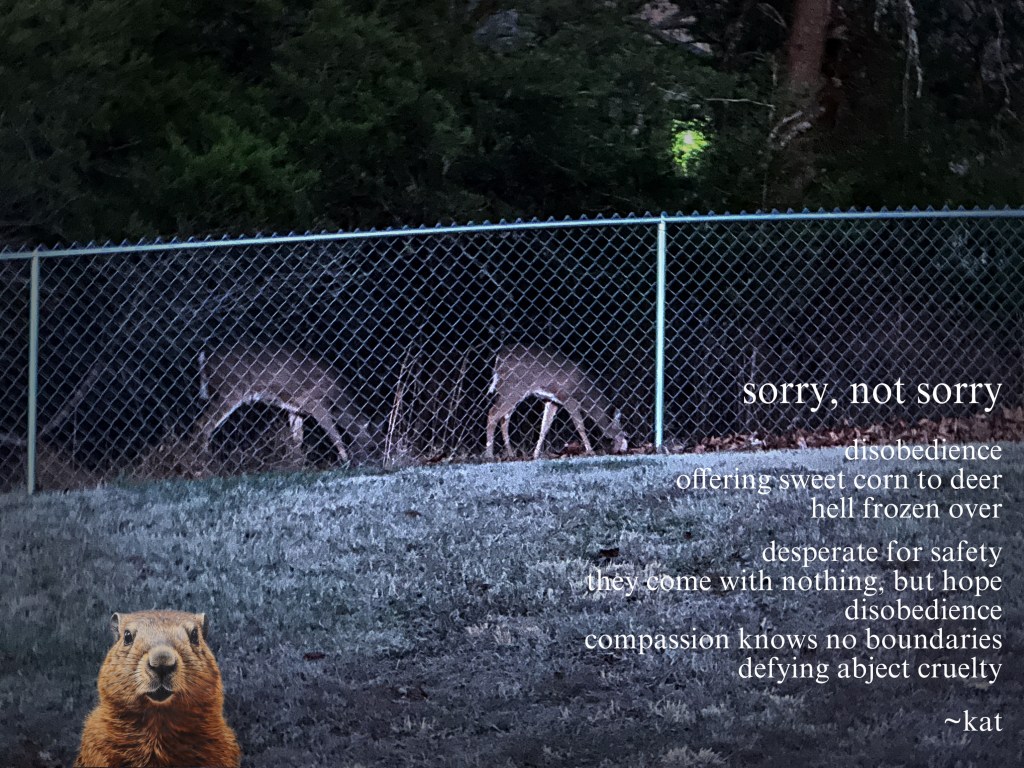
sorry, not sorry

disobedience
offering sweet corn to deer
hell frozen over

desperate for safety
they come with nothing, but hope
disobedience
compassion knows no boundaries
defying abject cruelty

~kat

Well, it’s official. Here in the US our resident winter weather oracle, the great and powerful Punxsutawney Phil, groundhog extraordinaire, saw his shadow this very morning at Gobbler’s Knob in Pennsylvania, declaring for all that there will be six more weeks of winter. I’m kinda over it, but hey Phil said it so it must be true.

Wish we had a similar forecaster who could tell us what to expect regarding the state of our society…oh wait…we do. When his handlers let him out of his secure bunker, lured into daylight by a double quarter pounder with cheese, he tells us exactly what to expect…and then does it, or at least tries to. Silly, sad wannabe. We just have to pay attention. if it means being awake, or woke as the kids say. Welp I don’t know about you but I’m thinking out loud here…this is NO TIME to sleep.

I confess, I am a criminal…I toss handfuls of corn for the deer on my property. It’s fucking freezing out there. There is barely anything left to forage for, and now Phil tells us we have six more weeks of this shit. I’m not opposed to civil disobedience when it comes to being a decent COMPASSIONATE HUMAN BEING!!! But I digress. Suffice to say I am not sleeping through the next four years of winter…did I say four years…I meant to say FOUR YEARS!!! Let this be my personal glimmer to you, for anyone who needs to know. I am a safe place. (You know what to do.)

Peace, love and fucking glimmers to you. Sorry,  not sorry, about the colorful language…words have power. We need to be loud, obnoxious and unapologetically out, upfront, and in the face of injustice and hate. This is not a dress rehearsal. Shits got real. 

~ unapologetically kat


Today’s poetry form is the HAINKA. Learn more about it HERE.


Zephyrus

Zephyrus 

he softly whispered
tossed my hair, kissed my bare neck
warm breath on my skin

the ancients named him
Zephyrus, god of the west wind
warm breath on my skin
gentlest of the Anemoi
deadly when he is jealous

~kat

I have enjoyed this past week’s practice of the Hainka. Familiar and yet nuanced. This coming week’s micropoetry form will be the Bob and Wheel. It incorporates a trifecta of rules: line, syllable and rhyme, which should be challenging and fun…if you like a good challenge like I do. Until then, enjoy your week end.


The Hainka

The 17-syllable haiku is the shortest form of poetry, and the 31-syllable tanka is probably the second shortest format of verse. Precisely the new form of poetry, hainka, is an assimilation of objective sensitivity of haiku with the more subjective oriented of tanka poetry. The synthesis in hainka is based on the image linking (the ‘fragment’ of haiku acting as the ‘pivot line’ of the following tanka) to explore and interweave human nature, love, emotion, humor in a broader sense by juxtaposition of the imageries.

It is also interesting to see the syllabic coherency between the ‘fragment’ (5-syllable words) with the 5-syllable words of the ‘pivot line’ of tanka. The final structural configuration would be 5/7/5/5/7/5/7/7 (s/l/s/s/l/s/l/l) with the significance of the image linking. A breathing gap (swinging space) is preferred between the haiku and tanka for the reader to imagine and experience the essence of poetry.

This image-linking across time and space is the art of painting an integrated poetic expression and exhibiting the fervent elucidation of hainka writing. Moreover, it retains its focus on the beauty of genetic image-linking to explore the poetic spell within the broader structural framework of the aesthetic essence and rhythms of Japanese short forms of poetry. Echoing the spirit of Basho’s ‘atarashimi’ (newness), I wish that the new verse will entwine the art of gratitude encompassing nature, living beings, non-living beings, and humanity as a whole.

Read more about the evolution of this form at Poetry Digest here: https://www.writersdigest.com/write-better-poetry/hainka-haiku-tanka-new-genre-of-poetic-form


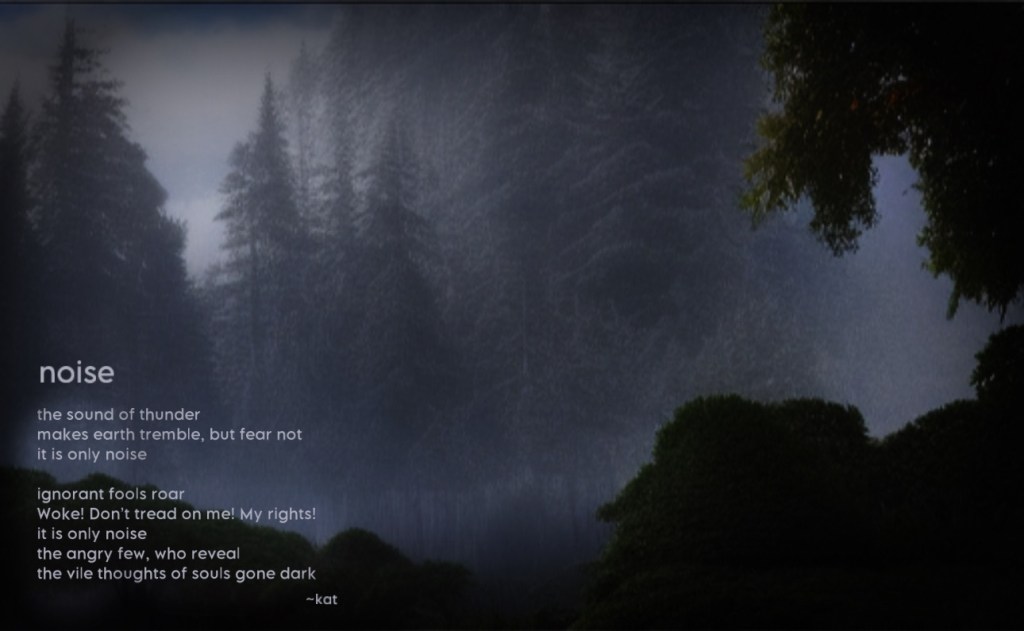
noise

noise

the sound of thunder
makes earth tremble, but fear not
it is only noise

ignorant fools roar
Woke! Don’t tread on me! My rights!
it is only noise
the angry few, who reveal
the vile thoughts of souls gone dark

~kat

The Hainka

It is also interesting to see the syllabic coherency between the ‘fragment’ (5-syllable words) with the 5-syllable words of the ‘pivot line’ of tanka. The final structural configuration would be 5/7/5/5/7/5/7/7 (s/l/s/s/l/s/l/l) with the significance of the image linking. A breathing gap (swinging space) is preferred between the haiku and tanka for the reader to imagine and experience the essence of poetry.

This image-linking across time and space is the art of painting an integrated poetic expression and exhibiting the fervent elucidation of hainka writing. Moreover, it retains its focus on the beauty of genetic image-linking to explore the poetic spell within the broader structural framework of the aesthetic essence and rhythms of Japanese short forms of poetry. Echoing the spirit of Basho’s ‘atarashimi’ (newness), I wish that the new verse will entwine the art of gratitude encompassing nature, living beings, non-living beings, and humanity as a whole.

Read more about the evolution of this form at Poetry Digest here: https://www.writersdigest.com/write-better-poetry/hainka-haiku-tanka-new-genre-of-poetic-form


birds singing

This photo of the Bramlett Mountain woods is enhanced by AI using the PicsArt photo editing app. O
riginal photo by Kat.
birds singing

how sweetly birds sing
at dawn, leaves still wet with dew
sparkling like diamonds

it’s always a choice
how we will greet each new day
sparkling like diamonds
where possibilities wait,
a clean slate, the birds singing

~kat

The Hainka

The 17-syllable haiku is the shortest form of poetry, and the 31-syllable tanka is probably the second shortest format of verse. Precisely the new form of poetry, hainka, is an assimilation of objective sensitivity of haiku with the more subjective oriented of tanka poetry. The synthesis in hainka is based on the image linking (the ‘fragment’ of haiku acting as the ‘pivot line’ of the following tanka) to explore and interweave human nature, love, emotion, humor in a broader sense by juxtaposition of the imageries.

It is also interesting to see the syllabic coherency between the ‘fragment’ (5-syllable words) with the 5-syllable words of the ‘pivot line’ of tanka. The final structural configuration would be 5/7/5/5/7/5/7/7 (s/l/s/s/l/s/l/l) with the significance of the image linking. A breathing gap (swinging space) is preferred between the haiku and tanka for the reader to imagine and experience the essence of poetry.

This image-linking across time and space is the art of painting an integrated poetic expression and exhibiting the fervent elucidation of hainka writing. Moreover, it retains its focus on the beauty of genetic image-linking to explore the poetic spell within the broader structural framework of the aesthetic essence and rhythms of Japanese short forms of poetry. Echoing the spirit of Basho’s ‘atarashimi’ (newness), I wish that the new verse will entwine the art of gratitude encompassing nature, living beings, non-living beings, and humanity as a whole.

Read more about the evolution of this form at Poetry Digest here: https://www.writersdigest.com/write-better-poetry/hainka-haiku-tanka-new-genre-of-poetic-form


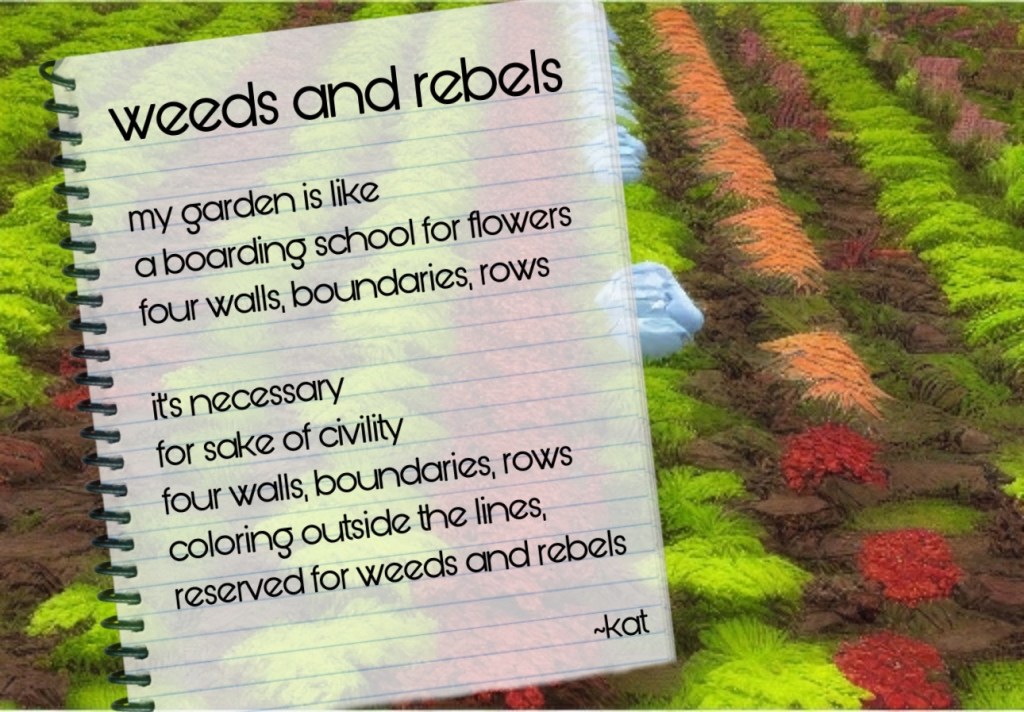
weeds and rebels

weeds and rebels

my garden is like
a boarding school for flowers
four walls, boundaries, rows

it’s necessary
for sake of civility
four walls, boundaries, rows
coloring outside the lines,
reserved for weeds and rebels

~kat

The Hainka

The 17-syllable haiku is the shortest form of poetry, and the 31-syllable tanka is probably the second shortest format of verse. Precisely the new form of poetry, hainka, is an assimilation of objective sensitivity of haiku with the more subjective oriented of tanka poetry. The synthesis in hainka is based on the image linking (the ‘fragment’ of haiku acting as the ‘pivot line’ of the following tanka) to explore and interweave human nature, love, emotion, humor in a broader sense by juxtaposition of the imageries.

It is also interesting to see the syllabic coherency between the ‘fragment’ (5-syllable words) with the 5-syllable words of the ‘pivot line’ of tanka. The final structural configuration would be 5/7/5/5/7/5/7/7 (s/l/s/s/l/s/l/l) with the significance of the image linking. A breathing gap (swinging space) is preferred between the haiku and tanka for the reader to imagine and experience the essence of poetry.

This image-linking across time and space is the art of painting an integrated poetic expression and exhibiting the fervent elucidation of hainka writing. Moreover, it retains its focus on the beauty of genetic image-linking to explore the poetic spell within the broader structural framework of the aesthetic essence and rhythms of Japanese short forms of poetry. Echoing the spirit of Basho’s ‘atarashimi’ (newness), I wish that the new verse will entwine the art of gratitude encompassing nature, living beings, non-living beings, and humanity as a whole.

Read more about the evolution of this form at Poetry Digest here: https://www.writersdigest.com/write-better-poetry/hainka-haiku-tanka-new-genre-of-poetic-form