Tag Archives: Poem a Day

September Cinqku 1 & 2

Catching up…for September’s short form, I’ll be exploring the Cinqku. (Read the description below.)

1-

maybe
tomorrow,
usually
means never…but there is
one day
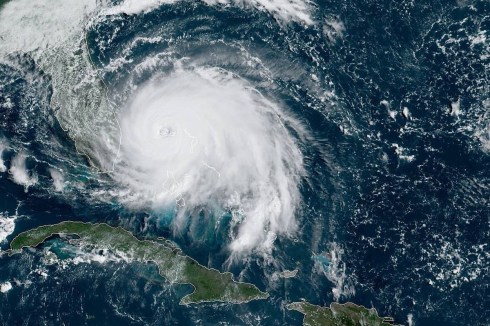
Hurricane Dorian -photo by VOX

2-

tempests
rage wildly
it’s what they do
its victims, helpless still,
ask why

~kat
(Thoughts for those affected by the hurricane…may they be safe.)


A cinqku must always have 5 lines and a perfect seventeen-syllable count. The lines typically follow a 2,3,4,6,2 format. There is no title requirement on the second line. As for syntax and diction styles, it follows the free Tanka style originally. There are no metric requirements for a cinqku poem. Additionally, the final line must contain a cinquain or kireji turn for emphasis. 


Oviellejo 27-28

starve a cold…

seasonally challenged am I
I can’t deny

when the first snap of cold air comes
I succumb

to stuffy headed coughing crud
become a slug

drinking hot toddies by the jug
out of commission, days on end
hiding away while on the mend
I can’t deny I succumb, become a slug

and yet there’s something glorious
though I may fuss

red-nosed sniffling, head in a vise
it is so nice

to feel the breezes, cool and dry
to close my eyes

it’s time to bid summer goodbye
this ruddy interlude between
wintery white and summer green
though I may fuss, it is so nice to close my eyes

~kat


True story…pass the spiked tea and honey please….

The Oviellejo is an Old Spanish verse form (derived from ovillo, a ball of yarn). A stanza consists of 10 lines, with a rhyme scheme of AABBCCCDDC. The second line of each rhyme scheme, Line 2,4,6, is short line of up to 5 syllables. The last line is a “redondilla,” a “little round” that collects all three of the short lines.


Oviellejo #26


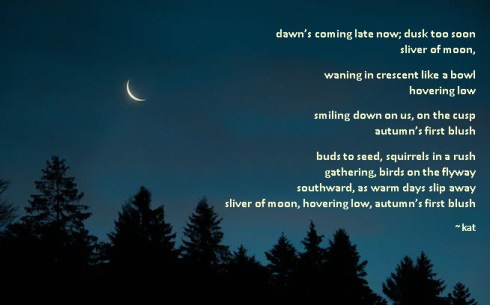
autumn

dawn’s coming late now; dusk too soon
sliver of moon,

waning in crescent like a bowl
hovering low

smiling down on us, on the cusp
autumn’s first blush

buds to seed, squirrels in a rush
gathering, birds on the flyway
southward, as warm days slip away
sliver of moon, hovering low, autumn’s first blush

~kat


Busy week…working on catching up on my daily Oviellejos for the Month of August.

The Oviellejo is an Old Spanish verse form (derived from ovillo, a ball of yarn). A stanza consists of 10 lines, with a rhyme scheme of AABBCCCDDC. The second line of each rhyme scheme, Line 2,4,6, is short line of up to 5 syllables. The last line is a “redondilla,” a “little round” that collects all three of the short lines.


Oviellejo #25

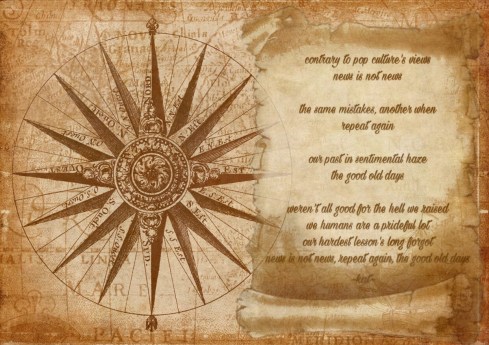
contrary to pop culture’s views
news is not news

the same mistakes, another when
repeat again

our past in sentimental haze
the good old days

weren’t all good for the hell we raised
we humans are a prideful lot
our hardest lesson’s long forgot
news is not news, repeat again, the good old days

~kat


The Oviellejo is an Old Spanish verse form (derived from ovillo, a ball of yarn). A stanza consists of 10 lines, with a rhyme scheme of AABBCCCDDC. The second line of each rhyme scheme, Line 2,4,6, is short line of up to 5 syllables. The last line is a “redondilla,” a “little round” that collects all three of the short lines.


Oviellejo 23 & 24 – up in smoke

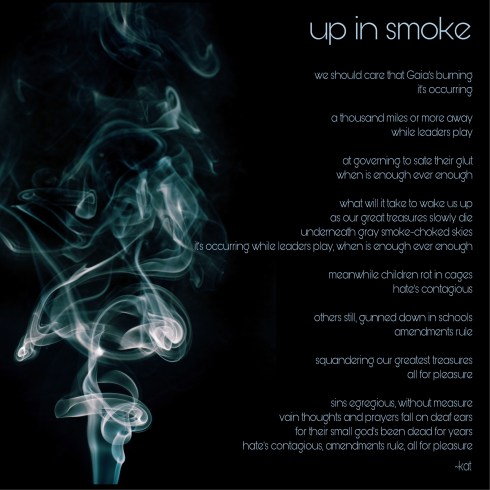
we should care that Gaia’s burning
it’s occurring

a thousand miles or more away
while leaders play

at governing to sate their glut
when is enough ever enough

what will it take to wake us up
as our great treasures slowly die
underneath gray smoke-choked skies
it’s occurring while leaders play, when is enough ever enough

~~~

meanwhile children rot in cages
hate’s contagious

others still, gunned down in schools
amendments rule

squandering our greatest treasures
all for pleasure

sins egregious, without measure
vain thoughts and prayers fall on deaf ears
for their small god’s been dead for years
hate’s contagious, amendments rule, all for pleasure

~kat


The Oviellejo is an Old Spanish verse form (derived from ovillo, a ball of yarn). A stanza consists of 10 lines, with a rhyme scheme of AABBCCCDDC. The second line of each rhyme scheme, Line 2,4,6, is short line of up to 5 syllables. The last line is a “redondilla,” a “little round” that collects all three of the short lines.