Tag Archives: free verse

Autumn – Stanza 21

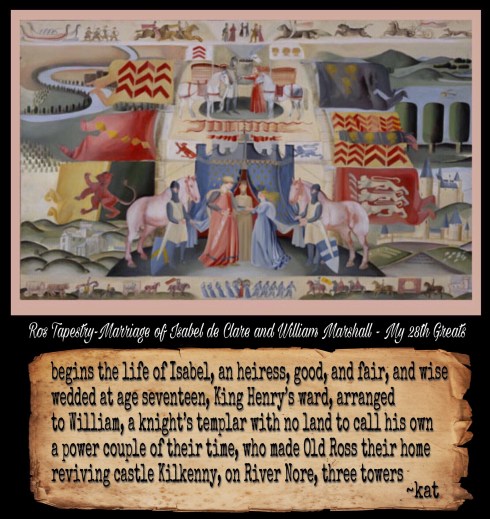
begins the life of Isabel, an heiress, good and fair and wise
wedded at age seventeen, King Henry’s ward, arranged
to William, a knight’s templar with no land to call his own
a power couple of their time, who made Old Ross their home
reviving castle Kilkenny, on River Nore, three towers

~kat

For Jane Dougherty’s August Stanza Challenge.


From Wikipedia, more on my 28th Great Grandparents Isabel and William:

Isabel was described as having been “the good, the fair, the wise, the courteous lady of high degree”. She allegedly spoke French, Irish and Latin. After her brother Gilbert’s death, Isabel became one of the wealthiest heiresses in the kingdom, owning besides the titles of Pembroke and Striguil, much land in Wales and Ireland.She inherited the numerous castles on the inlet of Milford Haven, guarding the South Channel, including Pembroke Castle. She was a legal ward of King Henry II, who carefully watched over her inheritance.

The new King Richard I arranged her marriage in August 1189 to William Marshal, regarded by many as the greatest knight and soldier in the realm. Henry II had promised Marshal he would be given Isabel as his bride, and his son and successor Richard upheld the promise one month after his accession to the throne. At the time of her marriage, Isabel was residing in the Tower of London in the protective custody of the Justiciar of England, Ranulf de Glanville. Following the wedding, which was celebrated in London “with due pomp and ceremony”, they spent their honeymoon at Stoke d’Abernon in Surrey which belonged to Enguerrand d’Abernon.

Marriage to Isabel elevated William Marshal from the status as a landless knight into one of the richest men in the kingdom. He would serve as Lord Marshal of England, four kings in all: Henry II, Richard I, John, and Henry III. Although Marshal did not become the jure uxoris 1st Earl of Pembroke, Earl of Striguil until 1199, he nevertheless assumed overlordship of Leinster in Ireland, Pembroke Castle, Chepstow Castle, as well as Isabel’s other castles in Wales such as the keep of Haverford, Tenby, Lewhaden, Narberth, Stackpole.

Shortly after their marriage, Marshal and Isabel arrived in Ireland, at Old Ross, a settlement located in the territory which belonged to her grandfather, Dermot MacMurrough. A motte was hastily constructed, a medieval borough quickly grew around it, and afterwards the Marshals founded the port town by the river which subsequently became known as New Ross. The Chronicles of Ross, which are housed in the British Museum, described Isabel and Marshal’s arrival in Ireland and records that Isabella set about building a lovely city on the banks of the Barrow.

In 1192, Isabel and her husband assumed the task of managing their vast lands; starting with the rebuilding of Kilkenny Castle and the town, both of which had been damaged by the O’Brien clan in 1173. Later they commissioned the construction of several abbeys in the vicinity.

The marriage was happy, despite the vast difference in age between them. William Marshal and Isabel produced a total of five sons and five daughters.
Autumn – Stanza 20

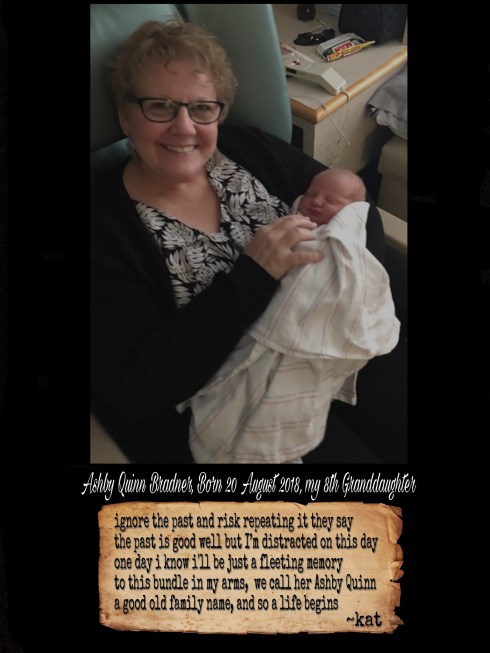
ignore the past and risk repeating it they say

the past is good well but I’m distracted on this day

one day i know i’ll be just a fleeting memory

to this bundle in my arms, we call her Ashby Quinn

a good old family name, and so a life begins

~kat

For Jane Dougherty’s August Stanza Challenge.


August – Stanza 19

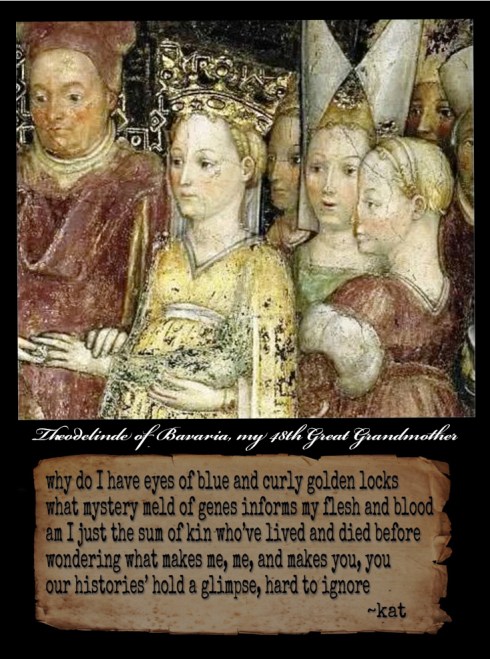
Theodelinda

why do I have eyes of blue and curly golden locks
what mystery meld of genes informs my flesh and blood
am I just the sum of kin who’ve lived and died before
wondering what makes me, me, and makes you, you
our histories’ hold a glimpse, hard to ignore

~kat

For Jane Dougherty’s August Stanza Challenge.

From a history source online:
Queens of Italy: Women in Power in Medieval Italy

Theodelinda was born in 570 A.D. in Bavaria. Her parents were Garipaldo, of Frank origin, and Valderada, daughter of a famous Lombard King, Vacone. At the age of nineteen, she became the wife of Autari, king of the Lombards, bringing him royal blood from her Lombard ancestor and good relationship with the Bavarian Kingdom. But after just one year of marriage, Autari died. According to the legend, the widow was allowed to choose her next husband: Agilulf, who became king of the Lombards. More likely, she was “persuaded” to marry the chief chosen by the dukes. The royal couple resided in Milan, a former capital of the Roman Empire. They pursued a policy of pacification among Lombards and Romans, promoting the coexistence of Catholicism and Arianism, the religion of the majority of the barbarians. Theodelinda founded a church in Monza (a few kilometers from Milan), doting it with a rich treasure and vast possessions. Cleverly, she made the church follow the 3-chapters doctrine, a schismatic position that was somehow half-way between Catholicism and Arianism. At the death of Agilulf, in year 616, Theodelinda became regent for her son Adaloaldo. The policy of pacific coexistence, however, was opposed by the Lombard chiefs, who overturned Adaloaldo in year 626. He died a little later, followed by Theodelinda in year 627.

The treasure of Theodelinda is an extraordinary collection of objects that can be seen at the museum of the “Duomo di Monza”. Among the objects donated by Theodelinda herself to the church, there are a precious binding for a Gospel book, a religious crown, a cross encrusted with precious stones, a goblet that was used by the royal couple at the ceremony of their engagement and small ampullas that contained oil from Holy Land. Other objects came from the queen’s funerary set: among them, a splendid group in silver representing a hen with seven chicks. The treasure of Theodelinda includes the famous “iron crown”, believed to contain a nail from Christ’s cross. Despite of the lack of any real connection to the queen, this symbol of royalty, used by German emperors and also by Napoleon, still adds to her myth.

Theodelinda was an influential woman in a society dominated by males and perturbed by violence and war. Her vision of a reformed society took shape centuries after her death, in Italy of the middle ages. Through time, she became a symbol of royalty and religious piousness. Even after all these centuries, her charm still lingers in the vaulted domes of the Duomo of Monza, where the wonder of her treasure reminds us of the woman who is considered to be the first “queen of Italy”.


August – Stanza 18

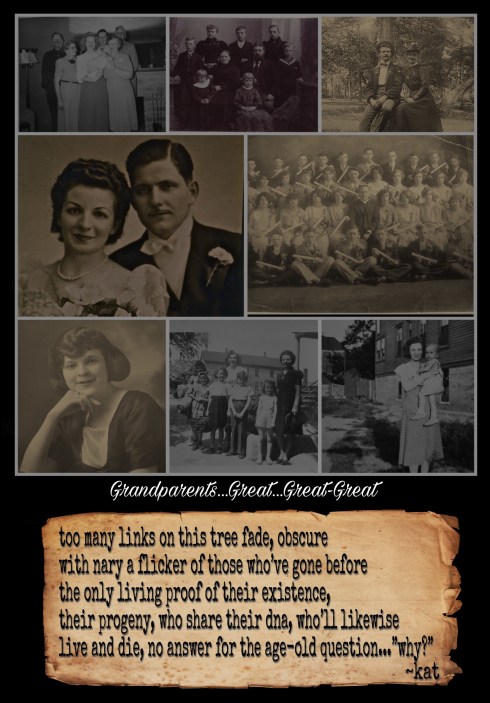
too many links on this tree fade, obscure
with nary a flicker of those who’ve gone before
the only living proof of their existence,
their progeny, who share their dna, who’ll likewise
live and die, no answer for the age-old question…”why?”

~kat

For Jane Dougherty’s August Stanza Challenge.


I have a few old family photos of some people I’ve never met, and of my grandparents gone too soon, before I could learn their stories. They are treasures of my past. I suppose that I why I write…to leave something behind for my grandkids.

The people shown above are a part of me. And so life goes on.


Top Left: My Grandpa Lambert Myrman, my Grandma Florence, née O’Malley, my Aunt Dolly holding my cousin Kristy, her husband Dean in back and his parents on the right.

Top Middle: My great-greats the Johansson’s and my Great Grandma Hanna (the youngest)

Top Right: my Great Grandparents, Peter O’Malley and Annie, née Powers

Middle Left: My Grandpa William Cunningham and my Grandma Mary, née Sluka

Middle Right: Grandma Mary’s graduation picture. She’s in the middle row, far right.

Lower Left: Grandma Florence O’Malley Myrman

Lower Middle: Grandma Mary (r) with my mom (girl with black skirt), her brother, Richard and sister, Sylvia

Lower Right: Grandma Mary holding my Mom, Dorothy


August – Stanza 17

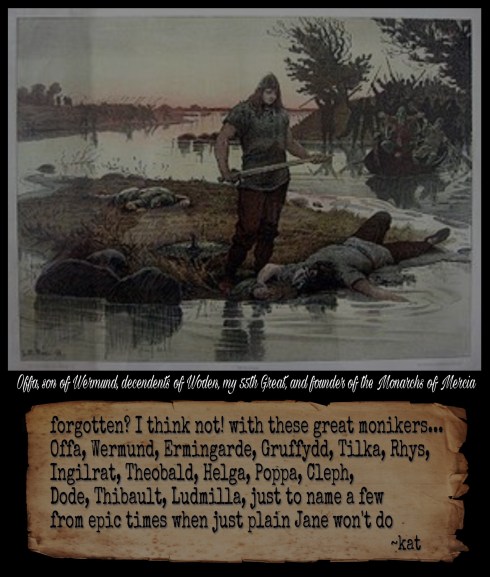
forgotten? I think not! with these great monikers…
Offa, Wermund, Ermingarde, Gruffydd, Tilka, Rhys,
Ingilrat, Theobald, Helga, Poppa, Cleph,
Dode, Thibault, Ludmilla, just to name a few
from epic times when just plain Jane won’t do

~kat

For Jane Dougherty’s August Stanza Challenge.

I have been fascinated by the names of my ancestors. Some are so unique. I’ve featured only a handful here, but there are many…and of course plenty if Tom’s, Dick’s and Mary’s too! 😊