Category Archives: Blackout Poetry

grief repeating – Monday with the Muse

BlueMuse

Painting, “Blue” by Kat Myrman

grief repeating

even now, grief
repeats itself
whispering,
“what hope for
love survives
here”…

some
see only
dusty
reflections
in blue

~kat


A Blackout poem inspired by the poem below “Anne Frank Huis” by Andrew Motion.

Anne Frank Huis
by Andrew Motion
Even now, after twice her lifetime of grief
and anger in the very place, whoever comes
to climb these narrow stairs, discovers how
the bookcase slides aside, then walks through
shadow into sunlit room(s), can never help
 
but break her secrecy again. Just listening
is a kind of guilt: the Westerkirk repeats
itself outside, as if all time worked round
towards her fear, and made each stroke
die down on guarded streets. Imagine it—

four years of whispering, and loneliness,
and plotting, day by day, theAllied line
in Europe with a yellow chalk. What hope
she had for ordinary love and interest
survives her here, displayed above the bed
 
as pictures of her family; some actors;
fashions chosen by Princess Elizabeth.
And those who stoop to see them find
not only patience missing its reward,
but one enduring wish for chances
 
like my own: to leave as simply
as I do, and walk at ease
up dusty tree-lined avenues, or watch
a silent barge come clear of bridges
settling their reflections in the blue canal.

Andrew Motion, “Anne Frank Huis” from Coming In To Land: Selected Poems 1975—2015.  Copyright © 2017 by Andrew Motion.  Reprinted by permission of HarperCollins Publishers Inc..
Source: Coming In To Land: Selected Poems 1975—2015 (HarperCollins, 2017)

Mondays with the Muse

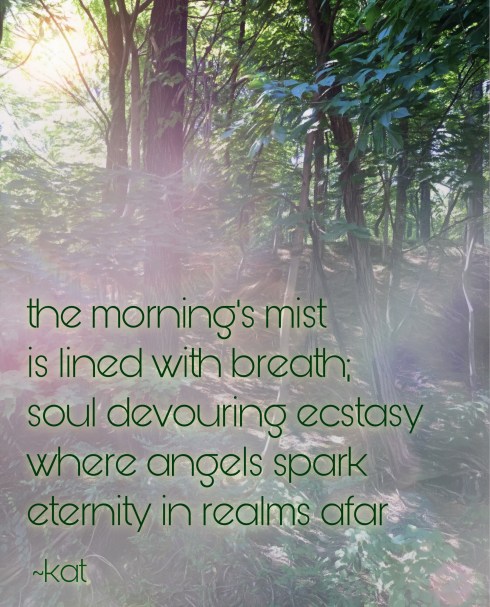
the morning’s mist
is lined with breath;
soul devouring ecstasy
where angels spark
eternity in realms afar

~kat


A Blackout Poem, courtesy of the Muse and this poem:

Aspiration

by Adah Isaacs Menken

Poor, impious Soul! that fixes its high hopes
In the dim distance, on a throne of clouds,
And from the morning’s mist would make the ropes
To draw it up amid acclaim of crowds—
Beware! That soaring path is lined with shrouds;
 And he who braves it, though of sturdy breath,
May meet, half way, the avalanche and death!

O poor young Soul!—whose year-devouring glance
Fixes in ecstasy upon a star,
Whose feverish brilliance looks a part of earth,
Yet quivers where the feet of angels are,
And seems the future crown in realms afar—
Beware! A spark thou art, and dost but see
Thine own reflection in Eternity
brilliance looks a part of earth,
Yet quivers where the feet of angels are,
And seems the future crown in realms afar
Beware! A spark thou art, and dost but see
Thine own reflection in Eternity


Monday with the Muse

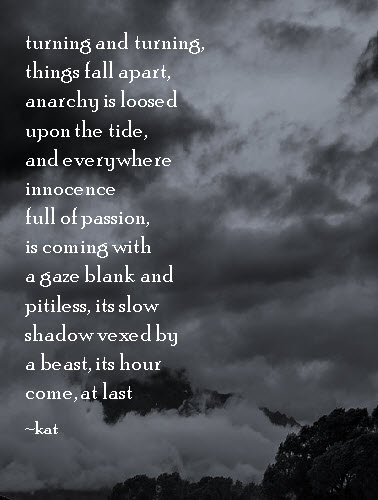
turning

turning and turning,
things fall apart,
anarchy is loosed
upon the tide,
and everywhere
innocence
full of passion,
is coming with
a gaze blank and
pitiless, its slow
shadow vexed by
a beast, its hour
come, at last

~kat


A Blackout Poem inspired by the poem, The Second Coming with Yeats as seen below.

The Second Coming
BY WILLIAM BUTLER YEATS

Turning and turning in the widening gyre
The falcon cannot hear the falconer;
Things fall apart; the centre cannot hold;
Mere anarchy is loosed upon the world,
The blood-dimmed tide is loosed, and everywhere
The ceremony of innocence is drowned;
The best lack all conviction, while the worst
Are full of passionate intensity.

Surely some revelation is at hand;
Surely the Second Coming is at hand.
The Second Coming! Hardly are those words out
When a vast image out of Spiritus Mundi
Troubles my sight: somewhere in sands of the desert
A shape with lion body and the head of a man,
A gaze blank and pitiless as the sun,
Is moving its slow thighs, while all about it
Reel shadows of the indignant desert birds.
The darkness drops again; but now I know
That twenty centuries of stony sleep
Were vexed to nightmare by a rocking cradle,
And what rough beast, its hour come round at last,
Slouches towards Bethlehem to be born?
Source: The Collected Poems of W. B. Yeats (1989)


unbearable – Monday with the Muse

neon

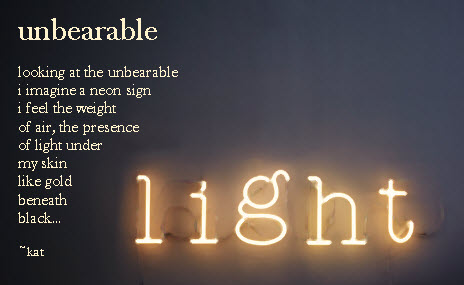
unbearable

looking at the unbearable
i imagine a neon sign
i feel the weight
of air, the presence
of light under
my skin
like gold
beneath
black…

~kat


A blackout poem inspired by the poem, “At the Beach” by Elizabeth Alexander below:

At the Beach
BY ELIZABETH ALEXANDER

Looking at the photograph is somehow not
unbearable: My friends, two dead, one low
on T-cells, his white T-shirt an X-ray
screen for the virus, which I imagine
as a single, swimming paisley, a sardine
with serrated fins and a neon spine.

I’m on a train, thinking about my friends
and watching two women talk in sign language.
I feel the energy and heft their talk
generates, the weight of their words in the air
the
same heft as your presence in this picture,
boys, the volume of late summer air at the beach.

Did you tea-dance that day? Write poems
in the sunlight? Vamp with strangers? There is
sun under your skin like the gold Sula
found beneath Ajax’s black. I calibrate
the weight of your beautiful bones, the weight
of your elbow, Melvin,
on Darrell’s brown shoulder.

“At the Beach” by Elizabeth Alexander. From Body of Life, published by Tia Chucha Press. Copyright 1996 Elizabeth Alexander. Used by permission of the author.
Source: Body of Life (Tia Chucha, 1996)


A Song of Spring – Blackout Poem

song of spring

a song of spring

the green land,
the water, the leaves
sing of spring…

come forth,
to love’s edge,
dance in the moment
enter the light
where silence
screams

~kat


A Blackout Poem inspired by the poem below


The Lake in Central Park

BY JAY WRIGHT

It should have a woman’s name,

something to tell us how the green skirt of land

has bound its hips.

When the day lowers its vermilion tapestry over the west ridge,

the water has the sound of leaves shaken in a sack,

and the child’s voice that you have heard below

sings of the sea.


By slow movements of the earth’s crust,

or is it that her hip bones have been shaped

by a fault of engineering?

Some coquetry cycles this blue edge,

a spring ready to come forth to correct

love’s mathematics.


Saturday rises immaculately.

The water’s jade edge plays against corn-colored

picnic baskets, rose and lemon bottles, red balloons,

dancers in purple tights, a roan mare out of its field.

It is not the moment to think of Bahia

and the gray mother with her water explanation.

Not far from here, the city, a mass of swift water

in its own depression, licks its sores.


Still, I would be eased by reasons.

Sand dunes in drifts.

Lava cuts its own bed at a mountain base.

Blindness enters where the light refuses to go.

In Loch Lomond, the water flowers with algae

and a small life has taken the name of a star.


You will hear my star-slow heart

empty itself with a light-swift pitch

where the water thins to a silence.

And the woman who will not be named

screams in the birth of her fading away.


Jay Wright, “The Lake in Central Park” from Transfigurations: Collected Poems (Baton Rouge: Louisiana State University Press, 2000). Copyright © 2000 by Jay Wright. Reprinted with the permission of the author.

Source: Transfigurations: Collected Poems (Louisiana State University Press, 2000)