Tag Archives: word of the day

Tannenbaum – Friday’s Word of the Day Haiku

O
O Tannenbaum, O Tannenbaum! Today’s dictionary.com Word of the Day is one that we have come to associate with the Christmas season, the Tannenbaum, literally translated from German to mean “fir”.

Today most people have come to accept the Christmas tree as a holiday fixture in homes and town squares the world over. Though it’s modern form traces its roots to 15th and 16th century Germany, the practice of using evergreen branches and trees to celebrate winter festivals, pagan and Christian, dates back many thousand years before Christmas was even a thing. To Pagans, decking their homes and temples with evergreen branches during winter solstice made them think of the coming spring. Romans used evergreen branches to decorate their temples during the winter festival of Saturnalia, in homage to the god Saturn, whose name means “sowing”.

The strong association of the tannenbaum with paganism has faced the ire of fundamentalist christians though, who link the practice all the way back to the prophet Jeremiah. To support their opposition to Christmas trees they refer to his words in chapter 10:1-5:

10 Hear ye the word which the Lord speaketh unto you, O house of Israel:

2 Thus saith the Lord, Learn not the way of the heathen, and be not dismayed at the signs of heaven; for the heathen are dismayed at them.

3 For the customs of the people are vain: for one cutteth a tree out of the forest, the work of the hands of the workman, with the axe.

4 They deck it with silver and with gold; they fasten it with nails and with hammers, that it move not.

5 They are upright as the palm tree, but speak not: they must needs be borne, because they cannot go. Be not afraid of them; for they cannot do evil, neither also is it in them to do good.
King James Version (KJV)

More moderate christians explain away this argument by saying that Jeremiah was speaking about the idolatry of pagans in general. The tree is just for illustrative purposes.

Believe what you will, as I mentioned before, the first known Christmas tree was set up in 1419 in the town of Freiburg, Germany. It was the town bakers who donned a tree in the square with fruits, cakes and nuts as a treat for the children who were allowed remove them from the tree and eat them on New Years Day.

Later in the 16th century, none other than the renowned minister, Martin Luther, is credited for bringing the very first Christmas tree inside. As the story goes, while on an evening walk, he was inspired by the twinkling stars that shone through the branches of a nearby forest. He would later tell his children that the stars through the trees reminded him of Jesus who “left the stars of heaven to come to earth at Christmas”. Next time you’re wrestling with an unruly ball of holiday lights, remember that very first lit Christmas tree!!! Happy Happy Joy Joy!!!! 😜

But back to our word of the day, Tannenbaum. Most of us know the word because it was popularized by a folk song penned by the Leipzig organist, teacher and composer Ernst Anschütz. What you may not know about this happy song is that it was a revised version, with Anschütz adding additional verses to a tragic love song originally written by Joachim August Zarnack who sited the faithful evergreen tree as a contrast in virtue to his faithless lover who jilted him. Here’s Anschütz’s full version in German and a popular English Christmas carol rendering, of which there are dozens!

O Tannenbaum – the Christmas Carol:

O Tannenbaum, o Tannenbaum,
wie treu sind deine Blätter!
Du grünst nicht nur
zur Sommerzeit,
Nein auch im Winter, wenn es schneit.
O Tannenbaum, o Tannenbaum,
wie treu sind deine Blätter!

O Christmas Tree, O Christmas Tree,
How steadfast are your branches!
Your boughs are green
in summer’s clime
And through the snows of wintertime.
O Christmas Tree, O Christmas Tree,
How steadfast are your branches!

O Tannenbaum, o Tannenbaum!
Du kannst mir sehr gefallen!
Wie oft hat nicht zur Weihnachtszeit
Ein Baum von dir mich hoch erfreut!
O Tannenbaum, o Tannenbaum!
Du kannst mir sehr gefallen!

O Christmas Tree, O Christmas Tree,
What happiness befalls me when oft
at joyous Christmas-time
Your form inspires my song and rhyme.
O Christmas Tree, O Christmas Tree,
What happiness befalls me

O Tannenbaum, o Tannenbaum!
Dein Kleid will mich
was lehren:
Die Hoffnung und Beständigkeit
Gibt Trost und Kraft
zu jeder Zeit.
O Tannenbaum, o Tannenbaum!
Das soll dein Kleid
mich lehren.

O Christmas Tree, O Christmas Tree,
Your boughs can teach a lesson
That constant faith and hope sublime
Lend strength and comfort
through all time.
O Christmas Tree, O Christmas Tree,
Your boughs can teach a lesson.

As you can see, there are many twists ands turns to this beloved tradition. Here’s my haiku then…adding three more lines to all things Tannenbaum!


O Tannenbaum – A Haiku

Dear old Tannenbaum
with boughs dressed in sweets and light,
you’re heaven on earth!

kat ~ 23 December 2016


Hotsy-Totsy – Friday’s Word of the Day Haiku – 16 December 2016

roaring-20s

Channeling my inner Flapper at my granddaughter’s Roaring 20’s Sweet 16 Party 🙂

Happy Friday!  Today’s dictionary.com Word of the Day is hotsy-totsy. It is described as Older Slang. – about as right as can be; perfect: He always thinks everything is just hotsy-totsy.

Hotsy-totsy originated in the Roaring 20’s. There are many parallels between the 1920’s and modern times. The U.S. and the world was just coming out of a World War I. Science was amidst a great debate over the size of the universe (aka the “Great Debate” of 1920). Today we have a great debate of our own: climate change proponents and deniers. And speaking of science, the famous Scopes trial in 1925 was an attempt by creationists to vilify and abolish the teaching of evolution in schools. We’re still seeing this battle play out in school boards today.

In the 1920’s we saw a rise in radical political movements worldwide. Today, there are many references and parallels to those radical movements: Fascism, Nazism, Nationalism, Fundamentalism, Communism and National Socialism. Political agendas focused on moral issues in the 1920’s, as they continue to do today. In the 20’s the 18th Amendment was ratified prohibiting alcohol, only to be repealed in its entirety 13 years later by the 21st Amendment. Today it is marijuana that is flip-flopping between legal and illegal in our courts, with the states taking the lead in decriminalizing it.  The 19th Amendment, giving women the right to vote in the US was ratified in the 1920’s. Ironically, even though the door opened in 192o, women have a long way to go. Today women still suffer from workplace discrimination and wage discrepancies and continue to be objectified and denied the right to make their own  health decisions. We have not come very far from the days when women were considered the property of her husband.

The Immigration Act of 1924 placed restrictions and quotas on the number of immigrants allowed to come into the U.S. Today, we are seeking to do the same and more, by building walls, registering immigrants of a particular religion and threatening to send immigrants back to where they came from. Also in the 1920’s we saw enrollment in the KKK peak after its resurgence in 1915. Sadly we are seeing a this trend again in today’s volatile and polarized society.

In the 1920’s if someone was hotsy-totsy he likely thought quite highly of himself. I can think of a few people who shall remain nameless that fit that description! 🙂 I love the other terms that were mentioned in the “Origin of the Word” segment in dictionary.com: heebie-jeebies and horsefeathers:

Origin of hotsy-totsy – The term hotsy-totsy first appeared in the 1920’s in William (Billy) De Beck’s hugely popular comic strip Barney Google and Snuffy Smith. De Beck, in addition to coining “hotsy-totsy”, also coined the terms “heebie-jeebies” and “horsefeathers”.

Such fun words! Of course I had to figure out a way to use them in a haiku. And so here it is. I often hear the warning that those who don’t learn from history are doomed to repeat it. We never learn do we?

It’s hotsy-totsy
at least some think so…others?
It’s just horsefeathers!

kat ~ 16 December 2016


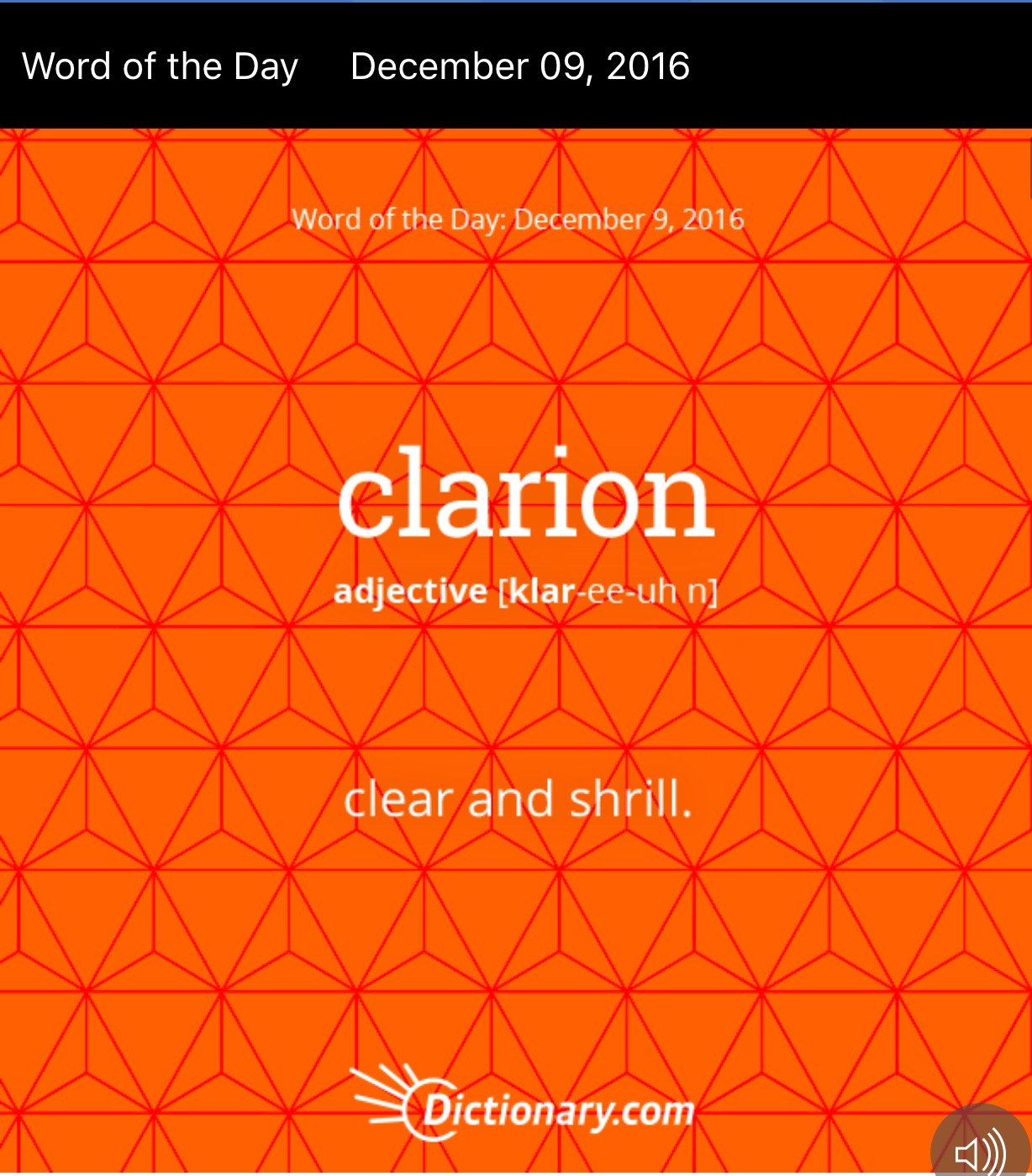
Clarion – Friday’s Word Of The Day Haiku – 9 December 2016


Happy Friday! Today’s word of the day on Dictionary.com is Clarion. It is defined as a1. Clear and shrill: the clarion call of a battle trumpet, and 2. An ancient trumpet with a curved shape.

It is when the one gets into the origin of the word that things get interesting…

Origin of clarion

The etymology of clarion is clear and simple. Spellings of the equivalent term in Old French include clarain,clarin, claron, clairon, clarine. The diminutive noun in French formed from clarine is clarinette, meaning“clarinet.” Clarion entered English in the late 1300s,clarinette in the late 1700s.

But I think my favorite reference to the word is in its application in a quote by Jane Goodall:

“This book is a clarion call to rouse such people fromspineless acceptance of the status quo. I cannotstress strongly enough that every individual makes a difference.”
Jane Goodall, with Gary McAvoy and Gail Hudson, Harvest for Hope, 2005

Inspired by Ms. Goodall’s words, I give you a few Haiku. Have a great weekend! 😊

Clarion – A Haiku Study

those who are awake
shriek a clarion warning
to rouse those who sleep

clarion crooners
sooth the rage of common beasts
and crying babies

it’s not the sunrise
it’s the cock’s clarion call 
that rallies the dawn

kat ~ 9 December 2016


Faustian – Friday’s Word of the Day Haiku

faustian

TGIF! That’s all I can say! It’s been a rough several weeks for many of us. And it gets crazier each and every day! Today’s Dictionary.com Word of the Day is another of those blasted words that has a poignant parallel to current events. Last week I dodged the bullet, so to speak, and refused to apply the theme of my haiku to the obvious. But there is no way around it this week…Faustian…how else does one explain the madness that we are currently witnessing?

Dictionary.com defines Faustian as

  1. sacrificing spiritual values for power, knowledge, or material gain: a Faustian pact with the Devil. or
  2. of, relating to, or characteristic of Faust: a Faustian novel.

But it is the origin of the word that truly sent me over the edge…

Johann Faust (c1481–c1541), Latinized as Johannes Faustus, was an itinerant German alchemist, astrologer, magician, and thaumaturge. Legend has it that even though he was very successful, he became dissatisfied with his life and with the limits of human knowledge and therefore sold his soul to the Devil for limitless knowledge and pleasure for a limited time—the Faustian bargain. Faust in German means ”fist”; faustus in Latin means ”of favorable omen, auspicious.”

I know I don’t need to mention it, but it bears repeating, especially since many of you are not from the U.S. Just in case you might be wondering if I am one of those insane persons in the minority who dealt our country a lethal blow last month by voting for, well, you know who. At any rate, here goes…

I did NOT vote for Trump.

That being said, as much as I might want to scream from the rooftops, “He is not my president; he will NEVER be MY president!” I am reminded that the angry minority that voted for him thought that very same thing about my President these last eight years, misinformed and misguided though they may have been. They voted recently, many of them – especially those who claim to be Christians – by selling their soul, in true Faustian fashion, turning a blind eye to his misogyny, racism, privileged, narcissistic, bullying and lying behavior because basically, they were “mad” at a government that they believed was not serving their self-righteous needs. Oops sorry…too harsh? Oh well.

Apparently I am still stinging from the betrayal of many of my friends and family who voted for this monster. In my heart of hearts I know that they are not all those awful things that define the man that they voted for. And while I have admonished myself to be forgiving I am finding that this is an ongoing inner battle that I must fight each and every time I hear another one of his outrageous lies or his announcements of each vile cabinet appointment. “What were they, those who voted for him, thinking?” I think…

Taking a deep breath.

Like it or not, he is THE president-elect. Forgiving those I love for their error (IMHO of course) will, I’m sure, continue to be a thorn in my side, but one that I am determined to press through because I do love them.

As for my country? Just because I forgive the generally nice people who were blinded by his skulduggery, does not mean that I will not continue to stand for justice with every ounce of my being. It’s a fine line we walk, those of us who are awake. But the future depends on it.

Peace and LOVE to you all…kat

“We the People” reap
fallout from Faustian pacts…
elections matter!

kat ~ 2 December 2016


Schlockmeister – Friday’s Word of the Day Haiku

Happy Friday! Black Friday to be exact, and whooo-boy do I have a deal, I mean word for you! Actually dictionary.com has a word and a very timely one at that! Today’s word of the day…it’s a word you didn’t even know you needed until now…in fact it will change your life and you’re gong to want to say it every chance you get. The word…here for a limited time only, is none other than Schlockmeister!

Schlockmeister is called an Americanism, originating around 1960-65. It’s a combination of schlock, a Yiddish word meaning cheap or trashy and mayster or German Meister which means master craftsman.

I’m sure you will agree this is the perfect word for today as bargain hunters flood the shopping centers and malls in search of the latest, greatest next big, must have thing that will likely be collecting dust when next year’s Black Friday rolls around!

Happy Holidays!

schlockmeisters don’t care
if you need what they’re selling
they will convince you

people who must have
the latest, greatest new things
are schlockmeister’s tools

the internet is full
of schlockmeisters in disguise
with perfect selfies

kat – 25 November 2016