Tag Archives: stanza

Autumn ~ Stanza 24

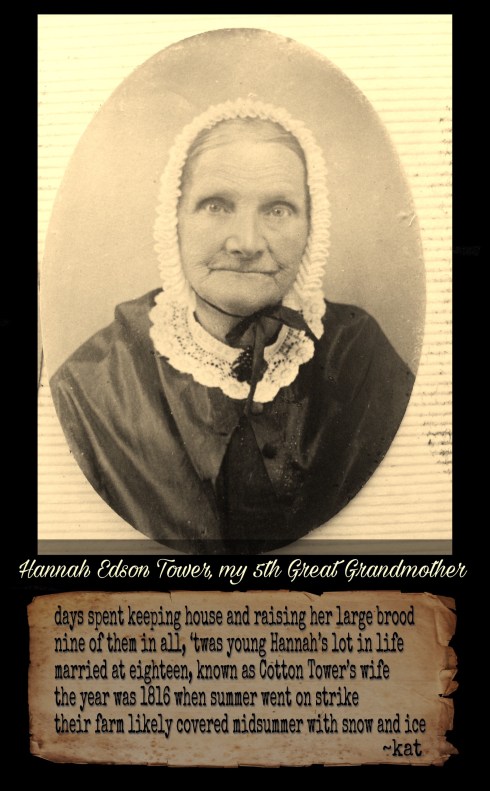
days spent keeping house and raising her large brood
nine of them in all, ‘twas young Hannah’s lot in life
married at eighteen, known as Cotton Tower’s wife
the year was 1816 when summer went on strike
their farm likely covered midsummer with snow and ice

~kat

For Jane Dougherty’s August Stanza Challenge.


History recounts the year 1816 as “The Year Of No Summer”. It was also the year my 5th Great Grandparents, Hannah Edson and Cotton Tower married. Cotton was a Farmer by trade. Hannah, who I am fortunate to have a photograph of, is listed on census records as a housewife. With 9 children I can’t imagine she had much time for anything else besides birthing and tending to her children. They all seem to have been of hearty stock though. Hannah died at the ripe old age of 74, with Cotton following her nearly a decade later at 85. They lived in Leavenworth, Indiana. I imagine the farms in that part of the country felt the chill, along with the rest of the world, caused by the eruption of Mount Tambora in Indonesia. It is said that the atmosphere was thick with volcanic ash, limiting the amount of sunlight, cooling the Earth’s surface, and causing a once-in-a-lifetime event: a year-long winter.

Here is an excerpt I found from The Washington Times Herald :

A year without a summer

Although no documented local records of weather existed in 1816, the summer of 1816 is without question a memorable year, not only locally, but world wide. The year of 1816 is referred to as “the year without a summer.”

In 1961, Frank L. Hartle of Indianapolis was in possession of an 1816 newspaper article describing 1816 as being the coldest summer ever experienced by any person living at that time.

The following are excerpts from the article:

“June was described as the coldest month vegetation had ever experienced in this latitude. Frost and ice was as common as buttercups usually are in June.”

“Mothers made thick mittens for their children and they wore knitted sox of double thickness. Overcoats and gloves were required by farmers as they attempted to do their daily chores.”

“A heavy snowfall on June 17, 1816, was accompanied by a pathetic story. A Vermont farmer turned his sheep to pasture the previous day. Temperatures dropped below freezing over night and snow had begun falling about 9 a.m.”

As the farmer left home, he jokingly remarked to his wife: “Better start the neighbors searching soon for me.”

“It’s the middle of June you know and I may get lost in the snow.” Snow continued to fall in torrents and drifts began to form. By night fall nothing had been heard from him. The wife summoned neighbors and they began to search for him. They continued searching the second day. Only after the third day, was he found lying in a hollow, half-covered with snow, still alive but both feet frozen. The sheep were found nearby, but most of the flock of sheep had lost their lives.

July offered no respite. Ice thicker than window glass required breaking the ice in the livestock water troughs so they could drink.

But to everyone’s surprise August proved worst of all.

“Almost every green thing in the country and Europe was blasted daily by frost. Snow fell in August in London, England. In Quebec City, Canada, on June 10, 1816, they experienced a 12-inch snowfall and 1816 was the coldest year in the northern hemisphere on record.

As a result of these abnormal summer temperatures, parts of Europe experienced a stormier winter in 1816. That, in turn, resulted in the widespread death of much of the livestock.

Cool temperatures and heavy rains resulted in failed harvests in Great Britain and Ireland. Families in Wales traveled long distances as refugees begging for food. Famine was prevalent in North and South West Ireland following the failure of their wheat, oats and potato harvests. Violent demonstrations in front of grain markets and bakeries, followed by riots, arson and looting in many European cities due to food shortages and skyrocketing food prices.

Worldwide, no living person at that time had any recollection of weather creating such havoc throughout history. While it was known that other countries were also experiencing similar weather problems, the actual cause wasn’t known until years later.

A cause is found

Virtually no one in Daviess County, Ind., had ever heard of Indonesia or the small island of Sumatra nor had they any knowledge of Mount Tambora nor would they ever have believed that a volcano half way around the world could have any effect on their lives, especially their weather.

If asked, at the time, if they knew that there was a volcano eruption on Mount Tambora in Indonesia; their answer would probably be, “So who cares?” The science of climate and the factors which contribute to temperatures, the seasons, the air currents and ocean tides were not a part of common knowledge. In fact, if someone were to have suggested that a volcano was to be blamed, even the highly educated in 1816 would label us as a “fruitcake.”

To believe the cause of 12-inch snowfalls in June or world widespread crop failures were a direct result of a volcano in Indonesia would have been truly unbelievable.

Although there are several volcanoes today capable of eruption, the April 1815 Mount Tambora eruption was the largest volcanic eruption in recorded history. The explosion was deafening and was heard on the island of Sumatra more than 1,200 miles away. The estimated death toll exceeded 71,000 people. A team of archaeologists during excavation diggings in 2004 discovered cultural remains buried from the Mount Tambora volcanic explosion still intact beneath 9.9 foot deep pyroclastic lava deposits. Many of the bodies were preserved in the positions they occupied on that fateful day in 1815.
August ~ Stanza 23

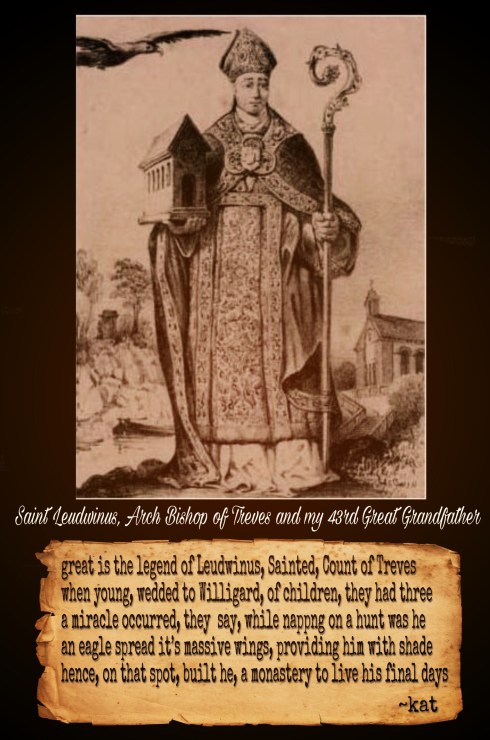
great is the legend of Leudwinus, Sainted, Count of Treves
when young, wedded to Willigard, of children, they had three
a miracle occurred, they say, while nappng on a hunt was he
an eagle spread it’s massive wings, providing him with shade
hence, on that spot, built he, a monastery to live his final days

~kat

For Jane Dougherty’s August Stanza Challenge.


A bit about my 43rd Great Grandfather, Saint Leudwinus from Wikipedia

Leudwinus was born a French nobleman and was a member of one of the most powerful clans in Austrasia. His father, Warinus, was Count of Poitiers and Gunza of Metz. Lambert of Maastricht was his kinsman. His Frankish name is Liutwin. Leudwinus spent his early life at the royal court of Austrasia[ and was styled Count of Treves. He received his education from his maternal uncle, Saint Basinus, Archbishop of Treves. In 697, Leudwinus signed the Deed of Echternach with his uncle.

Initially uninterested in an ecclesiastical career, Leudwinus married Willigard of Bavaria. Their children were:

Milo, Count of Treves

Wido, Count of Hornbach

(Possibly) Chrotrude of Treves (Rotrude), who married Charles Martel and became Duchess of Austrasia.

According to legend, the abbey in Mettlach was founded after Leudwinus went hunting near Saar. He grew tired and fell asleep under the shade of a tree. As he slept the sun changed positions exposing him to its hot rays, but an eagle swept down and sat on Leudwinus with its wings spread out. When Leudwinus woke up, his servant told him how the eagle had protected him from being burnt by the sun.

Coincidentally, Leudwinus happened to be napping at the site of the Miracle Eagle near the chapel of St. Denis of Paris. Leudwinus saw this as a God-sent sign to establish a Benedictine monastery at that site, and it soon developed into a Christian missionary center. At the location of the original Dionysius Chapel now stands the parish church of St. Gangolf in Mettlach.

When Leudwinus became a widower, he joined the monastery he founded at Mettlach as a simple monk.

In 697, Leudwinus was appointed coadjutor of his uncle Basinus von Trier. In 698, he cofounded the Echternack Abbey at Mettlach.

When Archbishop Basinus died on 4 March 705, Leudwinus succeeded him and was consecrated Archbishop of Treve. Leudwinus was also appointed bishop of Laon. This made him one of the most important church dignitaries of the time in the Frankish kingdom.

Leudwinus died on the 29th of September 722 at Reims. He was succeeded as Archbishop of Treve by his son, Milo, who brought his father’s remains to Treve for burial. However, local customs prevented this, so Leudwinus’ family decided to let the dead saint choose his own place of burial. His coffin was placed on a ship without a crew. It sailed by itself first to Moselle, then Saar, and finally docked at Mettlach, where the church bells began to ring.

Leudwinus was buried in St. Mary’s Church at the Abbey at Mettlach. In 990, St. Mary’s Church was replaced by a new structure called the Old Tower, the oldest preserved stone building in Saar.


Autumn – Stanza 22

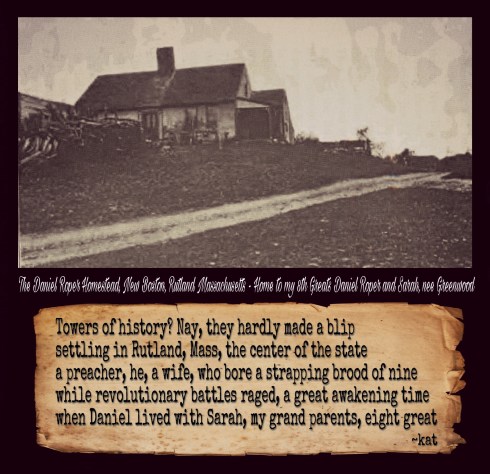
Towers of history? Nay, they hardly made a blip
settling in Rutland, Mass, the center of the state
a preacher, he, a wife, who bore a strapping brood of nine
while revolutionary battles raged, a great awakening time
when Daniel lived with Sarah, my great grand parents, times eight

~kat

For Jane Dougherty’s August Stanza Challenge.


Daniel Roper was born on October 2, 1730 in Worcester, Massachusetts, the son of Ephraim Roper and his wife Sybilla, née Moore. He married Sarah Greenwood on March 18, 1756 in Sutton, Massachusetts. Sarah was born on August 3, 1734 in Worcester, Massachusetts, the daughter of Daniel Greenwood and Sarah, née Adams.

Daniel served as a private in the Revolutionary Army in 1775-1776 under Captain Benjamin Richardson in the regiment of Colonel Benjamin Dikes out of Dorchester Heights. They settled in Rutland and had 9 children. Records indicate that Daniel was a Minister by trade. Sarah died in 1808. Daniel lived to the impressive age of 90, dying in 1821. Their second daughter, Sibbel is my 7th great grandmother. She married Daniel Walker. It would seem that Daniel was a popular name back in the day!


August – Stanza 18

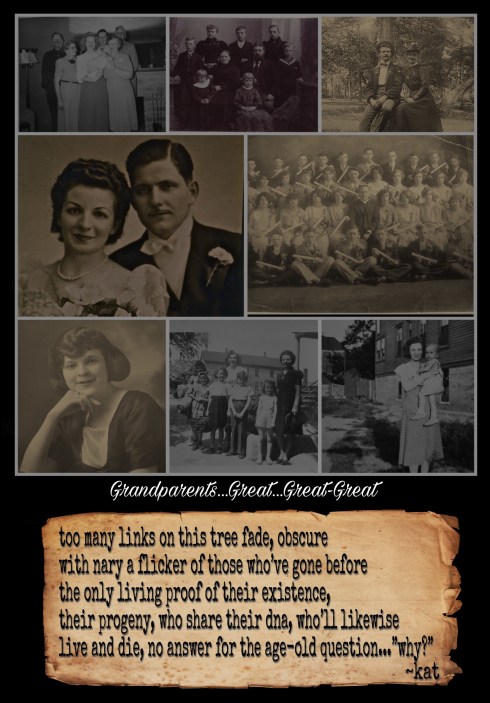
too many links on this tree fade, obscure
with nary a flicker of those who’ve gone before
the only living proof of their existence,
their progeny, who share their dna, who’ll likewise
live and die, no answer for the age-old question…”why?”

~kat

For Jane Dougherty’s August Stanza Challenge.


I have a few old family photos of some people I’ve never met, and of my grandparents gone too soon, before I could learn their stories. They are treasures of my past. I suppose that I why I write…to leave something behind for my grandkids.

The people shown above are a part of me. And so life goes on.


Top Left: My Grandpa Lambert Myrman, my Grandma Florence, née O’Malley, my Aunt Dolly holding my cousin Kristy, her husband Dean in back and his parents on the right.

Top Middle: My great-greats the Johansson’s and my Great Grandma Hanna (the youngest)

Top Right: my Great Grandparents, Peter O’Malley and Annie, née Powers

Middle Left: My Grandpa William Cunningham and my Grandma Mary, née Sluka

Middle Right: Grandma Mary’s graduation picture. She’s in the middle row, far right.

Lower Left: Grandma Florence O’Malley Myrman

Lower Middle: Grandma Mary (r) with my mom (girl with black skirt), her brother, Richard and sister, Sylvia

Lower Right: Grandma Mary holding my Mom, Dorothy


August – Stanza 17

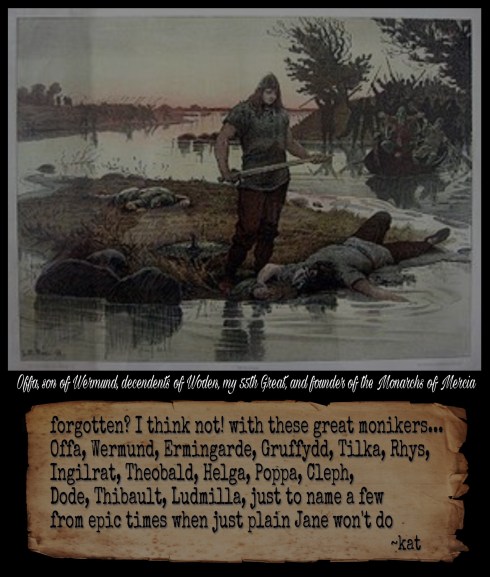
forgotten? I think not! with these great monikers…
Offa, Wermund, Ermingarde, Gruffydd, Tilka, Rhys,
Ingilrat, Theobald, Helga, Poppa, Cleph,
Dode, Thibault, Ludmilla, just to name a few
from epic times when just plain Jane won’t do

~kat

For Jane Dougherty’s August Stanza Challenge.

I have been fascinated by the names of my ancestors. Some are so unique. I’ve featured only a handful here, but there are many…and of course plenty if Tom’s, Dick’s and Mary’s too! 😊