Tag Archives: essay

Bedizen – Friday’s Word of the Day

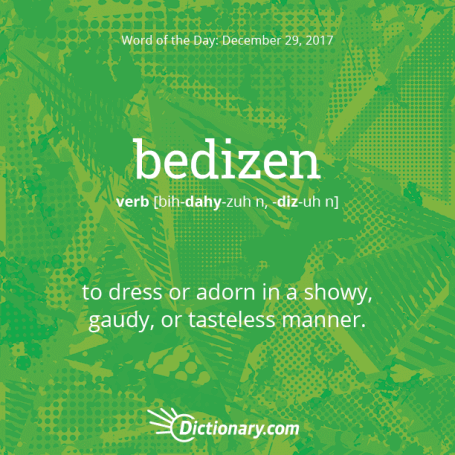
Today’s word of the day at Dictionary.com is Bedizen, which means ‘to dress or adorn in a showy, gaudy, or tasteless manner’.

According to Dictionary.com:

Bedizen is not a common verb in English. It is a derivative of the even more uncommon verb dizen, which occurs only from the 16th century and becomes obsolescent by the end of the 19th century. The element diz- is probably the same as in distaff “a staff for holding flax or wool for spinning” and is probably related to Middle Low German dise “bunch of flax on a staff for spinning.” Bedizen entered English in the 17th century.

I also learned that while the word bedizen is rarely used in conversation these days, it can be found in print. It has a flashy ring to it, don’t you think? Almost sounds like “bedazzled”. One site suggested that because it is an obscure word you can easily insult a highfalutin somebody! Being unfamiliar with its meaning they might even thank you for it!

To be clear, this is not a word meant to compliment someone. I don’t know about you, but I’m keeping this one in my tool chest for those special people in my life whose narcissistic, attention-seeking, haughty behavior gets under my skin…and I’m going to practice saying it with a wink and a smile…you’re welcome! 😀

Speaking of…

accustomed to glitz
they bedizened the White House
calling it a dump

~kat


Dundrearies – Friday’s Word of the Day

dundrearies

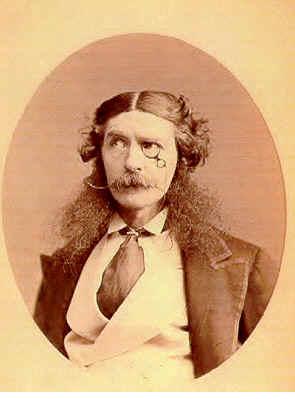
Today’s dictionary.com word of the day is dundrearies. It originated around 1860-65, thanks to “Lord Dundreary, a character in the play, “Our American Cousin”. Officially, it is defined as “long, full sideburns or muttonchop whiskers”.

We create all sorts of words based on the quirks or memorable attributes of the certain people. There is a word for it.  They are called Eponyms, ‘words based on a person’s name’. The cool thing about Eponyms is the history behind the word. Some eponyms you might recognize are: boycott, guillotine, sandwich, hooligan, gerrymander, adonis, braille, dunce, jacuzzi, judas, casanova, paparazzi, ritz, and trumpster. Scientists, doctors and inventors are known to use eponyms regularly in ascribing ownership of their handiwork.

But back to our word today, dundrearies, and it’s most interesting history. As already established, the word is attributed to one ‘Lord Dundreary’ from the three-act play, “Our American Cousin”.  The play was written by English playwright, Tom Taylor in 1858 and premiered at the Laura Keene’s Theatre in New York City on October 15, 1858. It was fairly popular for several years, but it was its fateful run at the Ford’s Theatre in Washington, DC, and specifically its showing on April 14, 1865 that etched it into American history. “Our American Cousin”, you see, was the play that President Abraham Lincoln was watching when he was assassinated by actor and Confederate sympathizer John Wilkes Booth.

According to Wikipedia, the cast modified a line of the play in honor of Abraham Lincoln: when the heroine asked for a seat protected from the draft, the reply – scripted as, “Well, you’re not the only one that wants to escape the draft” – was delivered instead as, “The draft has already been stopped by order of the President!”

Halfway through Act III, Scene 2, when the character of Asa Trenchard, played that night by Harry Hawk, uttered this line, considered one of the play’s funniest, to Mrs. Mountchessington: “Don’t know the manners of good society, eh? Well, I guess I know enough to turn you inside out, old gal — you sockdologizing old man-trap.”

It was during the ensuing laughter that President Lincoln laughed his last and the play ended abruptly. While Wilkes Booth was not a cast member of the play, he used the chose this moment when the laughter was at its height to muffle the sound of his gun.
Lord_Dundreary

Edward Sothern as Lord Dundreary, sporting “Dundrearies”

I don’t believe that the word, dundrearies has anything to do with this interesting sidebar. It has more to do with the popularity of the play and the first actor Edward Sothern who brilliantly played the part of ‘Lord Dundreary’.  I do find it fascinating though, how history and words and our experiences are all seem to be an intricate and interconnected web. We are all interconnected for that matter, I believe, by 6 degrees or less.

Have a great weekend. Here’s a haiku.

sporting dundrearies
once touted as all the rage
are now thought unkempt

~kat


Claque – Friday’s Word of the Day

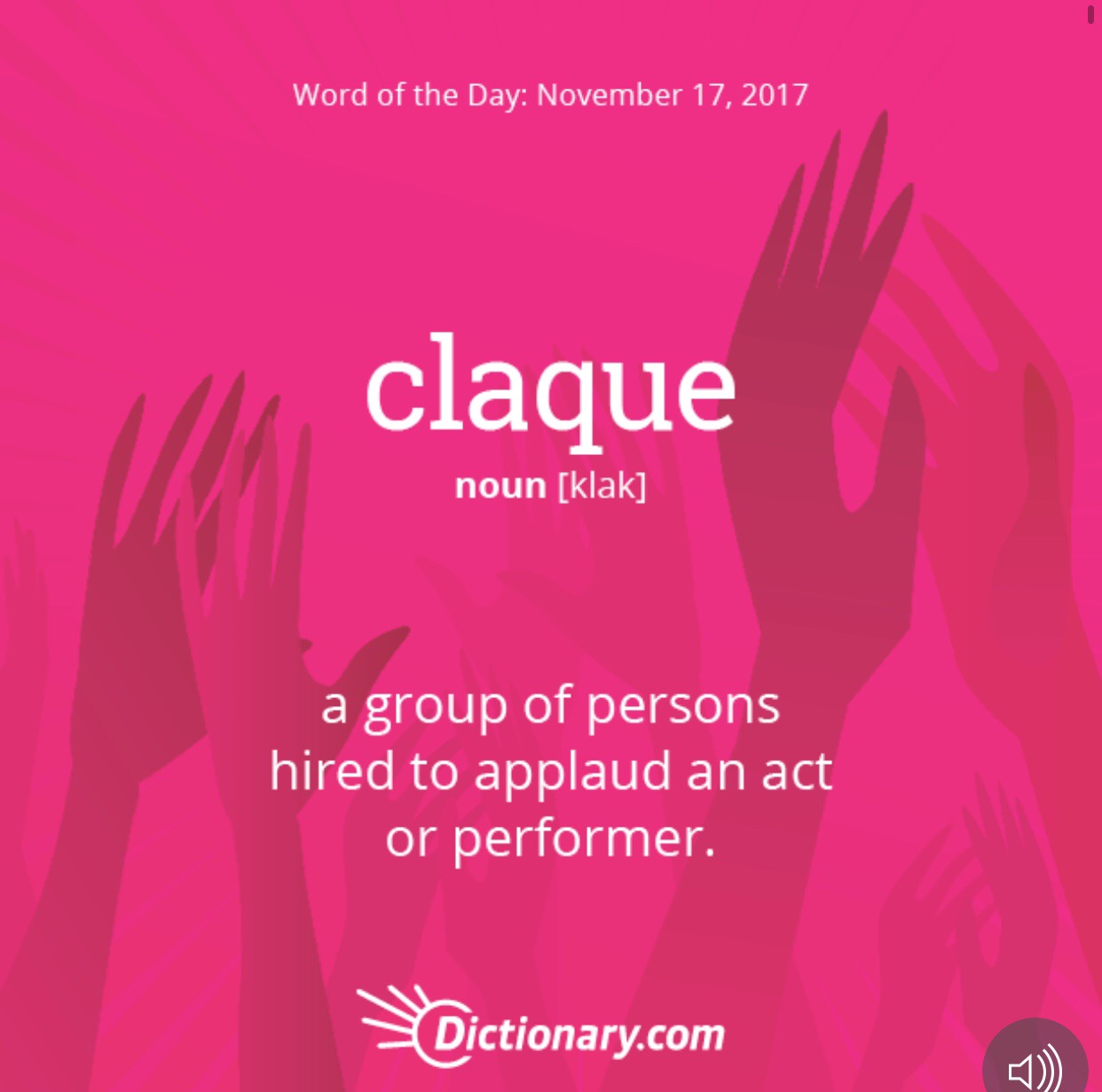
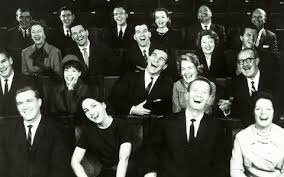
Our word of the day from Dictionary.com is claque. It’s a noun that means: a group of persons hired to applaud an act or performer; a group of sycophants.

Here’s how this word came to be:
Hired groups or squads to applaud actors and performers are nothing new. The Roman author Suetonius (75 – 150 a.d.) in his “Life of Nero” (chapter 20, in “Lives of the Twelve Caesars) reports that Nero hired 5,000 young men and taught them three different kinds if applause to use in his performances. In Paris by the mid 19th century, claques were organized into “platoons” whose various squads were rehearsed to laugh, cry, comment on, and encourage the actors. The great conductor Arturo Toscani (1867-1957) impised discipline and decorum on audiences and was instrumental in suppressing claques. Claque entered the English language in the 19th Century.

Claque is a perfect word for our current alternate reality. The powers that be think we need coaching when we’re told an apple is a banana. And not just any banana, but the most amazing banana in history of bananas. We need a cadre of claqueurs to rally and extol the amazing virtues of bananas from the sidelines. Their job is to convince us that what we’re hearing with our ears but failing to see with our own eyes is not what we think it is. They tell us when to laugh at unfunny jokes. They applaud wildly, standing in ovation to encourage us to do the same. These shills are paid for their loyalty and I learned that the professionals of this shady craft might even resort to extortion should the entertainer fail to pay for their feigned accolades by rousing choruses of boos. What is our world coming to?
As for me I like watching spectacles from the edge, trusting my intuition to come to my own conclusion. For example…It is not a banana. I know bananas. It is an apple of course. Your jokes are not funny and I refuse to reward you with applause for your outrageous claims. Thank you very much!
You can read more about this interesting word of the day at Wikipedia HERE.

Have a great weekend. And remember, if it walks like a duck and claques like a duck, it’s probably a turtle…..Ha! And I didn’t even need a laugh track to get a chuckle out of you…at least I imagine you smiling right now.

Here’s a little Haiku to reward you for reading this far.

the gullible gush
awed by the fake ovations
of shills and claqueurs

~kat


Shi Sai Sunday’s Week in ReVerse – 22 October 2017

Happy Sunday…it is still Sunday. Busy morning, dogs to the groomers, and then a nap. I love naps. Some people tell me they can’t sleep during the day. That is not me. I love a good midday slip between cool sheets with a fan moving cool air over me and my pup snuggled up close. It’s something, I have convinced myself, that I do for me. It’s a guilty pleasure, like a square of “Dove’s” dark chocolate chilled to perfection in the freezer, or flipping up the radio to 11 on the drive home from work.

It doesn’t take much to amuse me. Which is a good thing. Normally I use this space to reflect on what the posts from the previous seven days are telling me about where my brain was during the week.

But I’m not in the mood to rehash the latest, greatest hits and misses of the world that inspired my rambling last week. Not today. I’ll let the lines and (something new this week) photos tell the story.

As for my me. I’m feeling fab. Just had a nap and there is a tiny, frosty square of love calling my name. Sometimes you just have to let the world tend to itself for a while.

Peace out! 💗

Shi Sai Sunday’s Week in ReVerse – 22 October 2017

you’re about to be blown away<
runk to stem, veins to branches<
t is dark dusky quiet…<
ou dragged me here for a stupid kid’s ring?<
hat’s the one.

they said, empty your noggin<
paces in between

she weeps<
s a sweet young thing,<
ranslucent, placid surface

so fly my darling girl / don’t make waves drive fools to folly

baby steps…<
time to blossom<
ut for your light<
n purple<
reath of god softly flowing

~kat

A shi sai or ReVerse poem is a summary poem with a single line lifted from each entry of a collection of work over a particular timeframe and re-penned in chronological order as a new poem. Unlike a collaborative poem, the shi sai features the words of one writer, providing a glimpse into their thoughts over time. I use it as a review of the previous week.


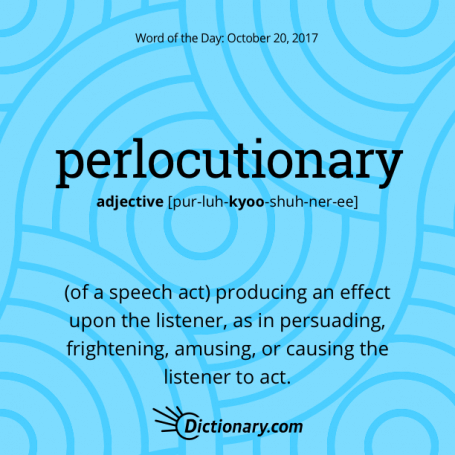
Perlocutionary -Friday’s Word of the Day

19F57CA8-A036-46B2-BF27-7349A2A453C4

Today’s word of the day on dictionary.com is a whopper, and therefore quite the challenge when constrained by the limited syllable budget of a Haiku. I shall nevertheless give it its due. Perlocutionary is an adjective that describes a type of speech that persuades, enlightens, inspires, frightens, or amuses the listener, causing them to act. Philosopher, J.L. Austin explains it perfectly in this excerpt from “How to Do Things with Words”, written in 1962: “We can similarly distinguish the locutionary act ‘he said that’ …from the illocutionary act ‘he argued that’…and the perlocutionary act ‘he convinced me that’…”

The word perlocution has been around since the 16th century originally meaning the act of speaking. It basis was formed from the Latin locutio, “speech, speaking, discourse”, a derivative of the verb loqui, “to speak”. Its present iteration as a noun and adjective did not enter the English language until the 20th century with the addition of the prefix ‘per’ meaning “through, complete or perfect” (as in brought to completion).

I learned that there are stages in the application of locutionary, illocutionary and perlocutionary acts. While it would seem that the latter is the more refined direct act of the three I was surprised to discover that, in fact, infants between the age of 0-8 months are masters in the art of perlocutionary discourse through the use of sounds and gestures. Every whimper, coo and cry has an affect on the hearer, causing them to act. Eventually the child begins to repeat actual words (locutionary acts) and to apply them with meaning as in the words “no” or “why” (illocutionary acts).

It’s all very interesting of course. And way over my head. I have rarely bothered myself to determine whether a speech or statement is locutionary, illocutionary or perlocutionary, but I do admit to being moved and swayed by words. A simple cry for help raises my adrenaline and propels me into help mode. And a temper tantrum can shut me down in no time flat.

We are so easily convinced by words. I doubt that I’ll take time to analyze the words that move me, next time it happens. Even though I now have a word for it. Perlocutionary acts…my biggest challenge at the moment is figuring out how to fit a six syllable word into a Haiku. But at least now you have a new word to file in your vocabulary drawer under “words that are nice to know”.😊

words of gloom and doom,
perlocutionary acts,
drive fools to folly

~kat

http://www.dictionary.com/wordoftheday/2017/10/20/perlocutionary