Tag Archives: essay

Sisyphean – Friday’s Word of the Day

sisyphean

Today’s word of the day on Dictionary.com is Sisyphean. It means, endless and unavailing, as labor or tasks; of or relating to Sisyphus. It  Entered the English language in the 17th Century.

So who was this Sisyphus fellow that the word is referring to?

Well, according to Greek mythology, Sisyphus was the founder and King of Ephyra (known today as Corinth). He was a vile, dishonest ruler with a very high opinion of himself. He took pleasure in killing travelers and guests to his kingdom as a way of exerting and maintaining his authority. This however, was a violation of xenia (“guest-friendship”) the ancient Greek concept of hospitality; the generosity and courtesy shown to those who are far from home and/or associates of the person bestowing guest-friendship.). Sisyphus was not concerned with the rule of law and even considered himself much more clever than Zeus. For his hubris, Zeus punished King Sisyphus by forcing him to roll a huge boulder up a steep hill, only to have it fall back down the hill. He was condemned to repeat this futile exercise for eternity. And this is where we get our word of the day. Things that are never-ending yet pointless are said to be Sisyphean.

Wikipedia also offered a few other scholarly references to things Sisyphean. ‘According to the solar theory, King Sisyphus is the disk of the sun that rises every day in the east and then sinks into the west. Other scholars regard him as a personification of waves rising and falling, or of the treacherous sea. The 1st-century BC Epicurean philosopher Lucretius interprets the myth of Sisyphus as personifying politicians aspiring for political office who are constantly defeated, with the quest for power, in itself and “empty thing” being likened to rolling the boulder up the hill.

In Plato‘s Apology, Socrates looks forward to the after-life where he can meet figures such as Sisyphus, who think themselves wise, so that he can question them and find who is wise and who “thinks he is when he is not”.’

More recently, J. Nigro Sansonese, building on the work of Georges Dumézil, speculates that the origin of the name “Sisyphos” is onomatopoetic of the continual back-and-forth, susurrant sound (“siss phuss”) made by the breath in the nasal passages, situating the mythology of Sisyphus in a far larger context of archaic (see Proto-Indo-European religion) trance-inducing techniques related to breath control. The repetitive inhalation–exhalation cycle is described esoterically in the myth as an up–down motion of Sisyphus and his boulder on a hill.

In experiments that test how workers respond when the meaning of their task is diminished, the test condition is referred to as the Sisyphusian condition. The two main conclusions of the experiment are that people work harder when their work seems more meaningful, and that people underestimate the relationship between meaning and motivation.

Once again, Dictionary.com is having a bit of fun with us. There are certain leaders, who shall remain nameless, who seem to embody Sisyphus in our times. I’m not going there today. I can think of another application for this word, given that I am on lunch break from my 9-5 droning means of survival. But it is Friday. The weekend offers a bit of relief from the rat race. Have a good one.

slogging for success
is a Sisyphean rut
who you know matters

~kat


Silver-Tongued – Friday’s Word of the Day

Today’s Word of the Day is silver-tongued. Oh dictionary.com you make this too easy! To be silver-tongued means to speak persuasively; eloquently: a silver-tongued orator.

It’s origin according to dictionary.com:

Silver-tongued may be named for the pleasing resonance of a silver bell. Even more pleasing and eloquent, therefore, would be chrysostom or chrysostomos “golden-mouthed,” from Greek chrysόstomos, from chrysόs “gold” and stόma “mouth.” As an epithet, chrysostom is reserved for the ancient Greek philosopher and historian Dio (or Dion) Chrysostom (c40–c115 a.d.), but in particular for the Greek patriarch and Church Father John Chrysostom (c347–407). On the first page of Ulysses, the unreliable, malevolent narrator refers to Buck Mulligan, who has gold fillings in his teeth and a very bawdy wit, as chrysostomos. Silver-tongued entered English in the late 16th century.

The art of eloquent speech is in short supply these days. We communicate in so many ways that are anything but silver-tongued. We have short attention spans that beg to be titillated by tweets, 60 second sound bites, text speak, ads that must grab our attention in the first three seconds, slang and abbreviated grunts!

But thankfully, beautiful words are not completely gone. In fact, when we hear a silver-tongued speech we rush to listen, inspired. ‘President Oprah’ had a very nice ring to it this week, even if only for a few days.

Notice, I did not refer to our current prez. He is what might be described as a silver-tongued devil (someone who, through flattery and slick speech, seeks to deceive others for their own gain.) Thanks to “45” we had a sad reality check this week. He reminded us why a majority of us didn’t vote for him, while reinforcing for the umpteenth time that he really is a racist, misogynistic, nationalist who is in the White House for his own self-aggrandizement. And all this while dragging us through the cesspool of his depraved mind adding another nasty word to our list of ‘not presidential’ diatribes, derogatory remarks and name-calling! Ugh! We are so fucked. (I considered toning that last word down but I am afraid another nicer word just won’t cut it…nope, fucked is the only way to say it…😳) Did I mention I didn’t vote for this guy? I didn’t vote for this guy.

But I digress, and I am sorry for that. Digressing is the last thing any of us should be doing. We need to hold fast to our love of beautiful words. We need to think them and write them and speak them. We need to speak to each other, face to face with the kindness and dignity due every human being.

I believe in the power of words. I believe in their beautiful ability to transform, uplift and affirm. And I’m rooting for the silver-tongued angels among us to win this war of words.

So I’ll close with a Lune, which is a short Haiku with the form 5/3/5. Sometimes brevity is the way to go!

let us strive to be
silver-tongued
angels not devils

~kat


Shi Sai Sunday’s Week in ReVerse – 7 January 2018

Well now…interesting week! I have my copy of “Fire and Fury” on order. I hadn’t originally considered purchasing it. I figured it contained revelations I already knew or that it at least confirmed what I’d suspected. And all the juicy parts would most certainly be revealed by cable news wonks ad nauseum. No, I bought my very own copy precisely because the “emperor with no clothes” tried to censor it. And because I wanted to be counted in the historic rush (I’m imagining it was historic) to say in no uncertain terms that this is America, and we do not ban books we don’t like, we don’t malign the press for reporting the truth, we don’t fire public servants who refuse to pledge allegiance to a dictator, we don’t build walls and isolate ourselves from the rest of the world, we believe in science, and freedom of religion and speech and expression…yes…Mr. “You’re Fired!” we READ, we are woke and stoked, and you are going down!

All this for the price of a book. What a bargain! How good it felt to buy it, simply because in my America, I can. And I am apparently not the only one. Yep, this is YUGE!

Stay warm, be encouraged, stay woke, my peeps. Have a great week!

Shi Sai Sunday’s Week in ReVerse – 7 January 2018

the universe sings,
we’re gonna need backup
when faint hearts become fearless
embedded blood-deep
this yearly pressure has to stop
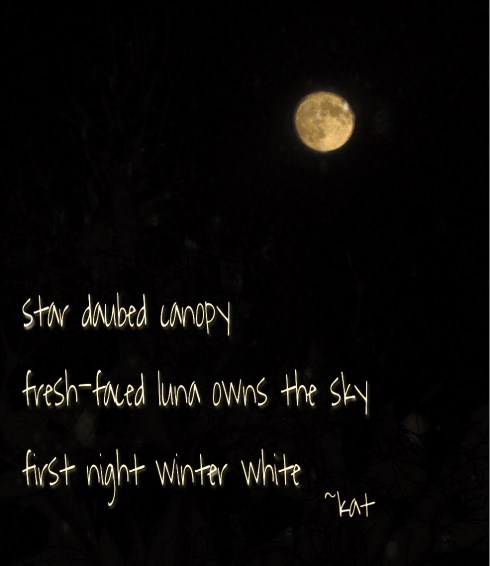
fresh-faced luna owns the sky
areas cordoned off so as not to disturb them
tick tock turncoats talk
if only they’d known
stars to wish on
soft clouds of air on the breeze
the world is flat

~kat

A shi sai or ReVerse poem is a summary poem with a single line lifted from each entry of a collection of work over a particular timeframe and re-penned in chronological order as a new poem. Unlike a collaborative poem, the shi sai features the words of one writer, providing a glimpse into their thoughts over time. I use it as a review of the previous week.


Bedizen – Friday’s Word of the Day

Today’s word of the day at Dictionary.com is Bedizen, which means ‘to dress or adorn in a showy, gaudy, or tasteless manner’.

According to Dictionary.com:

Bedizen is not a common verb in English. It is a derivative of the even more uncommon verb dizen, which occurs only from the 16th century and becomes obsolescent by the end of the 19th century. The element diz- is probably the same as in distaff “a staff for holding flax or wool for spinning” and is probably related to Middle Low German dise “bunch of flax on a staff for spinning.” Bedizen entered English in the 17th century.

I also learned that while the word bedizen is rarely used in conversation these days, it can be found in print. It has a flashy ring to it, don’t you think? Almost sounds like “bedazzled”. One site suggested that because it is an obscure word you can easily insult a highfalutin somebody! Being unfamiliar with its meaning they might even thank you for it!

To be clear, this is not a word meant to compliment someone. I don’t know about you, but I’m keeping this one in my tool chest for those special people in my life whose narcissistic, attention-seeking, haughty behavior gets under my skin…and I’m going to practice saying it with a wink and a smile…you’re welcome! 😀

Speaking of…

accustomed to glitz
they bedizened the White House
calling it a dump

~kat


Dundrearies – Friday’s Word of the Day

dundrearies

Today’s dictionary.com word of the day is dundrearies. It originated around 1860-65, thanks to “Lord Dundreary, a character in the play, “Our American Cousin”. Officially, it is defined as “long, full sideburns or muttonchop whiskers”.

We create all sorts of words based on the quirks or memorable attributes of the certain people. There is a word for it.  They are called Eponyms, ‘words based on a person’s name’. The cool thing about Eponyms is the history behind the word. Some eponyms you might recognize are: boycott, guillotine, sandwich, hooligan, gerrymander, adonis, braille, dunce, jacuzzi, judas, casanova, paparazzi, ritz, and trumpster. Scientists, doctors and inventors are known to use eponyms regularly in ascribing ownership of their handiwork.

But back to our word today, dundrearies, and it’s most interesting history. As already established, the word is attributed to one ‘Lord Dundreary’ from the three-act play, “Our American Cousin”.  The play was written by English playwright, Tom Taylor in 1858 and premiered at the Laura Keene’s Theatre in New York City on October 15, 1858. It was fairly popular for several years, but it was its fateful run at the Ford’s Theatre in Washington, DC, and specifically its showing on April 14, 1865 that etched it into American history. “Our American Cousin”, you see, was the play that President Abraham Lincoln was watching when he was assassinated by actor and Confederate sympathizer John Wilkes Booth.

According to Wikipedia, the cast modified a line of the play in honor of Abraham Lincoln: when the heroine asked for a seat protected from the draft, the reply – scripted as, “Well, you’re not the only one that wants to escape the draft” – was delivered instead as, “The draft has already been stopped by order of the President!”

Halfway through Act III, Scene 2, when the character of Asa Trenchard, played that night by Harry Hawk, uttered this line, considered one of the play’s funniest, to Mrs. Mountchessington: “Don’t know the manners of good society, eh? Well, I guess I know enough to turn you inside out, old gal — you sockdologizing old man-trap.”

It was during the ensuing laughter that President Lincoln laughed his last and the play ended abruptly. While Wilkes Booth was not a cast member of the play, he used the chose this moment when the laughter was at its height to muffle the sound of his gun.

Lord_Dundreary

Edward Sothern as Lord Dundreary, sporting “Dundrearies”

I don’t believe that the word, dundrearies has anything to do with this interesting sidebar. It has more to do with the popularity of the play and the first actor Edward Sothern who brilliantly played the part of ‘Lord Dundreary’.  I do find it fascinating though, how history and words and our experiences are all seem to be an intricate and interconnected web. We are all interconnected for that matter, I believe, by 6 degrees or less.

Have a great weekend. Here’s a haiku.

sporting dundrearies
once touted as all the rage
are now thought unkempt

~kat