Category Archives: Haibun

Hobbyhorse – Friday’s Word of the Day


When I think of a hobbyhorse I imagine a stick with a horse’s head or a rocking horse, ridden by children, which is, in fact the second definition for today’s word of the day on dictionary.com. The first definition, a pet idea or project is not something I ever associated with the word hobbyhorse. 

A look at the word’s origin tells a different story. According to etymology online the word hobby actually means a “small, active horse,” from hobi short for hobyn (mid-14c.; late 13c. in Anglo-Latin), and was probably originally a proper name for a horse that is now extinct. Hobby as a shortening of hobbyhorse also was used in the “morris horse” sense (1760), or as Dictionary.com states “in the 16th century hobbyhorse meant several things, e.g., a figure of a horse made of wicker worn in morris dances, pantomimes, and burlesques; a child’s toy consisting of horse’s head on the end of a stick or a rocking horse; a horse on a merry-go-round or a carousel in the 1680’s. By the 17th century hobbyhorse developed the meaning “pet project, favorite pastime.” Hobbyhorse entered English in the 16th century.”

Is it just me or does the term hobbyhorse sound a bit redundant? Basically one is saying horse (hobby) horse. But I digress.
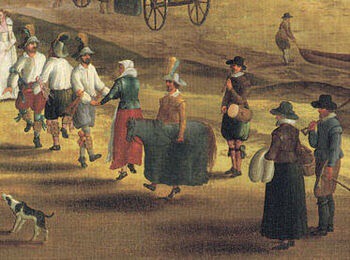
Painting of a hobby horse with Morris dancers beside the River Thames at Richmond, London, c.1620


Hobbyhorses were associated with May Day celebrations, Mummers plays and the aforementioned Morris dance in England in the 17th and 18th centuries. Wikipedia explains that there were several types of hobbyhorses:

*Tourney horses- meant to look like a person riding a small horse that is wearing a long cloth coat or caparison (as seen in medieval illustrations of jousting knights at a tourney or tournament)

* Sieve horses – a simpler version of the tourney horse. Known only in Lincolnshire, made from a farm sieve frame, with head and tail attached, suspended from the performer’s shoulders. The performer wears a horse blanket (the kind that includes a headpiece with holes for the eyes and ears) that covers them and the sieve.

* Mast horses – are meant to represent the horse (or other animal) itself. They had a head made of wood, or sometimes an actual horse’s skull was used; it usually has hinged jaws that can be made to snap. The head is attached to a stick about 1 m (3 ft) long. The person acting the creature is covered by a cloth attached to the back of its head; he (or, rarely, she) bends over forwards or crouches, holding the head in front of their own and resting the other end of the stick on the ground. A tail may be attached to the back of the cloth.

And this is only a sampling of the types of hobbyhorses used in Great Britain. In fact many countries and cultures have used a form of hobbyhorse in ceremonial dance, festivals, customs and theatre for centuries. You can read all about them at Wikipedia HERE.

So how did the word hobbyhorse become associated with an obsession? According to Wikipedia the term “hobby horse” came from the expression “to ride one’s hobby-horse”, meaning “to follow a favourite pastime”, and in turn, the modern sense of the term hobby. Makes perfect sense to me! 😉

Of course there is also the literary reference to the word penned by none other than the Bard himself, “Cal’st thou my love Hobbi-horse?” (Translation: A loose woman or strumpet) – William Shakespeare, Loves Labour’s Lost, in 1588. And there is the ‘velocipede’ (sounds like a very fast many-legged slug…the stuff of nightmares!)…also called a ‘pedestrian hobbyhorse’ or ‘dandy horse’. it was a two wheeled ‘bicycle’ that the rider propelled by pushing the ground with each foot alternately. This modern marvel, a forerunner to the modern pedaled version was all the rage in the early 19th century. It was featured in The Gentleman’s Magazine, February 1819.


So there you have it; a glimpse into today’s word of the day. And here’s a little Haiku to bring it all home…

this blogs a hobby
could say, it’s my hobbyhorse
my tack is a pen

~kat


Sexagenarian Sagacity


Sexagenarian Sagacity

Six. It seems like such a small number. That’s how many decades I have lived on this planet; three score; sixty years and counting. 

When I survey the old lady in the mirror I see a face that is suddenly wrinkly and fuzzy like a peach. My hair is thinning. My belly is softening. My steps are more measured. My eyesight is fading. But there is a glimmer still, and a sense of contentment.

My quest for the secret of life doesn’t hold the urgency it once did. I don’t need to know all the answers. Six decades, three score, goes by in a blink; a mere dot on page of history. But I have found happiness along the way. A moment’s happiness is more than enough.

pencil scratch hash marks
inch up an old wall, love notes,
lost baby teeth, pearls,
patent leather go-go boots,
random memories to keep

life in full measure
bursts of smoldering passion
settling to dust

~kat
A Haibun/Tanka/Haiku for Colleen Chesebro’s Poetry Tuesday Challenge. Prompt words this week are: Hunt and Find (there are a few thesaurus aliases in this piece :))


Ballon -Friday’s Word of the Day


Today’s word of the day at Dictionary.com is a French word: “ballon”. At first I wondered if it was a typo. “Shouldn’t that be ‘balloon’?” I thought. And then I looked at the definition and especially the origin of the word. It all began to make sense. From dictionary.com:

Origin of ballon
Ballon is a French term used especially in ballet, describing a dancer who appears to be floating in the air while executing a jump or other movement, like “His Airness,” Michael Jordan. Earlier English spellings of the word include balonne, baloune, and balloone as well as balloon. The original sense of the word in the early 17th century was “ball,” specifically a large, sturdy, inflated leather ball hit with the arms protected with wooden boards or kicked like a soccerball. By the late 17th century ballon and balloon had developed the meaning “a large globular glass vessel” used for chemical distillation; and by the late 18th century, balloon (thus spelled) also meant “a round, flexible, airtight bag that rises into the air when inflated with heated air or gas.” Balloon becomes the standard English spelling in the late 17th century. Ballon, as a ballet term, entered English in the 19th century.

So, ballon in ballet is about floating on air, and balloons? Well they are floaty orbs, unless they’re filled with water or made of glass. I got the impression that the original balloon was more about its shape than its floating qualities. And then I started to think of round, inflated ballerinas bursting at the seams of their leotards, tutus stretched tight and stiff around their middles, and I couldn’t help but giggle.

Which came first the ballon or the balloon? The latter, of course. Ballon, in ballet, entered the English vocabulary rather late to the dance in the 19th century. We humans had been filling animal bladders and other hollow bulbous things for centuries.

Somewhere between heaven and earth the idea of floating on air became associated with balloons and voila! We now have ballon to help us describe the amazing acrobatic, gravity-defying leaps of ballerinas. Being inflated and puffy not required!

I’m feeling silly today. I best give you my Haiku. Have a great weekend!

suspended, graceful,
the skilled ballon of dancers
defies gravity

~kat


Tea with Mom Haibun/Tanka

For Colleen Chesebro’s Tuesday Poetry  Challenge, a Haibun/Tanka infused with the words Heat and Confuse (and iterations thereof).


Tea with Mom

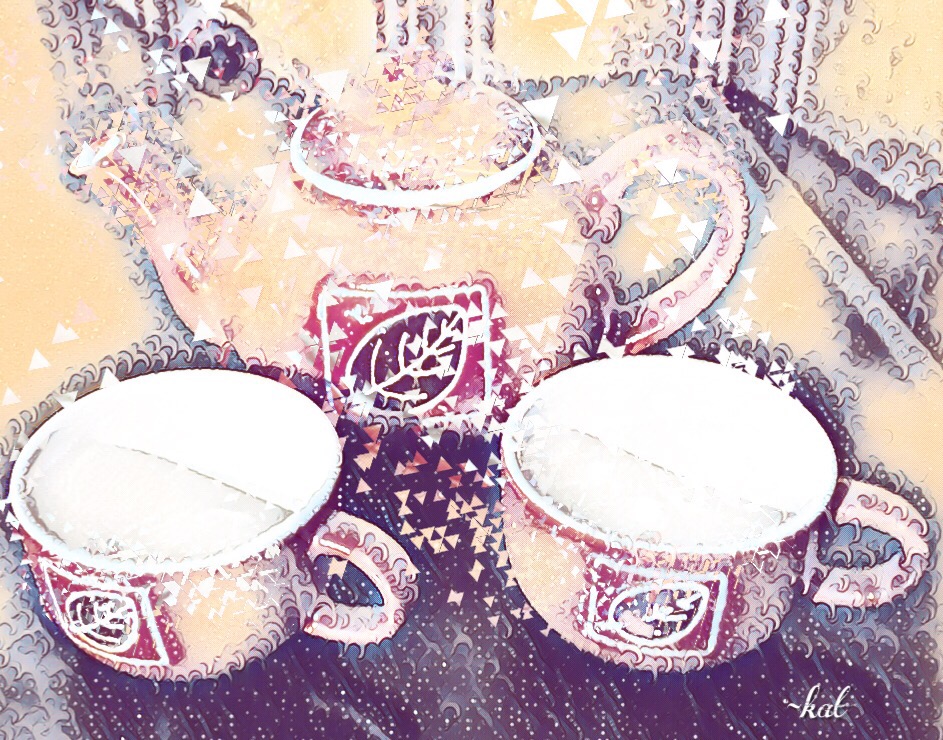
She takes her tea at 3:15 pm each day, steeped in a hand-painted porcelain pot, with two cubes of sugar and a splash of cream in her favorite tea cup. Rosemarie always joins her. They sit side by side in chairs positioned just so, at the window facing the pond, and sip away the hour chatting about this and that. I watch them from across the room with a ready smile and a nod hoping for a glimmer of recognition when she turns her gaze toward me. Most days she glances my way, a bit befuddled, settling into a wary tip of her head as she redirects her attention to the tea in her cup and the ducks aflutter in the pond. Most days I am grateful to be in the presence of this woman who raised me from a babe even though she doesn’t remember. I have memories aplenty for us both and savor them as I watch her fade into the hazy streams of afternoon sunlight…mom and her new best friend, nurse Rosemarie.

if I could, I would
sit beside you in the dark
and hold your frail hand
basking in warm memories
of us, as fog settles ’round

~kat


Al Desko – Friday’s Word of the Day Haibun

al desko

Today’s Dictionary.com word of the day…Al Desko…is patterned after al fresco and was first used in the 1980’s. Its facetious meaning alludes to eating a meal at one’s desk in an office: always snacking al desko; having an al desko lunch.

aldesko

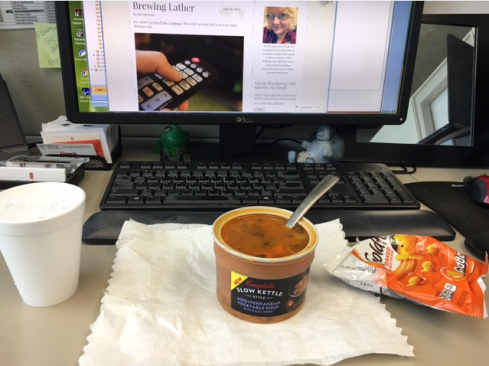
Here’s a look at my al desko lunch today, as a matter of fact. It’s not much different any other week day, though the menu changes slightly. I get 30 minutes of unpaid time for lunch. But most days, the lunch hour is exactly the time when my boss needs me to write notes from the morning’s meetings or prepare presentations for the afternoon meetings. It is a rare thing for me to even leave me desk in the course of an 8-1/2 to 9 hour day; rarer still to actually finish my soup while it is still warm. But today is a good day. The boss is flying as I type somewhere over the Rockies, so I am enjoying an uninterrupted break.

We are work-a-holics here in the US. The sad truth is we are encouraged to work long hours, and do, with the hopes of gaining the boss’s attention. Positive notice is what it takes to ace an evaluation which translates into a favorable raise, not the minimum pittance required for breathing, and positions one for future opportunities as a person who “works hard and gets the job done”. Sadly, though loyalty is a thing oft cited in great reviews, companies are loath to return the favor.

I’m exhausted just thinking about it. And yet I acquiesce to”the man” hoping that I might one day be able to afford to retire. It is highly unlikely that I ever will, but I like saying the word retire and thinking that I might have a shot at it. Especially now that I’ve passed the 60’s mark.

I’m sorry. I’m afraid I have digressed a bit. The word of the day al desko has nothing to do with retiring. But here I sit, eating my healthy store-bought soup, heated in the office breakroom, with my little bag of goldfish and a cup of ice water. Dining al desko, catching up on Facebook and WordPress. Checking the news and the weather; glad that I brought my umbrella in from my car this morning. It’s going to rain this afternoon.

I’ll leave this desk around 5:30 or so, squinting as I emerge from the building at seeing the light of day outside for the first time in hours. A quick 15-20 minute trip in traffic will deposit me home where I will feed my pets, grab a bit of grub myself and then settle in for the night. All to start again at 6 am next morning when I will get up…feed the pets…and pack another al desko lunch to tide me over mid-day.

I’m shaking my head as I read this back to myself. I really do need to step away from my desk at least once during the day. It occurs to me…I need a life! 😉 At least I have words and writing to sooth the lunacy. Blogging has saved me. 🙂

Have a great week. Step away from the keyboard every now and again. You deserve it. (I say this, hoping that I’ll remember to take my own advice!)

work-a-holics dine
on bagged lunches and take-out
al desko gourmets

~kat