Monthly Archives: June 2023

ReVerse Poem – Sunday, 11 June 2023

Happy Sunday! It’s time to look back on the past week and glean a thought from each day. And what a week it has been! Thank goodness for poetry! It helps keep me sane, draws me out of my head, and helps me remember to breathe…even if only for a conscious moment when I realize that I am holding my breath, yet again.

Some weeks, like this one, are just cloudy with good chance of left shoes dropping like rain…all hail about to break loose when we least expect it. True story…we have had so much rain that the gutter drains are forming trenches through the soil in our yard. I’ve never seen anything like it!

And metaphorically speaking the poles are entrenched as ever…with the hysterically woke on one side, and the angrily ignorant on the other. The forecast is daunting, but we’ll get to the other side just like we always do… slow and steady right through the middle where most of us huddle.

I can’t let myself stress about it. I won’t let myself stress about it. This morning is particularly spectacular, sun—kissed, green and sparkling, the birds happily singing, foraging, the wild blackberries are pink now, plumping up, a few weeks to ripe. What a glorious day, and I am so grateful that I am alive to see it!

Peace to you!


ReVerse Poem - Sunday, 11 June 2023 

moonlight, a glimpse of her heart
the way for grace to flow free
in crimson, sweetly fragrant
coloring outside the lines,
where possibilities wait,
it is only noise
warm breath on my skin

~kat

A ReVerse poem (a practice I started many years ago) is a summary poem with a single line lifted from each entry of a collection of work over a particular timeframe and re-penned in chronological order as a new poem. Unlike a collaborative poem, the ReVerse features the words of one writer, providing a glimpse into their thoughts over time.

Zephyrus

Zephyrus 

he softly whispered
tossed my hair, kissed my bare neck
warm breath on my skin

the ancients named him
Zephyrus, god of the west wind
warm breath on my skin
gentlest of the Anemoi
deadly when he is jealous

~kat

I have enjoyed this past week’s practice of the Hainka. Familiar and yet nuanced. This coming week’s micropoetry form will be the Bob and Wheel. It incorporates a trifecta of rules: line, syllable and rhyme, which should be challenging and fun…if you like a good challenge like I do. Until then, enjoy your week end.


The Hainka

The 17-syllable haiku is the shortest form of poetry, and the 31-syllable tanka is probably the second shortest format of verse. Precisely the new form of poetry, hainka, is an assimilation of objective sensitivity of haiku with the more subjective oriented of tanka poetry. The synthesis in hainka is based on the image linking (the ‘fragment’ of haiku acting as the ‘pivot line’ of the following tanka) to explore and interweave human nature, love, emotion, humor in a broader sense by juxtaposition of the imageries.

It is also interesting to see the syllabic coherency between the ‘fragment’ (5-syllable words) with the 5-syllable words of the ‘pivot line’ of tanka. The final structural configuration would be 5/7/5/5/7/5/7/7 (s/l/s/s/l/s/l/l) with the significance of the image linking. A breathing gap (swinging space) is preferred between the haiku and tanka for the reader to imagine and experience the essence of poetry.

This image-linking across time and space is the art of painting an integrated poetic expression and exhibiting the fervent elucidation of hainka writing. Moreover, it retains its focus on the beauty of genetic image-linking to explore the poetic spell within the broader structural framework of the aesthetic essence and rhythms of Japanese short forms of poetry. Echoing the spirit of Basho’s ‘atarashimi’ (newness), I wish that the new verse will entwine the art of gratitude encompassing nature, living beings, non-living beings, and humanity as a whole.

Read more about the evolution of this form at Poetry Digest here: https://www.writersdigest.com/write-better-poetry/hainka-haiku-tanka-new-genre-of-poetic-form


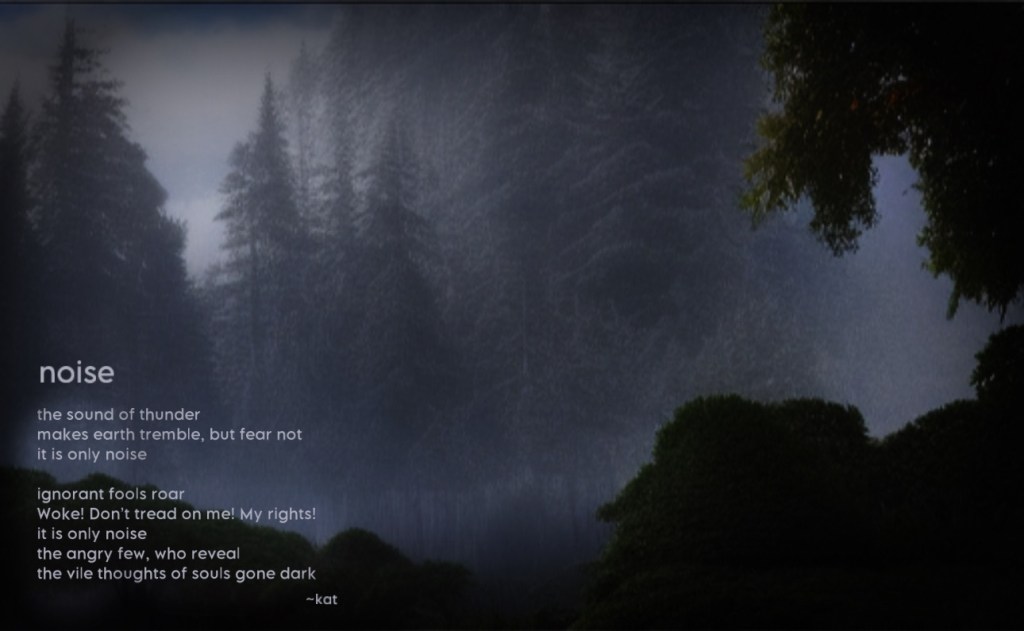
noise

noise

the sound of thunder
makes earth tremble, but fear not
it is only noise

ignorant fools roar
Woke! Don’t tread on me! My rights!
it is only noise
the angry few, who reveal
the vile thoughts of souls gone dark

~kat

The Hainka

It is also interesting to see the syllabic coherency between the ‘fragment’ (5-syllable words) with the 5-syllable words of the ‘pivot line’ of tanka. The final structural configuration would be 5/7/5/5/7/5/7/7 (s/l/s/s/l/s/l/l) with the significance of the image linking. A breathing gap (swinging space) is preferred between the haiku and tanka for the reader to imagine and experience the essence of poetry.

This image-linking across time and space is the art of painting an integrated poetic expression and exhibiting the fervent elucidation of hainka writing. Moreover, it retains its focus on the beauty of genetic image-linking to explore the poetic spell within the broader structural framework of the aesthetic essence and rhythms of Japanese short forms of poetry. Echoing the spirit of Basho’s ‘atarashimi’ (newness), I wish that the new verse will entwine the art of gratitude encompassing nature, living beings, non-living beings, and humanity as a whole.

Read more about the evolution of this form at Poetry Digest here: https://www.writersdigest.com/write-better-poetry/hainka-haiku-tanka-new-genre-of-poetic-form


birds singing

This photo of the Bramlett Mountain woods is enhanced by AI using the PicsArt photo editing app. O
riginal photo by Kat.
birds singing

how sweetly birds sing
at dawn, leaves still wet with dew
sparkling like diamonds

it’s always a choice
how we will greet each new day
sparkling like diamonds
where possibilities wait,
a clean slate, the birds singing

~kat

The Hainka

The 17-syllable haiku is the shortest form of poetry, and the 31-syllable tanka is probably the second shortest format of verse. Precisely the new form of poetry, hainka, is an assimilation of objective sensitivity of haiku with the more subjective oriented of tanka poetry. The synthesis in hainka is based on the image linking (the ‘fragment’ of haiku acting as the ‘pivot line’ of the following tanka) to explore and interweave human nature, love, emotion, humor in a broader sense by juxtaposition of the imageries.

It is also interesting to see the syllabic coherency between the ‘fragment’ (5-syllable words) with the 5-syllable words of the ‘pivot line’ of tanka. The final structural configuration would be 5/7/5/5/7/5/7/7 (s/l/s/s/l/s/l/l) with the significance of the image linking. A breathing gap (swinging space) is preferred between the haiku and tanka for the reader to imagine and experience the essence of poetry.

This image-linking across time and space is the art of painting an integrated poetic expression and exhibiting the fervent elucidation of hainka writing. Moreover, it retains its focus on the beauty of genetic image-linking to explore the poetic spell within the broader structural framework of the aesthetic essence and rhythms of Japanese short forms of poetry. Echoing the spirit of Basho’s ‘atarashimi’ (newness), I wish that the new verse will entwine the art of gratitude encompassing nature, living beings, non-living beings, and humanity as a whole.

Read more about the evolution of this form at Poetry Digest here: https://www.writersdigest.com/write-better-poetry/hainka-haiku-tanka-new-genre-of-poetic-form


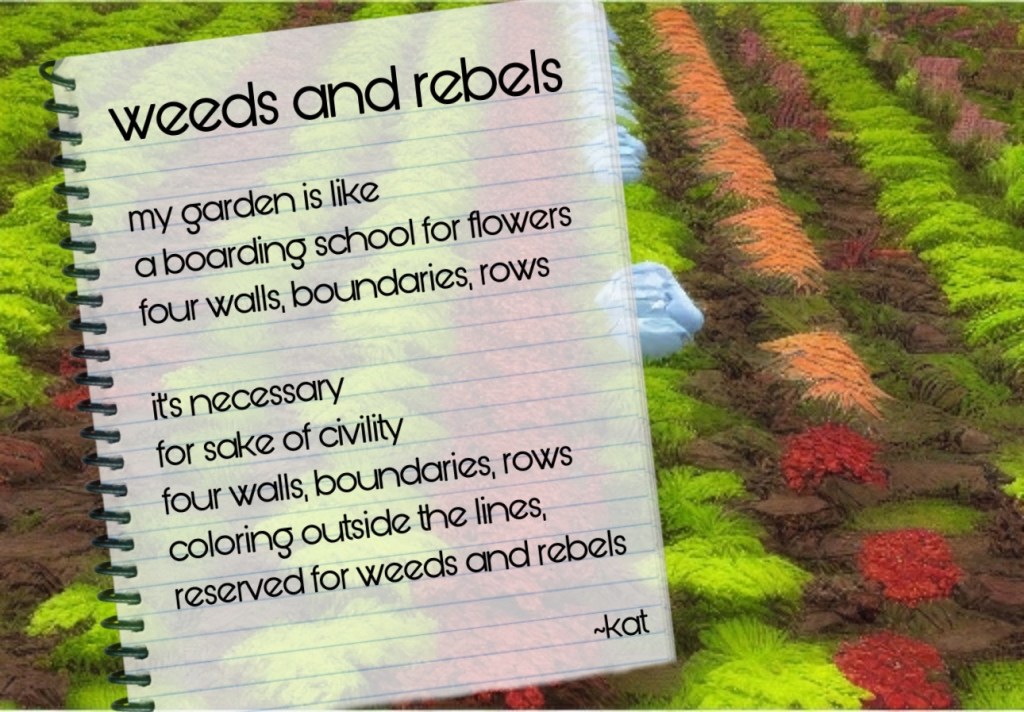
weeds and rebels

weeds and rebels

my garden is like
a boarding school for flowers
four walls, boundaries, rows

it’s necessary
for sake of civility
four walls, boundaries, rows
coloring outside the lines,
reserved for weeds and rebels

~kat

The Hainka

The 17-syllable haiku is the shortest form of poetry, and the 31-syllable tanka is probably the second shortest format of verse. Precisely the new form of poetry, hainka, is an assimilation of objective sensitivity of haiku with the more subjective oriented of tanka poetry. The synthesis in hainka is based on the image linking (the ‘fragment’ of haiku acting as the ‘pivot line’ of the following tanka) to explore and interweave human nature, love, emotion, humor in a broader sense by juxtaposition of the imageries.

It is also interesting to see the syllabic coherency between the ‘fragment’ (5-syllable words) with the 5-syllable words of the ‘pivot line’ of tanka. The final structural configuration would be 5/7/5/5/7/5/7/7 (s/l/s/s/l/s/l/l) with the significance of the image linking. A breathing gap (swinging space) is preferred between the haiku and tanka for the reader to imagine and experience the essence of poetry.

This image-linking across time and space is the art of painting an integrated poetic expression and exhibiting the fervent elucidation of hainka writing. Moreover, it retains its focus on the beauty of genetic image-linking to explore the poetic spell within the broader structural framework of the aesthetic essence and rhythms of Japanese short forms of poetry. Echoing the spirit of Basho’s ‘atarashimi’ (newness), I wish that the new verse will entwine the art of gratitude encompassing nature, living beings, non-living beings, and humanity as a whole.

Read more about the evolution of this form at Poetry Digest here: https://www.writersdigest.com/write-better-poetry/hainka-haiku-tanka-new-genre-of-poetic-form