
A Haiku based on the prompt word: Time, for Haiku Horizons.
Time is elusive
Dribbling through our fingers
Never to return.
kat ~ 13 June 2016
A Haiku based on the prompt word: Time, for Haiku Horizons.
kat ~ 13 June 2016

Once again the
mothers weep and
hide their children
safe to keep, as
talking heads, their
blood lust slaking,
vomit spin to
boost their ratings.
Lines are drawn and
trenches dredged as
pols fight for the
winning edge, and
fear and loathing set
the stage for
wayward zealots
venting rage.
We pride
ourselves as
civilized and
judge the
stranger with
our eyes, but
souls reside where
we can’t see, the
other’s not our
enemy. Remember
when you seek to
blame, under the
skin we are
the same.
kat ~ 12 June 2016
 Do you remember when you lost your way?
For some it was disguised as childplay
In cool divisive shades of pink and blue,
the lines were drawn according to the rules
And differences were judged in stark display.
Some fragile hearts were broken in the fray
of bitter battles between us and they
And lines were blurred obscuring every truth.
Do you remember?
How magnificent you are in every way.
Your life’s a precious gift infused with grace.
Don’t let world fraught with fear subdue
the beauty of your soul that makes you, You…
Do you remember?
kat – 12 June 2016
(a Rondeau)
A Rondeau is a French form, 15 lines long, consisting of three stanzas: a quintet, a quatrain, and a sestet with a rhyme scheme as follows: aabba aabR aabbaR. Lines 9 and 15 are short – a refrain (R) consisting of a phrase taken from line one. The other lines are longer (but all of the same metrical count)
 Happy Sunday! Another chapter and verse review of the past week. An interesting Shi Sai, in that it reads more like a story than poetry, but that doesn’t surprise me. I was able to carve out a bit of time to participate in a few flash fiction challenges. I’ve missed those!
So today I give you a prose poem that tells a story of its own. And as with any good story there is a simple lesson to take away. In a nutshell I think this week was telling me to say what I mean… and mean what I say. And it’s also a reminder to me that I need to say the important things while the people who mean the most to me are still here to hear me say them.
Tell those that you love that you do, speak kindly to strangers, don’t hold your tongue when it comes to the truth. Life is too short for regrets.
Love and light to you…and peace…always peace. ❤️
Shi Sai Sunday’s Week in ReVerse – 12 June 2016
I’ll probably regret this…oh well!
sometimes it’s best to leave things alone.
…slips of the tongue…
Who would do such a thing?!
…full of chatter, laughter and memories of those that were lost
gloaming on the cusp
We have gravitated to other means of speaking our mind…
clipping through choppy swells
as if they truly mean it…
Why couldn’t you just tell me while you were still here…kat ~ 12 June 2016
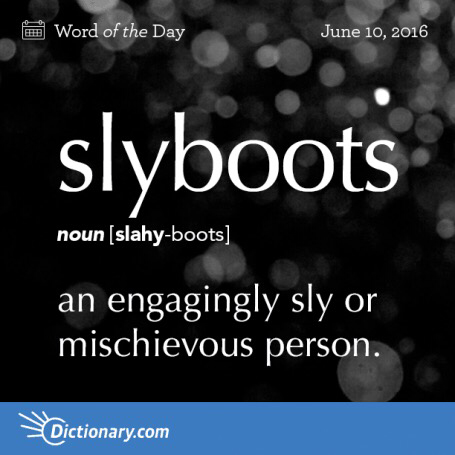 Today’s word of the Day on Dictionary.com is slyboots.
The Cambridge Dictionary defines slyboots as “a person who avoids showing or telling other people what he or she is thinking or intending.”
The Word Detective says that sly boot is a cousin to the term “sneaky Pete”.
“…The Oxford English Dictionary defines “sly boots” as “a sly, cunning, or crafty person; one who does things on the sly,” and notes that the phrase is usually applied in “mild or jocular use.” It’s not a phrase used in anger, in other words, but the sort of thing you say when you discover you’ve been mildly deceived (“Oh, you sly boots. You snuck a seventeenth kitten into the house!”).
“Sly boots” is a very old phrase, defined (“a seeming silly, but subtle Fellow”) in Nathan Bailey’s 1721 Dictionary of Canting and Thieving Slang, and probably a good deal older. “Sly,” of course, means “cunning, clever or wily,” and comes from an Old Norse word meaning “crafty.” “Boots” is the interesting bit, originally, in the 17th century, used as slang for a servant in a hotel who cleaned the guests’ boots. It was also used to mean the most junior officer of a regiment or member of a club, the one most likely to be stuck with menial chores (“My chief resistance to discipline was at mess where I could not brook the duties of Boots..,” 1806). “Boots,” used as a synonym of “fellow,” also found its way into various humorous and colloquial phrases of the period, such as “smooth boots” (one who is adept at flattery and manipulation), “clumsy boots” and “lazy boots.” These phrases are rarely heard today, but I think there’s an excellent case for bringing back “smooth boots,” especially here in the US. It is, after all, an election year.”
It seems that dictionary.com is enjoying this election season here in the US. Try as I might to avoid political commentary, politics seems to be a running theme! Here’s my Haiku!
Slyboots say, “trust me”
as if they truly mean it…
Trust me…they do not!
kat ~ 10 June 2016





 like mercury colliding...