Category Archives: Word of the Day Haiku

Pennyworth – Friday’s Word of the Day

So, today is Black Friday in the U.S. I try to avoid going out at the crack of dawn with thousands of crazed shoppers who have been known to fight over the ‘last one left’ of the latest, greatest widget of the day. I don’t need anything that dearly.

But that’s where Dictionary.com’s Word of the Day comes in. It is Pennyworth. And it means pretty much what it sounds like it does: ‘as much as can be bought for a penny’. It also a means: ‘a bargain, a small amount’, and my personal favorite, ‘a person’s contribution to a conversation, especially one that is unwelcome’. It originated ‘before the year 1000; Middle English penyworth, Old English penigweorth’.

It’s a pretty basic word. I couldn’t find much about it to write home about, but there was one thing that caught my eye. Did you know that Batman’s Butler, Alfred’s full name is, Alfred Thaddeus Crane Pennyworth? I did not. So now we can add this new information to our “Things Every Self-Respecting Nerd Needs to Know” Bucket.

Hope you have a great weekend! Here’s a Haiku.

pennyworth seekers
rise before dawn to mingle
with the early birds

~kat


Claque – Friday’s Word of the Day

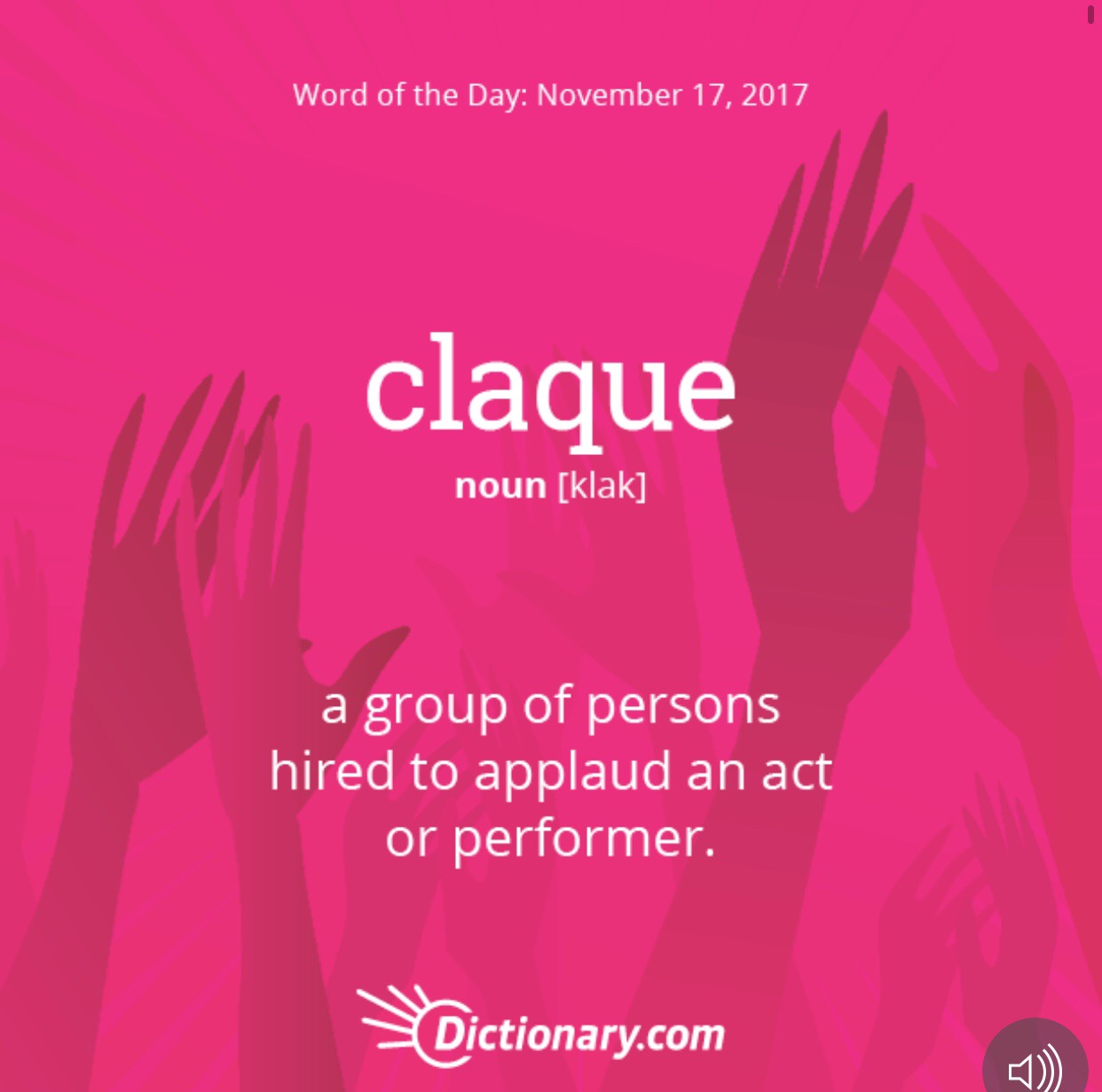
Our word of the day from Dictionary.com is claque. It’s a noun that means: a group of persons hired to applaud an act or performer; a group of sycophants.

Here’s how this word came to be:
Hired groups or squads to applaud actors and performers are nothing new. The Roman author Suetonius (75 – 150 a.d.) in his “Life of Nero” (chapter 20, in “Lives of the Twelve Caesars) reports that Nero hired 5,000 young men and taught them three different kinds if applause to use in his performances. In Paris by the mid 19th century, claques were organized into “platoons” whose various squads were rehearsed to laugh, cry, comment on, and encourage the actors. The great conductor Arturo Toscani (1867-1957) impised discipline and decorum on audiences and was instrumental in suppressing claques. Claque entered the English language in the 19th Century.

Claque is a perfect word for our current alternate reality. The powers that be think we need coaching when we’re told an apple is a banana. And not just any banana, but the most amazing banana in history of bananas. We need a cadre of claqueurs to rally and extol the amazing virtues of bananas from the sidelines. Their job is to convince us that what we’re hearing with our ears but failing to see with our own eyes is not what we think it is. They tell us when to laugh at unfunny jokes. They applaud wildly, standing in ovation to encourage us to do the same. These shills are paid for their loyalty and I learned that the professionals of this shady craft might even resort to extortion should the entertainer fail to pay for their feigned accolades by rousing choruses of boos. What is our world coming to?

As for me I like watching spectacles from the edge, trusting my intuition to come to my own conclusion. For example…It is not a banana. I know bananas. It is an apple of course. Your jokes are not funny and I refuse to reward you with applause for your outrageous claims. Thank you very much!

You can read more about this interesting word of the day at Wikipedia HERE.

Have a great weekend. And remember, if it walks like a duck and claques like a duck, it’s probably a turtle…..Ha! And I didn’t even need a laugh track to get a chuckle out of you…at least I imagine you smiling right now.

Here’s a little Haiku to reward you for reading this far.

the gullible gush
awed by the fake ovations
of shills and claqueurs

~kat


Arete – Friday’s Word of the Day

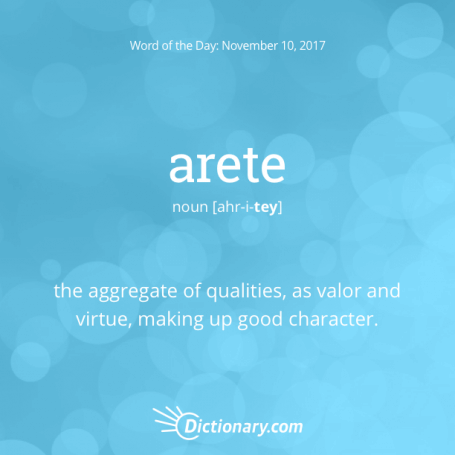
Today’s word of the day at Dictionary.com is arete, a noun that means the aggregate of qualities, such as valor and virtue, making up good character.

It is Greek in Origin as Dictionary.com summarizes:

It is hard to imagine a more Greek word than aretḗ “excellence.” The excellence is of all kinds: military (bravery and prowess), sports (footracing), but also intelligence, public speaking, and good character. Aretḗ applies to the gods and women as well as to warriors and heroes: Penelope in the Odyssey (book 18, line 251) complains that “The immortals destroyed all excellence of mine, in beauty and stature, when the Argives sailed for Troy, and with them my husband Odysseus.” Aretḗ also applies to land (“productive”) and domestic animals (horses, dogs). Socrates pursues aretḗ “virtue, excellence” even if it costs him his life. In the Septuagint and New Testament, aretḗ also means “rewards of excellence, distinction,” as also in classical Greek. Arete entered English in the 16th century.

Here’s a nice bit of info to round out the application of this word. According to Greekmythology.wikia.com:

Arete was the goddess or daimona of virtue, excellence, goodness and valour. She was depicted as a fair woman of high bearing, dressed in white. Her opposite number was the daimon Kakia, lady of vice.  The best known story of Arete is when Arete and Kakia approached Heracles and offered him a life of valour or a life of luxury.  Based on his numerous adventures it is clear that he chose the life of valour.

Arete is the theme Aristotle’s philosophical virtue theory. You can read more about it HERE. Basically Aristotle believed: Arete roughly means “moral virtue”. It refers to an innate “Excellence” or “Essence” in all things, and the striving toward that potential or purpose.

Incidentally, for obvious reason, businesses love to use arete or symbols of arete in their titles and logos. If you google arete, you find a long list of companies who advertise their excellence in this way.

Well, before I get lost in my thoughts as I consider the arete of the various aspects of my life…this could take some time. I better give you a Haiku.

Go forth the, and prosper. Be the best you can be. Strive for arete!

when arete is scorned
by ignominious fools
virtue is disdained

~kat


Ebullient – Friday’s Word of the Day

ebullient

Today’s word of the day at Dictionary.com is Ebullient, an adjective that means: overflowing with fervor, enthusiasm, or excitement; high-spirited:  (The award  winner  was in an ebullient mood at the dinner in her honor.);  bubbling up like a boiling liquid.

From Etymology Dictionary Online:

1590s, “boiling,” from Latin ebullientem (nominative ebulliens), present participle of ebullire “to boil over,” literally or figuratively, from ex “out, out of” (see ex-) + bullire “to bubble” (see boil (v.)). Figurative sense of “enthusiastic” is first recorded 1660s.

I found an amusing reference to and use of this word in Jonathan Swift’s book, “Gulliver’s Travels”. Here is an excerpt:

“There was a most ingenious doctor, who seemed to be perfectly versed in the whole nature and system of government. This illustrious person had very usefully employed his studies, in finding out effectual remedies for all diseases and corruptions to which the several kinds of public administration are subject, by the vices or infirmities of those who govern, as well as by the licentiousness of those who are to obey. For instance: whereas all writers and reasoners have agreed, that there is a strict universal resemblance between the natural and the political body; can there be any thing more evident, than that the health of both must be preserved, and the diseases cured, by the same prescriptions? It is allowed, that senates and great councils are often troubled with redundant, ebullient, and other peccant humours; with many diseases of the head, and more of the heart; with strong convulsions, with grievous contractions of the nerves and sinews in both hands, but especially the right; with spleen, flatus, vertigos, and deliriums; with scrofulous tumours, full of fetid purulent matter; with sour frothy ructations: with canine appetites, and crudeness of digestion, besides many others, needless to mention.

This doctor therefore proposed, “that upon the meeting of the senate, certain physicians should attend it the three first days of their sitting, and at the close of each day’s debate feel the pulses of every senator; after which, having maturely considered and consulted upon the nature of the several maladies, and the methods of cure, they should on the fourth day return to the senate house, attended by their apothecaries stored with proper medicines; and before the members sat, administer to each of them lenitives, aperitives, abstersives, corrosives, restringents, palliatives, laxatives, cephalalgics, icterics, apophlegmatics, acoustics, as their several cases required; and, according as these medicines should operate, repeat, alter, or omit them, at the next meeting.”

This made me laugh. No doubt politicians are an odd breed and not much has changed over the centuries!

I hope your weekend gives you reason to be most ebullient!  Until next Friday then, here’s today’s Haiku…

annoying, no end,
the ebullient boasting
of a poor winner

~kat


Preta & Guisard – Friday’s AND Saturday’s Words of the Day

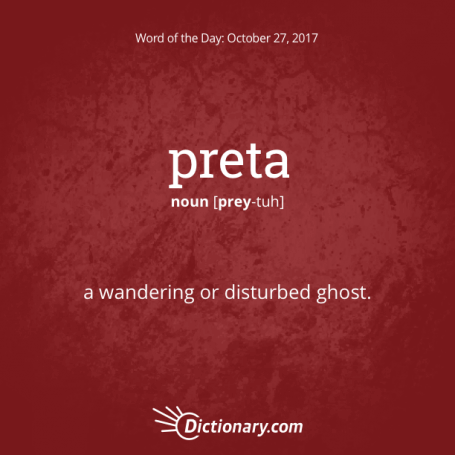
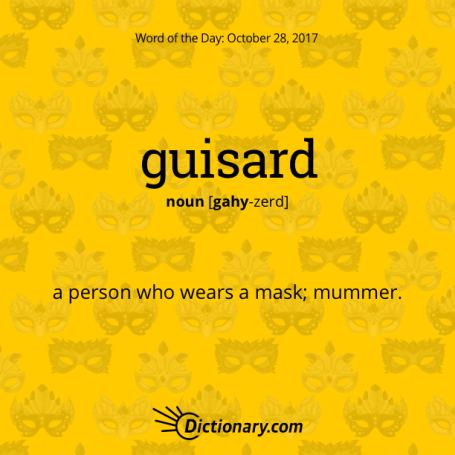
I missed posting yesterday’s word of the day, but as a bonus, today you shall have two lovely words to wrap your brain around! Friday’s word, Preta, a noun from Hindu Mythology meaning a wandering or disturbed ghost. And Saturday’s word, Guisard, a noun the means a person who wears a mask; mummer.

Given the season and impending dark night of all souls hallow, I thought it would be fitting to combine the two in a Haiku. Here’s a bit of history on the two from Dictionary.com:


Preta finds its origins In Sanskrit where e is a long vowel ( it is also transliterated as ē). Hindi grammarians correctly analyzed e as a monophthong replacing an earlier dipthong ai; thus the Sanskrit adjective preta, “gone before, deceased” is from an earlier form, ‘praita’, formed from the adverb and prefix ‘pra’ – “forth” and ‘ita’ – “gone”. Pra- is cognate with the Latin and Greek prepositions and prefixes, ‘prō’/‘pró’ (Greek) and ‘prae’, all of them meaning “before; in front of”. The Sanskrit participle ‘ita’ corresponds exactly with the Latin ‘itum’, past participle is the verb ‘īre’, “to go” and the Greek verbal adjective ‘itós’ “passable”, all from the Proto-Indi-European root ‘ei’, ‘i’ -“to go”. Preta entered English in the early 19th century. From wictionary we learn that: a Preta is a hungry ghost (a supernatural being in Buddhist folklore, the spirit of a greedy person whose divine retribution is to never be sated). How many a weary folk has woken to the first day of November the victim of mischievous antics of Pretas whose quest for sweets was not sated, in the form of TP garlands and raw egg peltings?!


And then there is Guisard, a Scottish and North English word. The first part of the word, guise, in Scotland and northern England means “to appear or go in disguise.” The suffix -ard, occasionally spelled -art, is now used mostly in a pejorative sense for someone who does something habitually or excessively, e.g., drunkard, braggart. Guisard entered English in the 17th century. Soon comes Halloween, when greedy, giddy guisards roam the streets, banging on doors, declaring their mantra, “trick or treat”. A wise somebody will appease these mummers by offering them the sweets they crave lest they transform into scary pretas with a vendetta to settle!

It’s all in good fun of course! An annual ritual that hearkens to an age when the veil between the living and the dead was not quite as pronounced. Our ancestors solemnly remembered and honored the dead more formally; gone but definitely not forgotten. Today we passingly engage this annual ritual in sport, sending our costumed children to the streets for a night of innocent begging. But the thinness of the veil is still there, souls lurking in the shadows, which adds to the drama of this dark, dark time.

These days, I must admit I turn my porch light out, not because I don’t enjoy the onslaught of tiny ghouls and gremlins, but because they terrify my fury housemates. We sit in darkness to the sound of potter-pattering feet outside our door…and entertain the lore of my ancestors, setting a place of honor at my table for loved ones passed. Sometimes I light a candle…or two or three to let them know I remember. I feel their presence ever so near. It could very well be my imagination, but there is something to this ancient dark night of all souls. Something indeed!

this dark night of souls
comes guisards begging for treats
pretas in the mist

~kat