Category Archives: Essays

Abubble – Friday’s Word of the Day

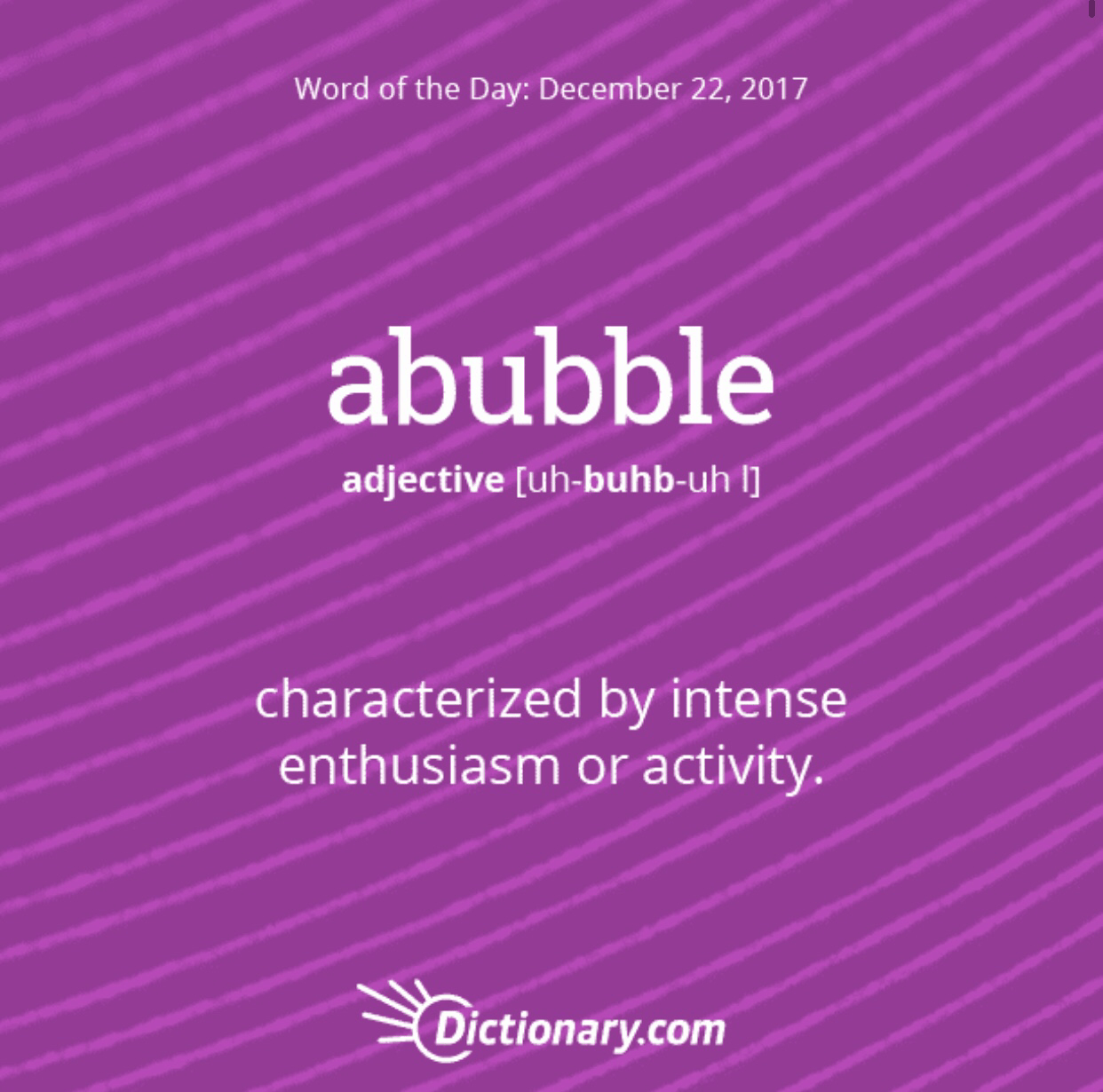
Today’s dictionary.com word of the day is ‘Abubble’. Now, first things first. This fine adjective is in the scrabble dictionary and will net you a respectable 13 base points in Scrabble and an even better 18 base points in Words With Friends. Though, I should point out that there are only two B’s in standard Scrabble and Words with Friends decks, so you’ll need a wild tile to pull it off. Bananagram, on the other hand, gives us three B’s to work with, because? Well I am guessing, ‘banana’ of course, but that’s just a guess.

Abubble is defined as ’characterized by intense enthusiasm or activity: the store was abubble with last-minute shoppers’, and ‘bubbling, as while cooking or boiling’.

Dictionary.com also gives us an English language lesson in its description of the origin of abubble:

“There are English adjectives that, like abubble, can be used only in the predicate and not as attributives, such as aglow and asleep : one can say “The baby is asleep,” but not “the asleep baby.” These predicative adjectives are in origin noun phrases consisting of the preposition on governing a following noun, which also explains why predicate adjectives show no degree of comparison (e.g., asleeper, asleepest) and cannot be modified by adverbs (e.g., “The baby is extremely asleep”). Abubble entered English in the 18th century.”

I can tell you that my spellcheck does not like this word, instigating a me-said, spellcheck-said battle every time I try to type it. It’s most annoying, having to override a persistent A.I.Bot who thinks the ‘a’ should be separated from its “bubble”.

But that just won’t do for today’s word of the day. A bubble is a noun after all, but abubble is something quite different. Ultimately I win this battle of wit and words, though spellcheck is a sore loser and underlines my word in red to remind me that it’s not over. Oh no. Spellcheck will slip into autocorrect every chance it gets if I’m not on my p’s and q’s and abubble’s.

I will admit there is a certain satisfaction that comes with out-texting spellcheck. One might say that I am abubble over winning this battle when spellcheck finally puts away its red line and lets me have my way.

Anyhoo…(can you believe spellcheck didn’t tag anyhoo? I don’t think it’s speaking to me now…big baby!) I should close out with a Senryu or Haiku. (Oh, there you are Spellcheck, with your red line! You don’t like Senryu, eh? Well, I can assure you that a Senryu is a thing. It’s a Poetry form in the pattern of a Haiku 5-7-5. From Wikipedia: Senryu tend to be about human foibles while haiku tend to be about nature, and senryu are often cynical or darkly humorous while haiku are more serious. So there!)

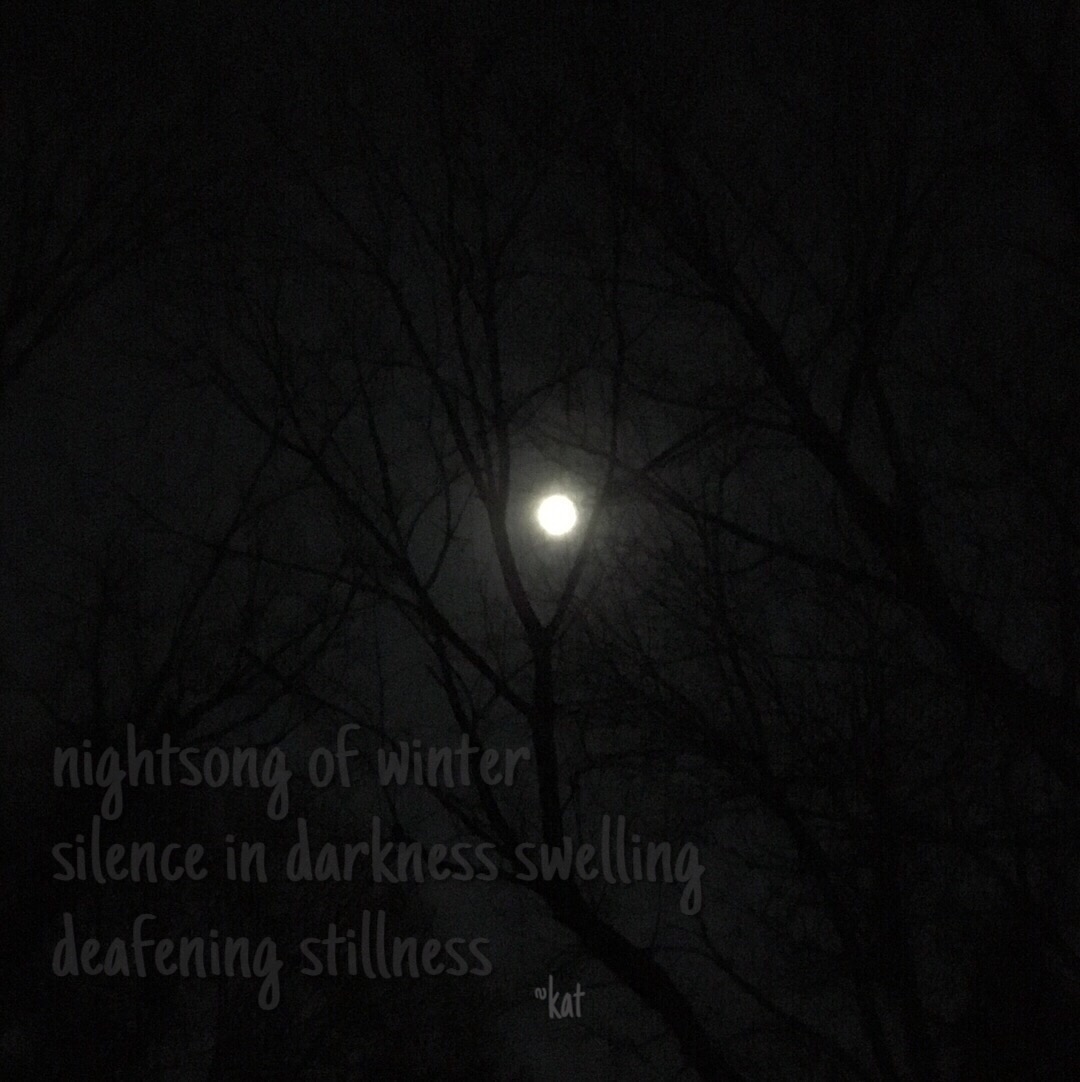
the pols are abubble
as he wields his crayon
signing us to debt

~kat

Yep…uh-hmmm…this just happened. (My newsfeed just announced this headline on the top of my screen…”Trump Signs a Sweeping $1.5 Trillion Tax Bill into Law”.) We are so (fill in your favorite expletive here), and we, as in regular, working people, are most certainly not abubble one tiny bit…though it is also true that our tempers might just be! Grrrrr!

Have a lovely weekend!


Twittering Tale #63 – 19 December 2017

About the challenge: Each Tuesday I will provide a photo prompt. Your mission, if you choose to accept the challenge, is to tell a story in 280 characters or less. Wait….WHAT?! YES! You read that correctly. Recently, the sages at Twitter announced that they were doubling the character limit. So, of course, I am passing this gift on to you! When you write your tale, be sure to let me know in the comments with a link to your tale.

A final note: if you need help tracking the number of characters in your story, there is a nifty online tool that will count for you at charactercountonline.com.

I will do a roundup each Tuesday, along with providing a new prompt. And if for some reason I missed your entry in the Roundup, as I have occasionally done, please let me know. I want to be sure to include your tale.

Finally, have fun!

And REMEMBER…you now have 280 characters (spaces and punctuation included), to tell your tales. I can’t wait to see what you do this week.


Twittering Tale #62 – The Roundup

Photo from the Commons at Pixabay

Start us off…

The Message:
milk

bread
red wine
brussel sprouts
toilet paper
soap
peanut butter
eggs
coffee
sugar
toothpaste
floss
spaghetti
tomato sauce
cheese
soup
strawberries

From Michael at Morpethroad:
Washed clean after years at sea, the bottle and message remain a mystery as it can’t be opened.
Speculation is rife. What if someone is desperate? What if its the map to secret treasure?
All we know is the bottle was made in 1735.
Its historical significance outweighs its contents.
(280 characters)

From Reena at ReInventions:
Too lazy to break the bottle and release the djinn?
No wonder jellyfish have survived without brains. They do not create Frankensteins.
(135 characters)

From Lady Lee at Lady Lee Manila:
I meander in my thought
Message I hope he finds
To my secret love
Things got to be released
Emotion I come to stir
Answering all the whys
Waiting for something to happen
Don’t make me stop
Perhaps one day we’ll be together
Seize the day or carpe diem
(242 characters)

From Martin at Martin Cororan:
…Terribly sorry to impose upon you old chap, but might I beg a brief audience to articulate the pickle in which I find myself. Time is short (as is paper) so allow me to harness the power of brevity and proceed forthwith to the kernel of my concern. I am stranded on a des…
[END OF MESSAGE]
277 Characters

From Di at Pensitivity101:
“To Whoever is reading this:
My name is Bryan Harley and I’m on holiday in Spain.
The date is June 20th 2004, so sorry, no hidden treasure.”
‘Hey! Bryan! You’re never going to believe this………………’
204 characters

From Lorraine at Lorraine’s Frilly Freudian Slip:
Flashback to lady of delight.
Once upon a daydream, she was the shape of my heart.
Left a message in a bottle: “Be my girl”.
Why don’t you answer?
Whispering voices, voices in my head.
Made me the madman running through the fields.
Now, every breath you take, I’ll be watching you.
(280)

From Fandango at This, That, and the Other:
We couldn’t believe it when we saw the bottle in the sand just beyond the reach of the surf. She dared me to open it up and read the message and I quickly obliged. We both laughed when I unfolded the message and read it aloud. It read, “NICKEL BOTTLE DEPOSIT OVERDUE.”
(268 characters)

From  D. Avery at ShiftnShake:
Cliché Clipper
She felt her ship had come in. She wondered at such fortune, finding a love to treasure, their fates cast together.
Their lives did not follow the course she had mapped, but she kept her disappointment corked. Her ship did not sailbut ran aground in a bottle.

From Hayley at The Story Files:
Dear Santa,
I’ve been really good this year. Please can I have the pink sparkly ponies play set, Girl’s Adventure books, Craft making box and a ton of chocolate!
Also, if you can make it snow that’d be great.
Love, Megan.

From Edwin at Edwin’s Journal:
The bottle, once thrown out
To the far edges of the ocean
Now came bound on the lone sands
All hopes to be found, totally lost

From Kathryn at Another Foodie Blogger:
Suzy was so excited when she launched her “message in a bottle” project for school. She spent days on the beach, looking out into the horizon, wondering where her bottle went and what country she’d hear back from. Imagine her dismay when she looked down at her feet 2 weeks later.
280 Characters

From Francine at Woman Walking Dog:
STRANDED
I signed up to be a sole castaway on this island. Tropical, nice.
My agent said: pick up after 7 days. It’s 2 weeks now – toe rags!
How dare they? I’m scared of spiders. Got this bottle, pen, paper
Here’s my story
       Help me

       Eating insects
       Wheres my fee
       I want to go home

From Jan at Strange Goings on in the Shed:
Dear love, feel my heartbeat
Brush your fingers across my lips
Whisper words of unbridled love
Come to me bare of all fear and insecurity
Feel my heartbeat
For I would walk across the oceans
To find you and only you
I speak your name, will you answer me?
I am your Soul, I am your Heart.
(279 characters)

From Anju at My Life..My Thoughts:
The message read,
“Hey! You, the most wonderful person on earth to find me!

Please do me 2 favours.
   i)Do at least 1 good deed per day.
   ii)When you are ready to do (i) throw me back to water!”
Immediately she packed it in the bottle and threw it into the ocean.
(261 Characters)

From Peter at Peter’s Pondering:
The last thing she needed, another bloody message in a bottle!
She’d come to this deserted island to finish her novel and it appeared to be on a major message in a bottle route. This was the 17th so far!
However, this one may perhaps prove useful, it was from a stranded publisher!
(280 characters)

From Jannat at Be Happy:
Totally alone and depressed, Jay walked along the beach; here she finds tranquillity and peace.
While walking she discovered a bottle with a letter which says, ‘You’re allowed to scream and cry but do not give up.’ She sticks to what it says and it completely changes her life.
(278 characters)

From Leena at Soul Connection:
Hey Look Wht I Found
Wooo Message Bottle.Open It Quickly
UNBELIEVABLE
What
I Had Thrown This Bottle Couple Of Years Back From Another Country.
And Your Msg?
Fulfill Every Wish Of D Reader
And Your Wish
To Meet True Love Of My Life
I LOVE YOU.. (He Kneels Down And Proposes Her With A Ring)

Wonderful Tales this week! For this week, a photograph I took of the candle in the window of the curved stairwell of my century-old home. It’s a favorite roost of my cats by day. There is an old tree just outside in my neighbor’s yard that is often teeming with squirrels and birds. It is a lovely tradition to have a candle in the window. Where I live, people have candles in their windows year-round. Not just during the holidays. But whatever the tradition, there is something about a candle in the darkness. There is always a story to be told. I’m looking forward to reading your tales. It is the perfect way, I think, to pass the time over a cup of tea on a long mid-winter night. Happy Yule.


 Twittering Tale #63 – 19 December 2017

Photo by Kat Myrman

From the inside, looking
out, there is nothing but
darkness, but from the
outside looking in, there
is a golden flush of
flickering light dancing
on the walls of a place
someone calls home.

~kat

(188 Characters)


Mishpocha – Friday’s Word of the Day

Mishpocha

Today’s word of the day at Dictionary.com is mishpocha [mish-pawkhuh, –poo khuh]. It is a Yiddish noun that means “an entire family network comprising relatives by blood and marriage and sometimes including close friends; clan” and originates from the Hebrew letter ‘heth’, meaning family, clan. It entered the English language in the mid 19th century.

Did you know the eight-day festival of lights, Hanukkah, started on December 12th this week? In honor of this holiday, a few fun facts:

From the website Chabad.org:

Why is Chanukah (Hanukkah) eight nights long? The Talmud asks and answers:

The sages taught: On the 25th of Kislev, the days of Chanukah are eight. One may not eulogize on them, and one may not fast on them. This is because when the Greeks entered the Sanctuary, they defiled all the oils that were in the Sanctuary. And when the Chashmonean monarchy overcame them and emerged victorious over them, they searched and found only one cruse of oil that remained with the seal of the High Priest. And there was sufficient oil there to light the candelabrum for only one day. A miracle occurred, and they lit the candelabrum from it for eight days. The next year, the sages instituted those days and made them holidays with the recitation of Hallel and prayers of thanksgiving.1

But there’s more. Seven represents all that is found within this world. There are seven days of the week, seven classical planets and seven musical notes. In fact, the world itself was created in seven days.

Then there is the number eight, which represents that which is above, that which does not fit into the neat slots that hold the bits and pieces of our lives. The number eight evokes the transcendent and the G‑dly. Eight is the number of miracles.

And since mishpocha is a Yiddish word, I thought it would be interesting to look at some other popular Yiddish words that have made it into our everyday English conversation from DailyWritingTips.com:

  1. baleboste
    A good homemaker, a woman who’s in charge of her home and will make sure you remember it.
  2. bissel
    Or 
    bisl– a little bit.
  3. bubbe
    Or 
    bobe. It means Grandmother, and bobeshiis the more affectionate form. Bubele is a similarly affectionate word, though it isn’t in Yiddish dictionaries.
  4. bupkes
    Not a word for polite company. 
    Bubkesor bobkes may be related to the Polish word for “beans”, but it really means “goat droppings” or “horse droppings.” It’s often used by American Jews for “trivial, worthless, useless, a ridiculously small amount” – less than nothing, so to speak. “After all the work I did, I got bupkes!”
  5. chutzpah
    Or 
    khutspe. Nerve, extreme arrogance, brazen presumption. In English, chutzpahoften connotes courage or confidence, but among Yiddish speakers, it is not a compliment.
  6. feh!
    An expression of disgust or disapproval, representative of the sound of spitting.
  7. glitch
    Or 
    glitsh. Literally “slip,” “skate,” or “nosedive,” which was the origin of the common American usage as “a minor problem or error.”
  8. gornisht
    More polite than 
    bupkes, and also implies a strong sense of nothing; used in phrases such as “gornisht helfn” (beyond help).
  9. goy
    A non-Jew, a Gentile. As in Hebrew, one Gentile is a goy, many Gentiles are goyim, the non-Jewish world in general is “the goyim.” 
    Goyishis the adjective form. Putting mayonnaise on a pastrami sandwich is goyish. Putting mayonnaise on a pastrami sandwich on white bread is even more goyish.
  10. kibbitz
    In Yiddish, it’s spelled 
    kibets, and it’s related to the Hebrew “kibbutz” or “collective.” But it can also mean verbal joking, which after all is a collective activity. It didn’t originally mean giving unwanted advice about someone else’s game – that’s an American innovation.
  11. klutz
    Or better yet, 
    klots. Literally means “a block of wood,” so it’s often used for a dense, clumsy or awkward person. See schlemiel.
  12. kosher
    Something that’s acceptable to Orthodox Jews, especially food. Other Jews may also “eat kosher” on some level but are not required to. Food that Orthodox Jews don’t eat – pork, shellfish, etc. – is called 
    traif. An observant Jew might add, “Both pork and shellfish are doubtlessly very tasty. I simply am restricted from eating it.” In English, when you hear something that seems suspicious or shady, you might say, “That doesn’t sound kosher.”
  13. kvetsh
    In popular English, 
    kvetchmeans “complain, whine or fret,” but in Yiddish, kvetshliterally means “to press or squeeze,” like a wrong-sized shoe. Reminds you of certain chronic complainers, doesn’t it? But it’s also used on Yiddish web pages for “click” (Click Here).
  14. maven
    Pronounced 
    meyven. An expert, often used sarcastically.
  15. Mazel Tov
    Or 
    mazltof. Literally “good luck,” (well, literally, “good constellation”) but it’s a congratulation for what just happened, not a hopeful wish for what might happen in the future. When someone gets married or has a child or graduates from college, this is what you say to them. It can also be used sarcastically to mean “it’s about time,” as in “It’s about time you finished school and stopped sponging off your parents.”
  16. mentsh
    An honorable, decent person, an authentic person, a person who helps you when you need help. Can be a man, woman or child.
  17. mishegas
    Insanity or craziness. A 
    meshugeneris a crazy man. If you want to insult someone, you can ask them, ”Does it hurt to be crazy?”
  18. mishpocheh
    Or 
    mishpokheor mishpucha. It means “family,” as in “Relax, you’re mishpocheh. I’ll sell it to you at wholesale.”
  19. nosh
    Or 
    nash. To nibble; a light snack, but you won’t be light if you don’t stop noshing. Can also describe plagarism, though not always in a bad sense; you know, picking up little pieces for yourself.
  20. nu
    A general word that calls for a reply. It can mean, “So?” “Huh?” “Well?” “What’s up?” or “Hello?”
  21. oy vey
    Exclamation of dismay, grief, or exasperation. The phrase “oy vey iz mir” means “Oh, woe is me.” “Oy gevalt!” is like oy vey, but expresses fear, shock or amazement. When you realize you’re about to be hit by a car, this expression would be appropriate.
  22. plotz
    Or 
    plats. Literally, to explode, as in aggravation. “Well, don’t plotz!” is similar to “Don’t have a stroke!” or “Don’t have a cow!” Also used in expressions such as, “Oy, am I tired; I just ran the four-minute mile. I could just plotz.” That is, collapse.
  23. shalom
    It means “deep peace,” and isn’t that a more meaningful greeting than “Hi, how are ya?”
  24. shlep
    To drag, traditionally something you don’t really need; to carry unwillingly. When people “shlep around,” they are dragging themselves, perhaps slouchingly. On vacation, when I’m the one who ends up carrying the heavy suitcase I begged my wife to leave at home, I shlep it.
  25. shlemiel
    A clumsy, inept person, similar to a klutz (also a Yiddish word). The kind of person who always spills his soup.
  26. schlock
    Cheap, shoddy, or inferior, as in, “I don’t know why I bought this schlocky souvenir.”
  27. shlimazel
    Someone with constant bad luck. When the shlemiel spills his soup, he probably spills it on the shlimazel. Fans of the TV sitcom “Laverne and Shirley” remember these two words from the Yiddish-American hopscotch chant that opened each show.
  28. shmendrik
    A jerk, a stupid person, popularized in 
    The Last Unicornand Welcome Back Kotter.
  29. shmaltzy
    Excessively sentimental, gushing, flattering, over-the-top, corny. This word describes some of Hollywood’s most famous films. From 
    shmaltz, which means chicken fat or grease.
  30. shmooze
    Chat, make small talk, converse about nothing in particular. But at Hollywood parties, guests often schmooze with people they want to impress.
  31. schmuck
    Often used as an insulting word for a self-made fool, but you shouldn’t use it in polite company at all, since it refers to male anatomy.
  32. spiel
    A long, involved sales pitch, as in, “I had to listen to his whole spiel before I found out what he really wanted.” From the German word for 
    play.
  33. shikse
    A non-Jewish woman, all too often used derogatorily. It has the connotation of “young and beautiful,” so referring to a man’s Gentile wife or girlfriend as a 
    shiksaimplies that his primary attraction was her good looks. She is possibly blonde. A shagetzor sheygets means a non-Jewish boy, and has the connotation of a someone who is unruly, even violent.
  34. shmutz
    Or 
    shmuts. Dirt – a little dirt, not serious grime. If a little boy has shmutz on his face, and he likely will, his mother will quickly wipe it off. It can also mean dirty language. It’s not nice to talk shmutz about shmutz. A current derivation, “schmitzig,” means a “thigamabob” or a “doodad,” but has nothing to do with filth.
  35. shtick
    Something you’re known for doing, an entertainer’s routine, an actor’s bit, stage business; a gimmick often done to draw attention to yourself.
  36. tchatchke
    Or 
    tshatshke. Knick-knack, little toy, collectible or giftware. It also appears in sentences such as, “My brother divorced his wife for some little tchatchke.” You can figure that one out.
  37. tsuris
    Or 
    tsores. Serious troubles, not minor annoyances. Plagues of lice, gnats, flies, locusts, hail, death… now, those were tsuris.
  38. tuches
    Rear end, bottom, backside, buttocks. In proper Yiddish, it’s spelled 
    tuchisor tuches or tokhis, and was the origin of the American slang word tush.
  39. yente
    Female busybody or gossip. At one time, high-class parents gave this name to their girls (after all, it has the same root as “gentle”), but it gained the Yiddish meaning of “she-devil”. The matchmaker in “Fiddler on the Roof” was named Yente (and she certainly was a 
    yentethough maybe not very high-class), so many people mistakenly think that yente means matchmaker.
  40. yiddisher kop
    Smart person. Literally means “Jewish head.” I don’t want to know what 
    goyisher kop

I am not Jewish, so a good deal of this is new to me. It’s also the reason I am a fan of using the generic “Happy Holidays” greeting as opposed to “Merry Christmas”.  Actually, I tend to respond in like fashion if anyone wishes me a holiday greeting. This is, after all, a season of light, hope, peace and love. That is the most important thing. That is what matters.

Finally, to my Jewish friends from me…a humble goy, “Chag Urim Sameach!” …“Hanukkah Sameach!” …“Chag Sameach!” – I hope that covers all the bases, respectfully. Light, hope, peace and love all. ❤

it’s time to gather
mishpocha from everywhere
family matters

~kat


Shi Sai Sunday’s Week in ReVerse – 10 December 2017

I must say that as interesting as this week’s reVerse is, I am most smitten with the last two lines. I wish I had written them in a single poem. Well I did,sort of, in this poem. Which is precisely why I love this weekly ritual. Choosing favorite lines from each post of the previous week always results in new inspiration or sets me on a course of heady reflection.

Back to my two favorite lines…

they will whisper
light is not quiet

Whoa…that is a mindful! Light is not quiet. Set a single lit candle in a dark room and you will see how loud she is! Light has also been likened to truth and neither is truth quiet. Though the purveyors of untruths believe they can silence truth, relegating it to whispers at water coolers, confessionals, and behind closed doors, it is only a matter of time. Once a whisper is allowed to escape it trickles from a stream to a gush to a deluge until the dam breaks.

We have witnessed the rage of this inevitable force of natural law these past few weeks. Like Pandora, truth seeks reparations for the assault of having been imprisoned inside the confines of its chamber.

She is fierce. She is brilliant. She is legion. And the terrible secret she has held for decades, for centuries, has found its voice. A whisper at first…and then a roar, “me too”.

We can only hope that we don’t try to contain her. To lock her away once the dust settles, like we do with so many other flickers of truth that come to light. She has a lesson to teach us. One hopes we are listening.

Shi Sai Sunday’s Week in ReVerse – 10 December 2017

softly she comes
mom called…her angel
silken shrouded death
life’s for the living
it’s all relative
so much for their brilliant plan
We miss you! Come back!
when people wake up
it was such a sad story, you see,
once touted as all the rage
…I love the futility of it all
tell me who you are
go for brilliance
when we look up we see the same sky
they will whisper
light is not quiet

~kat

A shi sai or ReVerse poem is a summary poem with a single line lifted from each entry of a collection of work over a particular timeframe and re-penned in chronological order as a new poem. Unlike a collaborative poem, the shi sai features the words of one writer, providing a glimpse into their thoughts over time. I use it as a review of the previous week.


Dundrearies – Friday’s Word of the Day

dundrearies

Today’s dictionary.com word of the day is dundrearies. It originated around 1860-65, thanks to “Lord Dundreary, a character in the play, “Our American Cousin”. Officially, it is defined as “long, full sideburns or muttonchop whiskers”.

We create all sorts of words based on the quirks or memorable attributes of the certain people. There is a word for it.  They are called Eponyms, ‘words based on a person’s name’. The cool thing about Eponyms is the history behind the word. Some eponyms you might recognize are: boycott, guillotine, sandwich, hooligan, gerrymander, adonis, braille, dunce, jacuzzi, judas, casanova, paparazzi, ritz, and trumpster. Scientists, doctors and inventors are known to use eponyms regularly in ascribing ownership of their handiwork.

But back to our word today, dundrearies, and it’s most interesting history. As already established, the word is attributed to one ‘Lord Dundreary’ from the three-act play, “Our American Cousin”.  The play was written by English playwright, Tom Taylor in 1858 and premiered at the Laura Keene’s Theatre in New York City on October 15, 1858. It was fairly popular for several years, but it was its fateful run at the Ford’s Theatre in Washington, DC, and specifically its showing on April 14, 1865 that etched it into American history. “Our American Cousin”, you see, was the play that President Abraham Lincoln was watching when he was assassinated by actor and Confederate sympathizer John Wilkes Booth.

According to Wikipedia, the cast modified a line of the play in honor of Abraham Lincoln: when the heroine asked for a seat protected from the draft, the reply – scripted as, “Well, you’re not the only one that wants to escape the draft” – was delivered instead as, “The draft has already been stopped by order of the President!”

Halfway through Act III, Scene 2, when the character of Asa Trenchard, played that night by Harry Hawk, uttered this line, considered one of the play’s funniest, to Mrs. Mountchessington: “Don’t know the manners of good society, eh? Well, I guess I know enough to turn you inside out, old gal — you sockdologizing old man-trap.”

It was during the ensuing laughter that President Lincoln laughed his last and the play ended abruptly. While Wilkes Booth was not a cast member of the play, he used the chose this moment when the laughter was at its height to muffle the sound of his gun.

Lord_Dundreary

Edward Sothern as Lord Dundreary, sporting “Dundrearies”

I don’t believe that the word, dundrearies has anything to do with this interesting sidebar. It has more to do with the popularity of the play and the first actor Edward Sothern who brilliantly played the part of ‘Lord Dundreary’.  I do find it fascinating though, how history and words and our experiences are all seem to be an intricate and interconnected web. We are all interconnected for that matter, I believe, by 6 degrees or less.

Have a great weekend. Here’s a haiku.

sporting dundrearies
once touted as all the rage
are now thought unkempt

~kat